Search Result
Results for "
carboxyl functional groups
" in MedChemExpress (MCE) Product Catalog:
48
Biochemical Assay Reagents
1
Isotope-Labeled Compounds
| Cat. No. |
Product Name |
Target |
Research Areas |
Chemical Structure |
-
- HY-142978
-
|
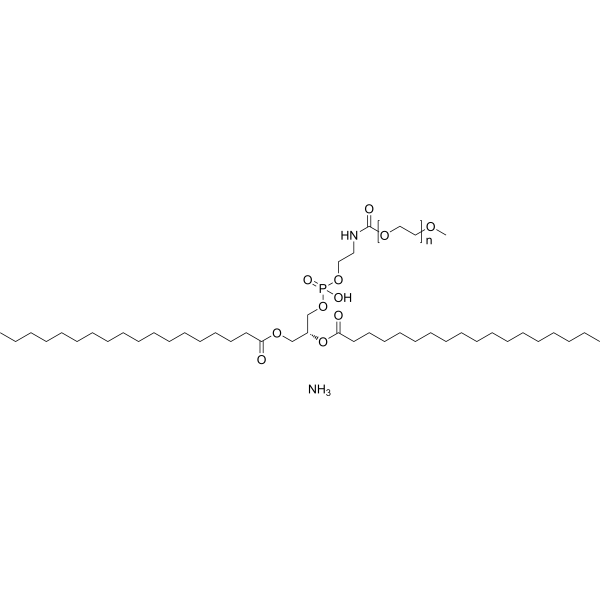
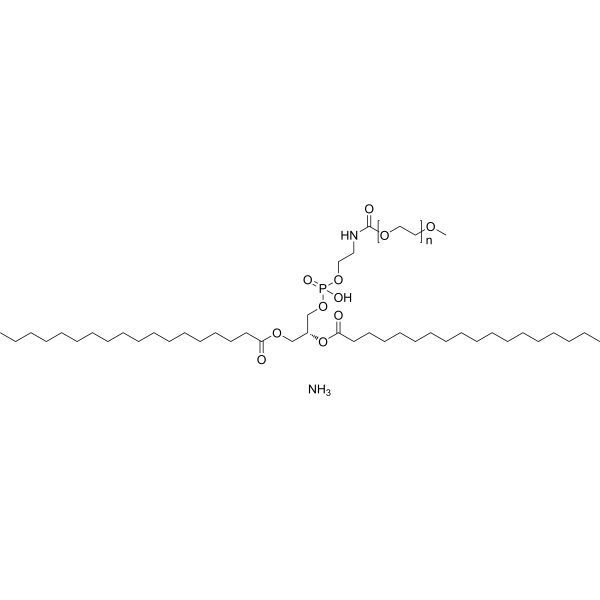
DSPE-mPEG2000; 1,2-Distearoyl-sn-glycero-3-phosphoethanolamine-N-[methoxy(polyethylene glycol)-2000]
|
Liposome
|
Others
|
|
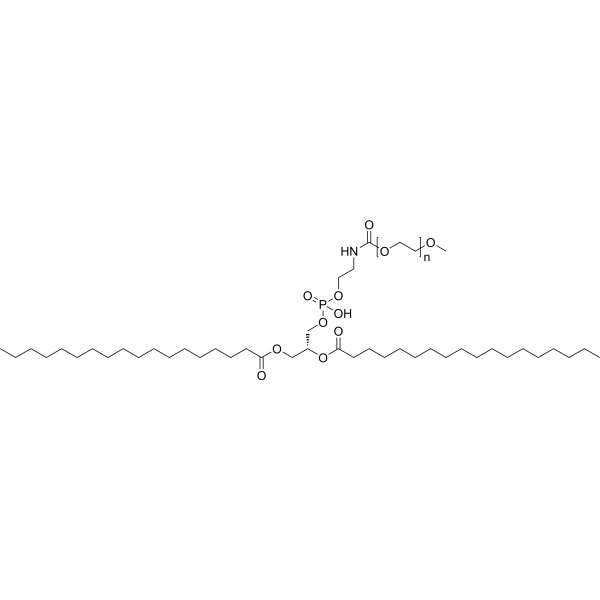
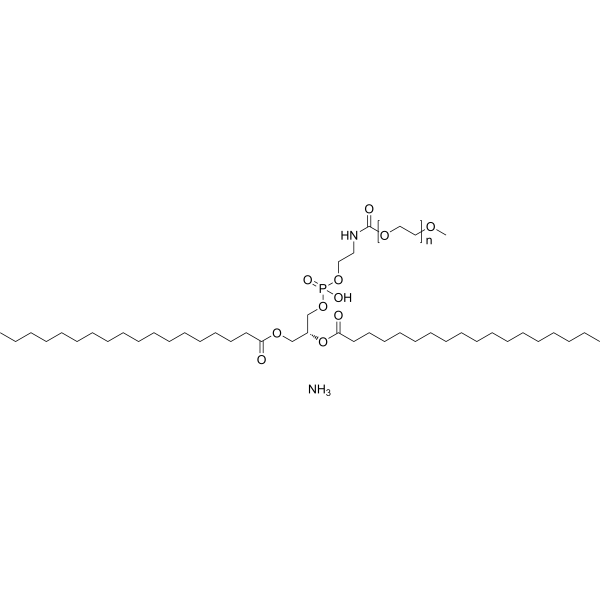
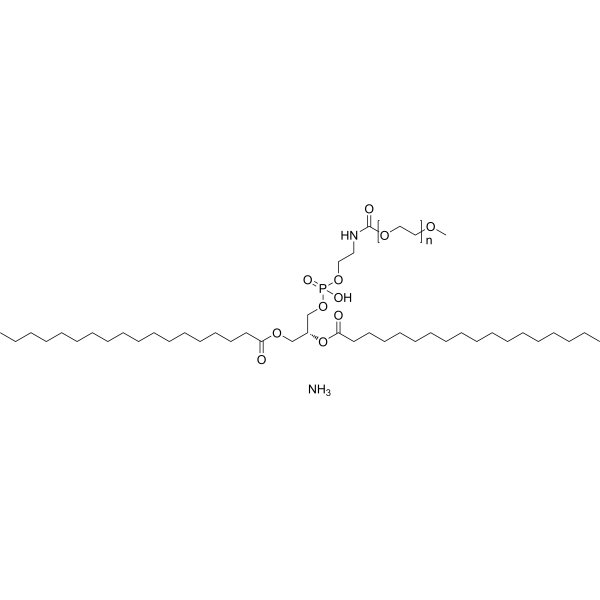
18:0 mPEG2000 PE (DSPE-mPEG2000) ammonium is a kind of amphiphilic polymer material. 18:0 mPEG2000 PE ammonium combines hydrophobic lipids (18:0 stearic acid chain) with hydrophilic polyethylene glycol (2 kDa) chains to form amphiphilic molecules, which are used to construct stable liposomes/nanoparticles, thereby enhancing drug delivery, prolonging circulation time, and achieving targeted effects through its functional terminal groups (usually biotin or carboxyl groups). 18:0 mPEG2000 PE ammonium can be used for the research of nanoprobes and drug delivery .
|
-
-
- HY-B1306
-
|
p-Aminohippuric acid
|
Others
|
Neurological Disease
Metabolic Disease
|
|
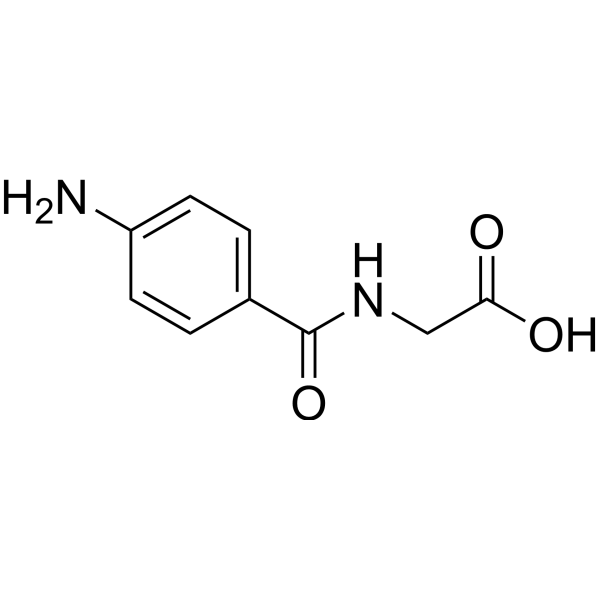
4-Aminohippuric acid (p-Aminohippuric acid) is a coordination ligand for metal ions (such as Cu 2+, Fe 3+, Hg 2+) and a functionalization reagent for nanomaterials. 4-Aminohippuric acid can coordinate with metal ions or modify the surface of materials such as carbon nanotubes and gold nanoparticles through amino and carboxyl groups. 4-Aminohippuric acid can form stable complexes with metal ions or participate in the synthesis of nanomaterials as a reducing agent/stabilizer, enriching metal ions or giving nanoparticles peroxidase-mimicking activity. 4-Aminohippuric acid can be used to construct highly sensitive electrochemical sensors or colorimetric sensors to detect and quantitatively analyze heavy metal ions such as copper, iron, and mercury in environmental water samples and biological samples. 4-Aminohippuric acid may also be a biomarker for attention-deficit/hyperactivity disorder (ADHD) .
|
-
-
- HY-Y0102
-
|
2-Mercaptobenzoic acid
|
Biochemical Assay Reagents
Drug Intermediate
|
Infection
|
|
Thiosalicylic acid (2-Mercaptobenzoic acid) is an organosulfur compound bearing both sulfhydryl and carboxyl functional groups. Thiosalicylic acid acts as a desulfurizing agent. Thiosalicylic acid also serves as a ligand to synthesize azosulfonamide derivatives with antibacterial and antifungal activities, as well as their Fe 3+, Cu 2+ and Hg 2+ chelates .
|
-
-
- HY-D1375
-
|
|
Fluorescent Dye
|
Others
|
|
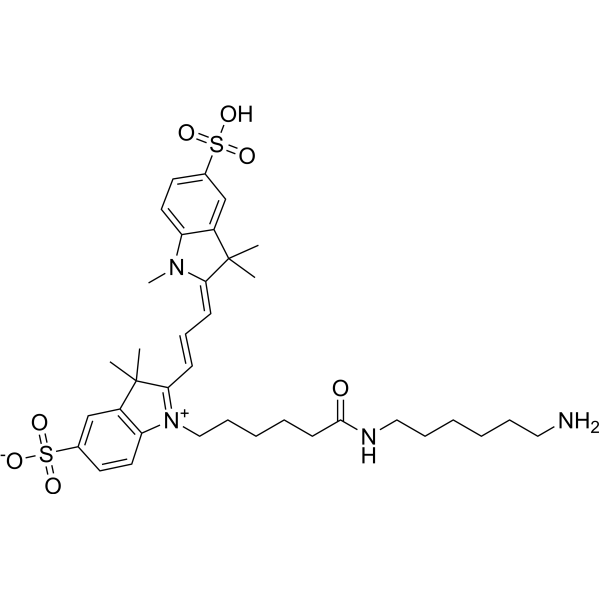
Sulfo-Cy5 amine is a dye derivative of Cyanine 5 (Cy5) (HY-D0821) bearing an amine group. The sulfonate ion increases the water solubility of the compound, making it suitable for use in aqueous solutions. Cy5 is a near-infrared fluorescent dye commonly used in biolabeling and cell imaging. The amine functionality of Sulfo-Cy5 amine can react with carboxyl groups to form covalent bonds. Sulfo-Cy5 amine can bind to biomolecules such as proteins and antibodies to track their location and dynamic changes in biological samples.
|
-
-
- HY-W243303J
-
|
|
Biochemical Assay Reagents
|
Cancer
|
|
Poly(acrylic acid) (MW 250000) is a synthetic cationic electrolyte containing abundant carboxyl groups (-COOH), which exhibits excellent water absorption and retention properties and is often cross-linked to form hydrogels. Poly(acrylic acid) (with a molecular weight of 250,000). Poly(acrylic acid) (MW 250000) can be used as a non-collagenous analog in the biomimetic mineralization research of type I collagen. Poly(acrylic acid) (MW 250000) has pH responsiveness and biocompatibility and is often used as a drug carrier, surface modifier and functional material .
|
-
-
- HY-144013H
-
|
DSPE-mPEG5000 ammonium; 1,2-Distearoyl-sn-glycero-3-phosphoethanolamine-N-[methoxy(polyethylene glycol)-5000] ammonium
|
Liposome
|
Cancer
|
|
18:0 mPEG5000 PE (DSPE-mPEG5000) ammonium is a kind of amphiphilic polymer material. 18:0 mPEG5000 PE ammonium combines hydrophobic lipids (18:0 stearic acid chain) with hydrophilic polyethylene glycol (5 kDa) chains to form amphiphilic molecules, which are used to construct stable liposomes/nanoparticles, thereby enhancing drug delivery, prolonging circulation time, and achieving targeted effects through its functional terminal groups (usually biotin or carboxyl groups). 18:0 mPEG5000 PE ammonium can be used for the research of nanoprobes and drug delivery .
|
-
-
- HY-W755033
-
-
-
- HY-78035
-
|
Methylmaleic anhydride
|
Biochemical Assay Reagents
|
Others
|
|
Citraconic anhydride (Methylmaleic anhydride) is a derivative of maleic anhydride (HY-Z0060) and novel antigen retrieval solution. Citraconic anhydride reversibly blocks protein amino groups, stabilizing specific enzymes and improving their catalytic performance. Citraconic anhydride reacts with free amino groups on proteins (especially lysine residues), converting positively charged NH3 + into carboxyl groups, thereby disrupting methylene bridge crosslinks caused by Formaldehyde during antigen retrieval. Citraconic anhydride functionalizes Isotactic polypropylene. Citraconic anhydride precisely responds to pH changes to achieve reversible modification. Citraconic anhydride is irritating to skin and eyes .
|
-
-
- HY-W460072
-
|
|
Biochemical Assay Reagents
|
Others
|
|
tert-Butyl 7-hydroxyheptanoate is a linker with a hydroxyl group and a t-butyl ester. The hydroxyl group allows for further derivatization or replacement with many other reactive functional groups. The t-butyl protected carboxyl group can be deprotected under acidic conditions.
|
-
-
- HY-W1123939C
-
|
|
Biochemical Assay Reagents
|
Others
|
|
Silane-PEG5000-COOH can be used to modify proteins, peptides and other materials with active groups. The carboxyl group (-COOH) can easily form a stable amide bond with the amino group, and can also form an ester bond with the hydroxyl group. Silane-functionalized PEG (Silane-PEG-X) can be used to modify glass, silicon, etc .
|
-
-
- HY-D1272
-
|
Sulfo-Cyanine3 amine
|
Fluorescent Dye
|
Others
|
|
Sulfo-Cy3 amine is a dye derivative of Cyanine 3 (Cy3) (HY-D0822) bearing an amine group. The sulfonate ion increases the water solubility of the compound, making it suitable for use in aqueous solutions. Cy3 is a fluorescent dye with a fluorescence spectrum typically in the green to orange wavelength range. The amine functionality of Sulfo-Cy3 amine can react with carboxyl groups to form covalent bonds. Sulfo-Cy3 amine can bind to biological molecules such as proteins and antibodies to track their location and dynamic changes in biological samples.
|
-
-
- HY-B1306R
-
|
p-Aminohippuric acid (Standard)
|
Reference Standards
Biochemical Assay Reagents
|
Neurological Disease
Metabolic Disease
|
|
4-Aminohippuric acid (p-Aminohippuric acid) (Standard) is the analytical standard of 4-Aminohippuric acid (HY-B1306). This product is intended for research and analytical applications. 4-Aminohippuric acid (p-Aminohippuric acid) is a coordination ligand for metal ions (such as Cu 2+, Fe 3+, Hg 2+) and a functionalization reagent for nanomaterials. 4-Aminohippuric acid can coordinate with metal ions or modify the surface of materials such as carbon nanotubes and gold nanoparticles through amino and carboxyl groups. 4-Aminohippuric acid can form stable complexes with metal ions or participate in the synthesis of nanomaterials as a reducing agent/stabilizer, enriching metal ions or giving nanoparticles peroxidase-mimicking activity. 4-Aminohippuric acid can be used to construct highly sensitive electrochemical sensors or colorimetric sensors to detect and quantitatively analyze heavy metal ions such as copper, iron, and mercury in environmental water samples and biological samples. 4-Aminohippuric acid may also be a biomarker for attention-deficit/hyperactivity disorder (ADHD) .
|
-
-
- HY-144013B
-
|
DSPE-mPEG550 ammonium; 1,2-Distearoyl-sn-glycero-3-phosphoethanolamine-N-[methoxy(polyethylene glycol)-550] ammonium
|
Biochemical Assay Reagents
Liposome
|
Others
|
|
18:0 mPEG550 PE (ammonium) is a PEG lipid functional end group used in the synthesis of liposomes (LPs) for the design of conjugated polymeric nanoparticles. Through biotin modification and carboxyl terminus, lipid nanoparticles (LNPs) further coupling with other biomolecules can be achieved. Functionalized nanoparticles can be used for targeted labeling of specific cellular proteins. With streptavidin as a linker, biotinylated PEG lipid-conjugated polymer nanoparticles are able to bind to biotinylated antibodies on cell surface receptors, yielding the utility of fluorescence-based imaging and sensing.
|
-
-
- HY-144013D
-
|
DSPE-mPEG1000 ammonium; 1,2-Distearoyl-sn-glycero-3-phosphoethanolamine-N-[methoxy(polyethylene glycol)-1000] ammonium
|
Liposome
|
Others
|
|
18:0 mPEG1000 PE (ammonium) is a PEG lipid functional end group used in the synthesis of liposomes (LPs) for the design of conjugated polymeric nanoparticles. Through biotin modification and carboxyl terminus, lipid nanoparticles (LNPs) further coupling with other biomolecules can be achieved. Functionalized nanoparticles can be used for targeted labeling of specific cellular proteins. With streptavidin as a linker, biotinylated PEG lipid-conjugated polymer nanoparticles are able to bind to biotinylated antibodies on cell surface receptors, yielding the utility of fluorescence-based imaging and sensing.
|
-
-
- HY-144013A
-
|
DSPE-mPEG350 ammonium; 1,2-Distearoyl-sn-glycero-3-phosphoethanolamine-N-[methoxy(polyethylene glycol)-350] ammonium
|
Liposome
|
Others
|
|
18:0 mPEG350 PE (ammonium) is a PEG lipid functional end group used in the synthesis of liposomes (LPs) for the design of conjugated polymer nanoparticles. Through biotin modification and carboxyl terminus, lipid nanoparticles (LNPs) further coupling with other biomolecules can be achieved. Functionalized nanoparticles can be used for targeted labeling of specific cellular proteins. With streptavidin as a linker, biotinylated PEG lipid-conjugated polymer nanoparticles are able to bind to biotinylated antibodies on cell surface receptors, yielding the utility of fluorescence-based imaging and sensing.
|
-
-
- HY-144013E
-
|
DSPE-mPEG3000 ammonium; 1,2-Distearoyl-sn-glycero-3-phosphoethanolamine-N-[methoxy(polyethylene glycol)-3000] ammonium
|
Liposome
|
Others
|
|
18:0 mPEG3000 PE (ammonium) is a PEG lipid functional end group used in the synthesis of liposomes (LPs) for the design of conjugated polymeric nanoparticles. Through biotin modification and carboxyl terminus, lipid nanoparticles (LNPs) further coupling with other biomolecules can be achieved. Functionalized nanoparticles can be used for targeted labeling of specific cellular proteins. With streptavidin as a linker, biotinylated PEG lipid-conjugated polymer nanoparticles are able to bind to biotinylated antibodies on cell surface receptors, yielding the utility of fluorescence-based imaging and sensing.
|
-
-
- HY-144013C
-
|
DSPE-mPEG750 ammonium; 1,2-Distearoyl-sn-glycero-3-phosphoethanolamine-N-[methoxy(polyethylene glycol)-750] ammonium
|
Biochemical Assay Reagents
Liposome
|
Others
|
|
18:0 mPEG750 PE (ammonium) is a PEG lipid functional end group used in the synthesis of liposomes (LPs) for the design of conjugated polymeric nanoparticles. Through biotin modification and carboxyl terminus, lipid nanoparticles (LNPs) further coupling with other biomolecules can be achieved. Functionalized nanoparticles can be used for targeted labeling of specific cellular proteins. With streptavidin as a linker, biotinylated PEG lipid-conjugated polymer nanoparticles are able to bind to biotinylated antibodies on cell surface receptors, yielding the utility of fluorescence-based imaging and sensing.
|
-
-
- HY-155934
-
|
DOPE-PEG5000 ammonium; 1,2-Dioleoyl-sn-glycero-3-phosphoethanolamine-N-[methoxy(polyethylene glycol)-5000] ammonium
|
Liposome
|
Others
|
|
18:1 PEG5000 PE ammonium (DOPE-PEG5000 ammonium) is a PEG lipid functional end group used in the synthesis of liposomes (LPs) for the design of conjugated polymer nanoparticles. Through biotin modification and carboxyl terminus, lipid nanoparticles (LNPs) further coupling with other biomolecules can be achieved. Functionalized nanoparticles can be used for targeted labeling of specific cellular proteins. With streptavidin as a linker, biotinylated PEG lipid-conjugated polymer nanoparticles are able to bind to biotinylated antibodies on cell surface receptors, yielding the utility of fluorescence-based imaging and sensing.
|
-
-
- HY-155926
-
|
14:0 PEG750 PE ammonium; 1,2-Dimyristoyl-sn-glycero-3-phosphoethanolamine-N-[methoxy(polyethylene glycol)-750] ammonium
|
Liposome
|
Others
|
|
DMPE-PEG750 ammonium (14:0 PEG750 PE ammonium) is a PEG lipid functional end group used in the synthesis of liposomes (LPs) for the design of conjugated polymeric nanoparticles. Through biotin modification and carboxyl terminus, lipid nanoparticles (LNPs) further coupling with other biomolecules can be achieved. Functionalized nanoparticles can be used for targeted labeling of specific cellular proteins. With streptavidin as a linker, biotinylated PEG lipid-conjugated polymer nanoparticles are able to bind to biotinylated antibodies on cell surface receptors, yielding the utility of fluorescence-based imaging and sensing.
|
-
-
- HY-155927
-
|
14:0 PEG1000 PE ammonium; 1,2-Dimyristoyl-sn-glycero-3-phosphoethanolamine-N-[methoxy(polyethylene glycol)-1000] ammonium
|
Liposome
|
Others
|
|
DMPE-PEG1000 ammonium (14:0 PEG1000 PE ammonium) is a PEG lipid functional end group used in the synthesis of liposomes (LPs) for the design of conjugated polymer nanoparticles. Through biotin modification and carboxyl terminus, lipid nanoparticles (LNPs) further coupling with other biomolecules can be achieved. Functionalized nanoparticles can be used for targeted labeling of specific cellular proteins. With streptavidin as a linker, biotinylated PEG lipid-conjugated polymer nanoparticles are able to bind to biotinylated antibodies on cell surface receptors, yielding the utility of fluorescence-based imaging and sensing.
|
-
-
- HY-155925
-
|
14:0 PEG550 PE ammonium; 1,2-Dimyristoyl-sn-glycero-3-phosphoethanolamine-N-[methoxy(polyethylene glycol)-550] ammonium
|
Liposome
|
Others
|
|
DMPE-PEG550 ammonium (14:0 PEG550 PE ammonium) is a PEG lipid functional end group used in the synthesis of liposomes (LPs) for the design of conjugated polymeric nanoparticles. Through biotin modification and carboxyl terminus, lipid nanoparticles (LNPs) further coupling with other biomolecules can be achieved. Functionalized nanoparticles can be used for targeted labeling of specific cellular proteins. With streptavidin as a linker, biotinylated PEG lipid-conjugated polymer nanoparticles are able to bind to biotinylated antibodies on cell surface receptors, yielding the utility of fluorescence-based imaging and sensing.
|
-
-
- HY-155924
-
|
14:0 PEG350 PE ammonium; 1,2-Dimyristoyl-sn-glycero-3-phosphoethanolamine-N-[methoxy(polyethylene glycol)-350] ammonium
|
Liposome
|
Others
|
|
DMPE-PEG350 ammonium (14:0 PEG350 PE ammonium) is a PEG lipid functional end group used in the synthesis of liposomes (LPs) for the design of conjugated polymer nanoparticles. Through biotin modification and carboxyl terminus, lipid nanoparticles (LNPs) further coupling with other biomolecules can be achieved. Functionalized nanoparticles can be used for targeted labeling of specific cellular proteins. With streptavidin as a linker, biotinylated PEG lipid-conjugated polymer nanoparticles are able to bind to biotinylated antibodies on cell surface receptors, yielding the utility of fluorescence-based imaging and sensing.
|
-
-
- HY-155929
-
|
14:0 PEG5000 PE ammonium; 1,2-Dimyristoyl-sn-glycero-3-phosphoethanolamine-N-[methoxy(polyethylene glycol)-5000] ammonium
|
Liposome
|
Others
|
|
DMPE-PEG5000 ammonium (14:0 PEG5000 PE ammonium) is a PEG lipid functional end group used in the synthesis of liposomes (LPs) for the design of conjugated polymer nanoparticles. Through biotin modification and carboxyl terminus, lipid nanoparticles (LNPs) further coupling with other biomolecules can be achieved. Functionalized nanoparticles can be used for targeted labeling of specific cellular proteins. With streptavidin as a linker, biotinylated PEG lipid-conjugated polymer nanoparticles are able to bind to biotinylated antibodies on cell surface receptors, yielding the utility of fluorescence-based imaging and sensing.
|
-
-
- HY-155928
-
|
14:0 PEG3000 PE ammonium; 1,2-Dimyristoyl-sn-glycero-3-phosphoethanolamine-N-[methoxy(polyethylene glycol)-3000] ammonium
|
Liposome
|
Others
|
|
DMPE-PEG3000 ammonium (14:0 PEG3000 PE ammonium) is a PEG lipid functional end group used in the synthesis of liposomes (LPs) for the design of conjugated polymer nanoparticles. Through biotin modification and carboxyl terminus, lipid nanoparticles (LNPs) further coupling with other biomolecules can be achieved. Functionalized nanoparticles can be used for targeted labeling of specific cellular proteins. With streptavidin as a linker, biotinylated PEG lipid-conjugated polymer nanoparticles are able to bind to biotinylated antibodies on cell surface receptors, yielding the utility of fluorescence-based imaging and sensing.
|
-
-
- HY-B1306S
-
|
p-Aminohippuric acid-d4
|
Biochemical Assay Reagents
|
Neurological Disease
Metabolic Disease
|
|
4-Aminohippuric acid-d4 (p-Aminohippuric acid-d4) is the deuterium labeled 4-Aminohippuric acid (HY-B1306). 4-Aminohippuric acid (p-Aminohippuric acid) is a coordination ligand for metal ions (such as Cu 2+, Fe 3+, Hg 2+) and a functionalization reagent for nanomaterials. 4-Aminohippuric acid can coordinate with metal ions or modify the surface of materials such as carbon nanotubes and gold nanoparticles through amino and carboxyl groups. 4-Aminohippuric acid can form stable complexes with metal ions or participate in the synthesis of nanomaterials as a reducing agent/stabilizer, enriching metal ions or giving nanoparticles peroxidase-mimicking activity. 4-Aminohippuric acid can be used to construct highly sensitive electrochemical sensors or colorimetric sensors to detect and quantitatively analyze heavy metal ions such as copper, iron, and mercury in environmental water samples and biological samples. 4-Aminohippuric acid may also be a biomarker for attention-deficit/hyperactivity disorder (ADHD) .
|
-
-
- HY-W1048547J
-
|
HOOC-PEG40000-Amine
|
PROTAC Linkers
|
Others
|
|
HOOC-PEG40000-NH2 (HOOC-PEG40000-Amine) is a heterobifunctional PEG crosslinker that can be used to attach functional PEG to biomolecules, particles, and other surface materials. The carboxyl group reacts with the amine group to form a stable amide bond. It can also react with the hydroxyl group to form an unstable ester bond. On the other hand, the amine group can be used to react with many amine-reactive groups, such as succinimidyl NHS esters, aldehydes, etc .
|
-
-
- HY-144012B
-
|
16:0 PEG550 PE; 1,2-Dipalmitoyl-sn-glycero-3-phosphoethanolamine-N-[methoxy(polyethylene glycol)-550] ammonium
|
Biochemical Assay Reagents
Liposome
|
Others
|
|
DPPE-PEG550 is a PEG lipid functional end group used in the synthesis of liposomes (LPs) for the design of conjugated polymer nanoparticles. Through biotin modification and carboxyl terminus, lipid nanoparticles (LNPs) further coupling with other biomolecules can be achieved. Functionalized nanoparticles can be used for targeted labeling of specific cellular proteins. With streptavidin as a linker, biotinylated PEG lipid-conjugated polymer nanoparticles are able to bind to biotinylated antibodies on cell surface receptors, yielding the utility of fluorescence-based imaging and sensing.
|
-
-
- HY-144012D
-
|
16:0 PEG1000 PE; 1,2-Dipalmitoyl-sn-glycero-3-phosphoethanolamine-N-[methoxy(polyethylene glycol)-1000] ammonium
|
Liposome
|
Others
|
|
DPPE-PEG1000 is a PEG lipid functional end group used in the synthesis of liposomes (LPs) for the design of conjugated polymer nanoparticles. Through biotin modification and carboxyl terminus, lipid nanoparticles (LNPs) further coupling with other biomolecules can be achieved. Functionalized nanoparticles can be used for targeted labeling of specific cellular proteins. With streptavidin as a linker, biotinylated PEG lipid-conjugated polymer nanoparticles are able to bind to biotinylated antibodies on cell surface receptors, yielding the utility of fluorescence-based imaging and sensing.
|
-
-
- HY-144012E
-
|
16:0 PEG3000 PE; 1,2-Dipalmitoyl-sn-glycero-3-phosphoethanolamine-N-[methoxy(polyethylene glycol)-3000] ammonium
|
Liposome
|
Others
|
|
DPPE-PEG3000 is a PEG lipid functional end group used in the synthesis of liposomes (LPs) for the design of conjugated polymer nanoparticles. Through biotin modification and carboxyl terminus, lipid nanoparticles (LNPs) further coupling with other biomolecules can be achieved. Functionalized nanoparticles can be used for targeted labeling of specific cellular proteins. With streptavidin as a linker, biotinylated PEG lipid-conjugated polymer nanoparticles are able to bind to biotinylated antibodies on cell surface receptors, yielding the utility of fluorescence-based imaging and sensing.
|
-
-
- HY-144012C
-
|
16:0 PEG750 PE; 1,2-Dipalmitoyl-sn-glycero-3-phosphoethanolamine-N-[methoxy(polyethylene glycol)-750] ammonium
|
Biochemical Assay Reagents
Liposome
|
Others
|
|
DPPE-PEG750 is a PEG lipid functional end group used in the synthesis of liposomes (LPs) for the design of conjugated polymer nanoparticles. Through biotin modification and carboxyl terminus, lipid nanoparticles (LNPs) further coupling with other biomolecules can be achieved. Functionalized nanoparticles can be used for targeted labeling of specific cellular proteins. With streptavidin as a linker, biotinylated PEG lipid-conjugated polymer nanoparticles are able to bind to biotinylated antibodies on cell surface receptors, yielding the utility of fluorescence-based imaging and sensing.
|
-
-
- HY-155931
-
|
DOPE-PEG550 ammonium; 1,2-Dioleoyl-sn-glycero-3-phosphoethanolamine-N-[methoxy(polyethylene glycol)-550] ammonium
|
Liposome
|
Others
|
|
18:1 PEG550 PE ammonium (DOPE-PEG550 ammonium) is a PEG lipid functional end group used in the synthesis of liposomes (LPs) for the design of conjugated polymer nanoparticles. Through biotin modification and carboxyl terminus, lipid nanoparticles (LNPs) further coupling with other biomolecules can be achieved. Functionalized nanoparticles can be used for targeted labeling of specific cellular proteins. With streptavidin as a linker, biotinylated PEG lipid-conjugated polymer nanoparticles are able to bind to biotinylated antibodies on cell surface receptors, yielding the utility of fluorescence-based imaging and sensing.
|
-
-
- HY-155933
-
|
DOPE-PEG3000 ammonium; 1,2-Dioleoyl-sn-glycero-3-phosphoethanolamine-N-[methoxy(polyethylene glycol)-3000] ammonium
|
Liposome
|
Others
|
|
18:1 PEG3000 PE ammonium (DOPE-PEG3000 ammonium) is a PEG lipid functional end group used in the synthesis of liposomes (LPs) for the design of conjugated polymer nanoparticles. Through biotin modification and carboxyl terminus, lipid nanoparticles (LNPs) further coupling with other biomolecules can be achieved. Functionalized nanoparticles can be used for targeted labeling of specific cellular proteins. With streptavidin as a linker, biotinylated PEG lipid-conjugated polymer nanoparticles are able to bind to biotinylated antibodies on cell surface receptors, yielding the utility of fluorescence-based imaging and sensing.
|
-
-
- HY-155932
-
|
DOPE-PEG1000 ammonium; 1,2-Dioleoyl-sn-glycero-3-phosphoethanolamine-N-[methoxy(polyethylene glycol)-1000] ammonium
|
Liposome
|
Others
|
|
18:1 PEG1000 PE ammonium (DOPE-PEG1000 ammonium) is a PEG lipid functional end group used in the synthesis of liposomes (LPs) for the design of conjugated polymer nanoparticles. Through biotin modification and carboxyl terminus, lipid nanoparticles (LNPs) further coupling with other biomolecules can be achieved. Functionalized nanoparticles can be used for targeted labeling of specific cellular proteins. With streptavidin as a linker, biotinylated PEG lipid-conjugated polymer nanoparticles are able to bind to biotinylated antibodies on cell surface receptors, yielding the utility of fluorescence-based imaging and sensing.
|
-
-
- HY-155930
-
|
DOPE-PEG350 ammonium; 1,2-Dioleoyl-sn-glycero-3-phosphoethanolamine-N-[methoxy(polyethylene glycol)-350] ammonium
|
Liposome
|
Others
|
|
18:1 PEG350 PE ammonium (DOPE-PEG350 ammonium) is a PEG lipid functional end group used in the synthesis of liposomes (LPs) for the design of conjugated polymer nanoparticles. Through biotin modification and carboxyl terminus, lipid nanoparticles (LNPs) further coupling with other biomolecules can be achieved. Functionalized nanoparticles can be used for targeted labeling of specific cellular proteins. With streptavidin as a linker, biotinylated PEG lipid-conjugated polymer nanoparticles are able to bind to biotinylated antibodies on cell surface receptors, yielding the utility of fluorescence-based imaging and sensing.
|
-
-
- HY-155455
-
|
|
Hapten
|
Inflammation/Immunology
|
Hapten Dca is an immunizing hapten. Hapten Dca is activated by a solution of N, N′-disuccinimidyl carbonate. Hapten Dca with a carboxyl functional group is conjugated to proteins .
|
-
-
- HY-W174661
-
|
|
Biochemical Assay Reagents
|
Others
|
|
tert-Butyl 6-hydroxyhexanoate is a linker with a hydroxyl group and a t-butyl ester. The hydroxyl group allows for further derivatization or replacement with many other reactive functional groups. The t-butyl protected carboxyl group can be deprotected under acidic conditions.
|
-
-
- HY-150352
-
|
|
Biochemical Assay Reagents
|
Others
|
|
Dextran-COOH is a dextran derivative with carboxyl (–COOH) functional groups introduced into the molecular chain. Dextran-COOH can be covalently coupled with a variety of bioactive molecules, drugs, small molecule ligands, fluorescent probes and other functional materials .
|
-
-
- HY-174364E
-
|
|
Biochemical Assay Reagents
|
Others
|
|
Alkyne-PEG20000-COOH is a heterobifunctional PEG crosslinker that can be used to attach functional PEG to biomolecules, particles, and other material surfaces. The carboxyl group can react with the amine group to form a stable amide bond .
|
-
-
- HY-174364C
-
|
|
Biochemical Assay Reagents
|
Others
|
|
Alkyne-PEG5000-COOH is a heterobifunctional PEG crosslinker that can be used to attach functional PEG to biomolecules, particles, and other material surfaces. The carboxyl group can react with the amine group to form a stable amide bond .
|
-
-
- HY-W1123939
-
|
|
Biochemical Assay Reagents
|
Others
|
|
Silane-PEG-COOH (MW 1000) can be used to modify proteins, peptides and other materials with active groups. The carboxyl group (-COOH) can easily form a stable amide bond with the amino group, and can also form an ester bond with the hydroxyl group. Silane-functionalized PEG (Silane-PEG-X) can be used to modify glass, silicon, etc .
|
-
-
- HY-D1852
-
|
|
Fluorescent Dye
|
Others
|
|
Cy3B amine chloride is a dye derivative of Cyanine 3 (Cy3) (HY-D0822) bearing an amine group. Cy3 is a fluorescent dye with a fluorescence spectrum typically in the green to orange wavelength range. The amine functionality of Sulfo-Cy3 amine can react with carboxyl groups to form covalent bonds. Sulfo-Cy3 amine can bind to biological molecules such as proteins and antibodies to track their location and dynamic changes in biological samples.
|
-
-
- HY-D1851
-
|
|
Fluorescent Dye
|
Others
|
|
Cy3B amine chloride is a dye derivative of Cyanine 3 (Cy3) (HY-D0822) bearing an amine group in the disodium salt form. Cy3 is a fluorescent dye with a fluorescence spectrum typically in the green to orange wavelength range. The amine functionality of Sulfo-Cy3 amine can react with carboxyl groups to form covalent bonds. Sulfo-Cy3 amine can bind to biological molecules such as proteins and antibodies to track their location and dynamic changes in biological samples.
|
-
-
- HY-D1863
-
|
|
Fluorescent Dye
|
Others
|
|
sulfo-Cy7.5 amine is a dye derivative of Cyanine 7.5 (Cy7.5) (HY-D0926) bearing an amine group. The sulfonate ion increases the water solubility of the compound, making it suitable for use in aqueous solutions. Cy7.5 is a near-infrared fluorescent dye commonly used for biolabeling and cell imaging. The amine functionality of sulfo-Cy7.5 amine can react with carboxyl groups to form covalent bonds. Sulfo-Cy7.5 amine can bind to biomolecules such as proteins and antibodies to track their location and dynamic changes in biological samples.
|
-
-
- HY-174364B
-
|
|
Biochemical Assay Reagents
|
Others
|
|
Alkyne-PEG3400-COOH is a heterobifunctional PEG crosslinker that can be used to attach functional PEG to biomolecules, particles, and other material surfaces. The carboxyl group can react with the amine group to form a stable amide bond .
|
-
-
- HY-174364
-
|
|
Biochemical Assay Reagents
|
Others
|
|
Alkyne-PEG1000-COOH is a heterobifunctional PEG crosslinker that can be used to attach functional PEG to biomolecules, particles, and other material surfaces. The carboxyl group can react with the amine group to form a stable amide bond .
|
-
-
- HY-174364H
-
|
|
Biochemical Assay Reagents
|
Others
|
|
Alkyne-PEG40000-COOH is a heterobifunctional PEG crosslinker that can be used to attach functional PEG to biomolecules, particles, and other material surfaces. The carboxyl group can react with the amine group to form a stable amide bond .
|
-
-
- HY-174364D
-
|
|
Biochemical Assay Reagents
|
Others
|
|
Alkyne-PEG10000-COOH is a heterobifunctional PEG crosslinker that can be used to attach functional PEG to biomolecules, particles, and other material surfaces. The carboxyl group can react with the amine group to form a stable amide bond .
|
-
-
- HY-174364A
-
|
|
Biochemical Assay Reagents
|
Others
|
|
Alkyne-PEG2000-COOH is a heterobifunctional PEG crosslinker that can be used to attach functional PEG to biomolecules, particles, and other material surfaces. The carboxyl group can react with the amine group to form a stable amide bond .
|
-
-
- HY-150352C
-
|
|
Biochemical Assay Reagents
|
Others
|
|
Dextran-COOH (MW 100 kDa) is a dextran derivative with carboxyl (–COOH) functional groups introduced into the molecular chain. Dextran-COOH can be covalently coupled with a variety of bioactive molecules, drugs, small molecule ligands, fluorescent probes and?other?functional?materials.
|
-
-
- HY-150352A
-
|
|
Biochemical Assay Reagents
|
Others
|
|
Dextran-COOH (MW 10 kDa) is a dextran derivative with carboxyl (–COOH) functional groups introduced into the molecular chain. Dextran-COOH can be covalently coupled with a variety of bioactive molecules, drugs, small molecule ligands, fluorescent probes and?other?functional?materials.
|
-
- HY-150352D
-
|
|
Biochemical Assay Reagents
|
Others
|
|
Dextran-COOH (MW 250 kDa) is a dextran derivative with carboxyl (–COOH) functional groups introduced into the molecular chain. Dextran-COOH can be covalently coupled with a variety of bioactive molecules, drugs, small molecule ligands, fluorescent probes and?other?functional?materials.
|
-
- HY-150352E
-
|
|
Biochemical Assay Reagents
|
Others
|
|
Dextran-COOH (MW 500 kDa) is a dextran derivative with carboxyl (–COOH) functional groups introduced into the molecular chain. Dextran-COOH can be covalently coupled with a variety of bioactive molecules, drugs, small molecule ligands, fluorescent probes and?other?functional?materials.
|
-
- HY-150352B
-
|
|
Biochemical Assay Reagents
|
Others
|
|
Dextran-COOH (MW 70 kDa) is a dextran derivative with carboxyl (–COOH) functional groups introduced into the molecular chain. Dextran-COOH can be covalently coupled with a variety of bioactive molecules, drugs, small molecule ligands, fluorescent probes and?other?functional?materials.
|
-
- HY-130159
-
|
|
Biochemical Assay Reagents
|
Others
|
|
Hydroxy-PEG12-t-butyl ester is a PEG linker containing a hydroxyl group with a t-butyl ester. The hydrophilic PEG spacer increases solubility in aqueous media. The hydroxyl group enables further derivatization or replacement with other reactive functional groups. The t-butyl protected carboxyl group can be deprotected under acidic conditions.
|
-
- HY-W1123939B
-
|
|
Biochemical Assay Reagents
|
Others
|
|
Silane-PEG3400-COOH can be used to modify proteins, peptides and other materials with active groups. The carboxyl group (-COOH) can easily form a stable amide bond with the amino group, and can also form an ester bond with the hydroxyl group. Silane-functionalized PEG (Silane-PEG-X) can be used to modify glass, silicon, etc .
|
-
- HY-W1048547A
-
|
HOOC-PEG2000-Amine
|
Biochemical Assay Reagents
|
Others
|
|
HOOC-PEG2000-NH2 (HOOC-PEG2000-Amine) is a heterobifunctional PEG crosslinker that can be used to attach functional PEG to biomolecules, particles, and other surface materials. The carboxyl group reacts with the amine group to form a stable amide bond. It can also react with the hydroxyl group to form an unstable ester bond. On the other hand, the amine group can be used to react with many amine-reactive groups, such as succinimidyl NHS esters, aldehydes, etc .
|
-
- HY-W1048547H
-
|
HOOC-PEG1000-Amine
|
Biochemical Assay Reagents
|
Others
|
|
HOOC-PEG1000-NH2 (HOOC-PEG1000-Amine) is a heterobifunctional PEG crosslinker that can be used to attach functional PEG to biomolecules, particles, and other surface materials. The carboxyl group reacts with the amine group to form a stable amide bond. It can also react with the hydroxyl group to form an unstable ester bond. On the other hand, the amine group can be used to react with many amine-reactive groups, such as succinimidyl NHS esters, aldehydes, etc .
|
-
- HY-W1048547E
-
|
HOOC-PEG20000-Amine
|
Biochemical Assay Reagents
|
Others
|
|
HOOC-PEG20000-NH2 (HOOC-PEG20000-Amine) is a heterobifunctional PEG crosslinker that can be used to attach functional PEG to biomolecules, particles, and other surface materials. The carboxyl group reacts with the amine group to form a stable amide bond. It can also react with the hydroxyl group to form an unstable ester bond. On the other hand, the amine group can be used to react with many amine-reactive groups, such as succinimidyl NHS esters, aldehydes, etc .
|
-
- HY-W1048547I
-
|
HOOC-PEG3400-Amine
|
Biochemical Assay Reagents
|
Others
|
|
HOOC-PEG3400-NH2 (HOOC-PEG3400-Amine) is a heterobifunctional PEG crosslinker that can be used to attach functional PEG to biomolecules, particles, and other surface materials. The carboxyl group reacts with the amine group to form a stable amide bond. It can also react with the hydroxyl group to form an unstable ester bond. On the other hand, the amine group can be used to react with many amine-reactive groups, such as succinimidyl NHS esters, aldehydes, etc .
|
-
- HY-W1048547C
-
|
HOOC-PEG5000-Amine
|
Biochemical Assay Reagents
|
Others
|
|
HOOC-PEG5000-NH2 (HOOC-PEG5000-Amine) is a heterobifunctional PEG crosslinker that can be used to attach functional PEG to biomolecules, particles, and other surface materials. The carboxyl group reacts with the amine group to form a stable amide bond. It can also react with the hydroxyl group to form an unstable ester bond. On the other hand, the amine group can be used to react with many amine-reactive groups, such as succinimidyl NHS esters, aldehydes, etc .
|
-
- HY-W1048547D
-
|
HOOC-PEG10000-Amine
|
Biochemical Assay Reagents
|
Others
|
|
HOOC-PEG10000-NH2 (HOOC-PEG10000-Amine) is a heterobifunctional PEG crosslinker that can be used to attach functional PEG to biomolecules, particles, and other surface materials. The carboxyl group reacts with the amine group to form a stable amide bond. It can also react with the hydroxyl group to form an unstable ester bond. On the other hand, the amine group can be used to react with many amine-reactive groups, such as succinimidyl NHS esters, aldehydes, etc .
|
-
| Cat. No. |
Product Name |
Type |
-
- HY-D1375
-
|
|
Fluorescent Dyes
|
|
Sulfo-Cy5 amine is a dye derivative of Cyanine 5 (Cy5) (HY-D0821) bearing an amine group. The sulfonate ion increases the water solubility of the compound, making it suitable for use in aqueous solutions. Cy5 is a near-infrared fluorescent dye commonly used in biolabeling and cell imaging. The amine functionality of Sulfo-Cy5 amine can react with carboxyl groups to form covalent bonds. Sulfo-Cy5 amine can bind to biomolecules such as proteins and antibodies to track their location and dynamic changes in biological samples.
|
-
- HY-D1272
-
|
Sulfo-Cyanine3 amine
|
Fluorescent Dyes
|
|
Sulfo-Cy3 amine is a dye derivative of Cyanine 3 (Cy3) (HY-D0822) bearing an amine group. The sulfonate ion increases the water solubility of the compound, making it suitable for use in aqueous solutions. Cy3 is a fluorescent dye with a fluorescence spectrum typically in the green to orange wavelength range. The amine functionality of Sulfo-Cy3 amine can react with carboxyl groups to form covalent bonds. Sulfo-Cy3 amine can bind to biological molecules such as proteins and antibodies to track their location and dynamic changes in biological samples.
|
-
- HY-D1852
-
|
|
Fluorescent Dyes
|
|
Cy3B amine chloride is a dye derivative of Cyanine 3 (Cy3) (HY-D0822) bearing an amine group. Cy3 is a fluorescent dye with a fluorescence spectrum typically in the green to orange wavelength range. The amine functionality of Sulfo-Cy3 amine can react with carboxyl groups to form covalent bonds. Sulfo-Cy3 amine can bind to biological molecules such as proteins and antibodies to track their location and dynamic changes in biological samples.
|
-
- HY-D1851
-
|
|
Fluorescent Dyes
|
|
Cy3B amine chloride is a dye derivative of Cyanine 3 (Cy3) (HY-D0822) bearing an amine group in the disodium salt form. Cy3 is a fluorescent dye with a fluorescence spectrum typically in the green to orange wavelength range. The amine functionality of Sulfo-Cy3 amine can react with carboxyl groups to form covalent bonds. Sulfo-Cy3 amine can bind to biological molecules such as proteins and antibodies to track their location and dynamic changes in biological samples.
|
-
- HY-D1863
-
|
|
Fluorescent Dyes
|
|
sulfo-Cy7.5 amine is a dye derivative of Cyanine 7.5 (Cy7.5) (HY-D0926) bearing an amine group. The sulfonate ion increases the water solubility of the compound, making it suitable for use in aqueous solutions. Cy7.5 is a near-infrared fluorescent dye commonly used for biolabeling and cell imaging. The amine functionality of sulfo-Cy7.5 amine can react with carboxyl groups to form covalent bonds. Sulfo-Cy7.5 amine can bind to biomolecules such as proteins and antibodies to track their location and dynamic changes in biological samples.
|
| Cat. No. |
Product Name |
Type |
-
- HY-142978
-
|
DSPE-mPEG2000; 1,2-Distearoyl-sn-glycero-3-phosphoethanolamine-N-[methoxy(polyethylene glycol)-2000]
|
Biochemical Assay Reagents
|
|
18:0 mPEG2000 PE (DSPE-mPEG2000) ammonium is a kind of amphiphilic polymer material. 18:0 mPEG2000 PE ammonium combines hydrophobic lipids (18:0 stearic acid chain) with hydrophilic polyethylene glycol (2 kDa) chains to form amphiphilic molecules, which are used to construct stable liposomes/nanoparticles, thereby enhancing drug delivery, prolonging circulation time, and achieving targeted effects through its functional terminal groups (usually biotin or carboxyl groups). 18:0 mPEG2000 PE ammonium can be used for the research of nanoprobes and drug delivery .
|
-
- HY-Y0102
-
|
2-Mercaptobenzoic acid
|
Biochemical Assay Reagents
|
|
Thiosalicylic acid (2-Mercaptobenzoic acid) is an organosulfur compound bearing both sulfhydryl and carboxyl functional groups. Thiosalicylic acid acts as a desulfurizing agent. Thiosalicylic acid also serves as a ligand to synthesize azosulfonamide derivatives with antibacterial and antifungal activities, as well as their Fe 3+, Cu 2+ and Hg 2+ chelates .
|
-
- HY-W243303J
-
|
|
Biochemical Assay Reagents
|
|
Poly(acrylic acid) (MW 250000) is a synthetic cationic electrolyte containing abundant carboxyl groups (-COOH), which exhibits excellent water absorption and retention properties and is often cross-linked to form hydrogels. Poly(acrylic acid) (with a molecular weight of 250,000). Poly(acrylic acid) (MW 250000) can be used as a non-collagenous analog in the biomimetic mineralization research of type I collagen. Poly(acrylic acid) (MW 250000) has pH responsiveness and biocompatibility and is often used as a drug carrier, surface modifier and functional material .
|
-
- HY-144013H
-
|
DSPE-mPEG5000 ammonium; 1,2-Distearoyl-sn-glycero-3-phosphoethanolamine-N-[methoxy(polyethylene glycol)-5000] ammonium
|
Biochemical Assay Reagents
|
|
18:0 mPEG5000 PE (DSPE-mPEG5000) ammonium is a kind of amphiphilic polymer material. 18:0 mPEG5000 PE ammonium combines hydrophobic lipids (18:0 stearic acid chain) with hydrophilic polyethylene glycol (5 kDa) chains to form amphiphilic molecules, which are used to construct stable liposomes/nanoparticles, thereby enhancing drug delivery, prolonging circulation time, and achieving targeted effects through its functional terminal groups (usually biotin or carboxyl groups). 18:0 mPEG5000 PE ammonium can be used for the research of nanoprobes and drug delivery .
|
-
- HY-78035
-
|
Methylmaleic anhydride
|
Biochemical Assay Reagents
|
|
Citraconic anhydride (Methylmaleic anhydride) is a derivative of maleic anhydride (HY-Z0060) and novel antigen retrieval solution. Citraconic anhydride reversibly blocks protein amino groups, stabilizing specific enzymes and improving their catalytic performance. Citraconic anhydride reacts with free amino groups on proteins (especially lysine residues), converting positively charged NH3 + into carboxyl groups, thereby disrupting methylene bridge crosslinks caused by Formaldehyde during antigen retrieval. Citraconic anhydride functionalizes Isotactic polypropylene. Citraconic anhydride precisely responds to pH changes to achieve reversible modification. Citraconic anhydride is irritating to skin and eyes .
|
-
- HY-W1123939C
-
|
|
Biochemical Assay Reagents
|
|
Silane-PEG5000-COOH can be used to modify proteins, peptides and other materials with active groups. The carboxyl group (-COOH) can easily form a stable amide bond with the amino group, and can also form an ester bond with the hydroxyl group. Silane-functionalized PEG (Silane-PEG-X) can be used to modify glass, silicon, etc .
|
-
- HY-144013B
-
|
DSPE-mPEG550 ammonium; 1,2-Distearoyl-sn-glycero-3-phosphoethanolamine-N-[methoxy(polyethylene glycol)-550] ammonium
|
Biochemical Assay Reagents
|
|
18:0 mPEG550 PE (ammonium) is a PEG lipid functional end group used in the synthesis of liposomes (LPs) for the design of conjugated polymeric nanoparticles. Through biotin modification and carboxyl terminus, lipid nanoparticles (LNPs) further coupling with other biomolecules can be achieved. Functionalized nanoparticles can be used for targeted labeling of specific cellular proteins. With streptavidin as a linker, biotinylated PEG lipid-conjugated polymer nanoparticles are able to bind to biotinylated antibodies on cell surface receptors, yielding the utility of fluorescence-based imaging and sensing.
|
-
- HY-144013D
-
|
DSPE-mPEG1000 ammonium; 1,2-Distearoyl-sn-glycero-3-phosphoethanolamine-N-[methoxy(polyethylene glycol)-1000] ammonium
|
Biochemical Assay Reagents
|
|
18:0 mPEG1000 PE (ammonium) is a PEG lipid functional end group used in the synthesis of liposomes (LPs) for the design of conjugated polymeric nanoparticles. Through biotin modification and carboxyl terminus, lipid nanoparticles (LNPs) further coupling with other biomolecules can be achieved. Functionalized nanoparticles can be used for targeted labeling of specific cellular proteins. With streptavidin as a linker, biotinylated PEG lipid-conjugated polymer nanoparticles are able to bind to biotinylated antibodies on cell surface receptors, yielding the utility of fluorescence-based imaging and sensing.
|
-
- HY-144013A
-
|
DSPE-mPEG350 ammonium; 1,2-Distearoyl-sn-glycero-3-phosphoethanolamine-N-[methoxy(polyethylene glycol)-350] ammonium
|
Biochemical Assay Reagents
|
|
18:0 mPEG350 PE (ammonium) is a PEG lipid functional end group used in the synthesis of liposomes (LPs) for the design of conjugated polymer nanoparticles. Through biotin modification and carboxyl terminus, lipid nanoparticles (LNPs) further coupling with other biomolecules can be achieved. Functionalized nanoparticles can be used for targeted labeling of specific cellular proteins. With streptavidin as a linker, biotinylated PEG lipid-conjugated polymer nanoparticles are able to bind to biotinylated antibodies on cell surface receptors, yielding the utility of fluorescence-based imaging and sensing.
|
-
- HY-144013E
-
|
DSPE-mPEG3000 ammonium; 1,2-Distearoyl-sn-glycero-3-phosphoethanolamine-N-[methoxy(polyethylene glycol)-3000] ammonium
|
Biochemical Assay Reagents
|
|
18:0 mPEG3000 PE (ammonium) is a PEG lipid functional end group used in the synthesis of liposomes (LPs) for the design of conjugated polymeric nanoparticles. Through biotin modification and carboxyl terminus, lipid nanoparticles (LNPs) further coupling with other biomolecules can be achieved. Functionalized nanoparticles can be used for targeted labeling of specific cellular proteins. With streptavidin as a linker, biotinylated PEG lipid-conjugated polymer nanoparticles are able to bind to biotinylated antibodies on cell surface receptors, yielding the utility of fluorescence-based imaging and sensing.
|
-
- HY-144013C
-
|
DSPE-mPEG750 ammonium; 1,2-Distearoyl-sn-glycero-3-phosphoethanolamine-N-[methoxy(polyethylene glycol)-750] ammonium
|
Biochemical Assay Reagents
|
|
18:0 mPEG750 PE (ammonium) is a PEG lipid functional end group used in the synthesis of liposomes (LPs) for the design of conjugated polymeric nanoparticles. Through biotin modification and carboxyl terminus, lipid nanoparticles (LNPs) further coupling with other biomolecules can be achieved. Functionalized nanoparticles can be used for targeted labeling of specific cellular proteins. With streptavidin as a linker, biotinylated PEG lipid-conjugated polymer nanoparticles are able to bind to biotinylated antibodies on cell surface receptors, yielding the utility of fluorescence-based imaging and sensing.
|
-
- HY-155934
-
|
DOPE-PEG5000 ammonium; 1,2-Dioleoyl-sn-glycero-3-phosphoethanolamine-N-[methoxy(polyethylene glycol)-5000] ammonium
|
Biochemical Assay Reagents
|
|
18:1 PEG5000 PE ammonium (DOPE-PEG5000 ammonium) is a PEG lipid functional end group used in the synthesis of liposomes (LPs) for the design of conjugated polymer nanoparticles. Through biotin modification and carboxyl terminus, lipid nanoparticles (LNPs) further coupling with other biomolecules can be achieved. Functionalized nanoparticles can be used for targeted labeling of specific cellular proteins. With streptavidin as a linker, biotinylated PEG lipid-conjugated polymer nanoparticles are able to bind to biotinylated antibodies on cell surface receptors, yielding the utility of fluorescence-based imaging and sensing.
|
-
- HY-155926
-
|
14:0 PEG750 PE ammonium; 1,2-Dimyristoyl-sn-glycero-3-phosphoethanolamine-N-[methoxy(polyethylene glycol)-750] ammonium
|
Biochemical Assay Reagents
|
|
DMPE-PEG750 ammonium (14:0 PEG750 PE ammonium) is a PEG lipid functional end group used in the synthesis of liposomes (LPs) for the design of conjugated polymeric nanoparticles. Through biotin modification and carboxyl terminus, lipid nanoparticles (LNPs) further coupling with other biomolecules can be achieved. Functionalized nanoparticles can be used for targeted labeling of specific cellular proteins. With streptavidin as a linker, biotinylated PEG lipid-conjugated polymer nanoparticles are able to bind to biotinylated antibodies on cell surface receptors, yielding the utility of fluorescence-based imaging and sensing.
|
-
- HY-155927
-
|
14:0 PEG1000 PE ammonium; 1,2-Dimyristoyl-sn-glycero-3-phosphoethanolamine-N-[methoxy(polyethylene glycol)-1000] ammonium
|
Biochemical Assay Reagents
|
|
DMPE-PEG1000 ammonium (14:0 PEG1000 PE ammonium) is a PEG lipid functional end group used in the synthesis of liposomes (LPs) for the design of conjugated polymer nanoparticles. Through biotin modification and carboxyl terminus, lipid nanoparticles (LNPs) further coupling with other biomolecules can be achieved. Functionalized nanoparticles can be used for targeted labeling of specific cellular proteins. With streptavidin as a linker, biotinylated PEG lipid-conjugated polymer nanoparticles are able to bind to biotinylated antibodies on cell surface receptors, yielding the utility of fluorescence-based imaging and sensing.
|
-
- HY-155925
-
|
14:0 PEG550 PE ammonium; 1,2-Dimyristoyl-sn-glycero-3-phosphoethanolamine-N-[methoxy(polyethylene glycol)-550] ammonium
|
Biochemical Assay Reagents
|
|
DMPE-PEG550 ammonium (14:0 PEG550 PE ammonium) is a PEG lipid functional end group used in the synthesis of liposomes (LPs) for the design of conjugated polymeric nanoparticles. Through biotin modification and carboxyl terminus, lipid nanoparticles (LNPs) further coupling with other biomolecules can be achieved. Functionalized nanoparticles can be used for targeted labeling of specific cellular proteins. With streptavidin as a linker, biotinylated PEG lipid-conjugated polymer nanoparticles are able to bind to biotinylated antibodies on cell surface receptors, yielding the utility of fluorescence-based imaging and sensing.
|
-
- HY-155924
-
|
14:0 PEG350 PE ammonium; 1,2-Dimyristoyl-sn-glycero-3-phosphoethanolamine-N-[methoxy(polyethylene glycol)-350] ammonium
|
Biochemical Assay Reagents
|
|
DMPE-PEG350 ammonium (14:0 PEG350 PE ammonium) is a PEG lipid functional end group used in the synthesis of liposomes (LPs) for the design of conjugated polymer nanoparticles. Through biotin modification and carboxyl terminus, lipid nanoparticles (LNPs) further coupling with other biomolecules can be achieved. Functionalized nanoparticles can be used for targeted labeling of specific cellular proteins. With streptavidin as a linker, biotinylated PEG lipid-conjugated polymer nanoparticles are able to bind to biotinylated antibodies on cell surface receptors, yielding the utility of fluorescence-based imaging and sensing.
|
-
- HY-155929
-
|
14:0 PEG5000 PE ammonium; 1,2-Dimyristoyl-sn-glycero-3-phosphoethanolamine-N-[methoxy(polyethylene glycol)-5000] ammonium
|
Biochemical Assay Reagents
|
|
DMPE-PEG5000 ammonium (14:0 PEG5000 PE ammonium) is a PEG lipid functional end group used in the synthesis of liposomes (LPs) for the design of conjugated polymer nanoparticles. Through biotin modification and carboxyl terminus, lipid nanoparticles (LNPs) further coupling with other biomolecules can be achieved. Functionalized nanoparticles can be used for targeted labeling of specific cellular proteins. With streptavidin as a linker, biotinylated PEG lipid-conjugated polymer nanoparticles are able to bind to biotinylated antibodies on cell surface receptors, yielding the utility of fluorescence-based imaging and sensing.
|
-
- HY-155928
-
|
14:0 PEG3000 PE ammonium; 1,2-Dimyristoyl-sn-glycero-3-phosphoethanolamine-N-[methoxy(polyethylene glycol)-3000] ammonium
|
Biochemical Assay Reagents
|
|
DMPE-PEG3000 ammonium (14:0 PEG3000 PE ammonium) is a PEG lipid functional end group used in the synthesis of liposomes (LPs) for the design of conjugated polymer nanoparticles. Through biotin modification and carboxyl terminus, lipid nanoparticles (LNPs) further coupling with other biomolecules can be achieved. Functionalized nanoparticles can be used for targeted labeling of specific cellular proteins. With streptavidin as a linker, biotinylated PEG lipid-conjugated polymer nanoparticles are able to bind to biotinylated antibodies on cell surface receptors, yielding the utility of fluorescence-based imaging and sensing.
|
-
- HY-W1048547J
-
|
HOOC-PEG40000-Amine
|
Biochemical Assay Reagents
|
|
HOOC-PEG40000-NH2 (HOOC-PEG40000-Amine) is a heterobifunctional PEG crosslinker that can be used to attach functional PEG to biomolecules, particles, and other surface materials. The carboxyl group reacts with the amine group to form a stable amide bond. It can also react with the hydroxyl group to form an unstable ester bond. On the other hand, the amine group can be used to react with many amine-reactive groups, such as succinimidyl NHS esters, aldehydes, etc .
|
-
- HY-144012B
-
|
16:0 PEG550 PE; 1,2-Dipalmitoyl-sn-glycero-3-phosphoethanolamine-N-[methoxy(polyethylene glycol)-550] ammonium
|
Biochemical Assay Reagents
|
|
DPPE-PEG550 is a PEG lipid functional end group used in the synthesis of liposomes (LPs) for the design of conjugated polymer nanoparticles. Through biotin modification and carboxyl terminus, lipid nanoparticles (LNPs) further coupling with other biomolecules can be achieved. Functionalized nanoparticles can be used for targeted labeling of specific cellular proteins. With streptavidin as a linker, biotinylated PEG lipid-conjugated polymer nanoparticles are able to bind to biotinylated antibodies on cell surface receptors, yielding the utility of fluorescence-based imaging and sensing.
|
-
- HY-144012D
-
|
16:0 PEG1000 PE; 1,2-Dipalmitoyl-sn-glycero-3-phosphoethanolamine-N-[methoxy(polyethylene glycol)-1000] ammonium
|
Biochemical Assay Reagents
|
|
DPPE-PEG1000 is a PEG lipid functional end group used in the synthesis of liposomes (LPs) for the design of conjugated polymer nanoparticles. Through biotin modification and carboxyl terminus, lipid nanoparticles (LNPs) further coupling with other biomolecules can be achieved. Functionalized nanoparticles can be used for targeted labeling of specific cellular proteins. With streptavidin as a linker, biotinylated PEG lipid-conjugated polymer nanoparticles are able to bind to biotinylated antibodies on cell surface receptors, yielding the utility of fluorescence-based imaging and sensing.
|
-
- HY-144012E
-
|
16:0 PEG3000 PE; 1,2-Dipalmitoyl-sn-glycero-3-phosphoethanolamine-N-[methoxy(polyethylene glycol)-3000] ammonium
|
Biochemical Assay Reagents
|
|
DPPE-PEG3000 is a PEG lipid functional end group used in the synthesis of liposomes (LPs) for the design of conjugated polymer nanoparticles. Through biotin modification and carboxyl terminus, lipid nanoparticles (LNPs) further coupling with other biomolecules can be achieved. Functionalized nanoparticles can be used for targeted labeling of specific cellular proteins. With streptavidin as a linker, biotinylated PEG lipid-conjugated polymer nanoparticles are able to bind to biotinylated antibodies on cell surface receptors, yielding the utility of fluorescence-based imaging and sensing.
|
-
- HY-144012C
-
|
16:0 PEG750 PE; 1,2-Dipalmitoyl-sn-glycero-3-phosphoethanolamine-N-[methoxy(polyethylene glycol)-750] ammonium
|
Biochemical Assay Reagents
|
|
DPPE-PEG750 is a PEG lipid functional end group used in the synthesis of liposomes (LPs) for the design of conjugated polymer nanoparticles. Through biotin modification and carboxyl terminus, lipid nanoparticles (LNPs) further coupling with other biomolecules can be achieved. Functionalized nanoparticles can be used for targeted labeling of specific cellular proteins. With streptavidin as a linker, biotinylated PEG lipid-conjugated polymer nanoparticles are able to bind to biotinylated antibodies on cell surface receptors, yielding the utility of fluorescence-based imaging and sensing.
|
-
- HY-155931
-
|
DOPE-PEG550 ammonium; 1,2-Dioleoyl-sn-glycero-3-phosphoethanolamine-N-[methoxy(polyethylene glycol)-550] ammonium
|
Biochemical Assay Reagents
|
|
18:1 PEG550 PE ammonium (DOPE-PEG550 ammonium) is a PEG lipid functional end group used in the synthesis of liposomes (LPs) for the design of conjugated polymer nanoparticles. Through biotin modification and carboxyl terminus, lipid nanoparticles (LNPs) further coupling with other biomolecules can be achieved. Functionalized nanoparticles can be used for targeted labeling of specific cellular proteins. With streptavidin as a linker, biotinylated PEG lipid-conjugated polymer nanoparticles are able to bind to biotinylated antibodies on cell surface receptors, yielding the utility of fluorescence-based imaging and sensing.
|
-
- HY-155933
-
|
DOPE-PEG3000 ammonium; 1,2-Dioleoyl-sn-glycero-3-phosphoethanolamine-N-[methoxy(polyethylene glycol)-3000] ammonium
|
Biochemical Assay Reagents
|
|
18:1 PEG3000 PE ammonium (DOPE-PEG3000 ammonium) is a PEG lipid functional end group used in the synthesis of liposomes (LPs) for the design of conjugated polymer nanoparticles. Through biotin modification and carboxyl terminus, lipid nanoparticles (LNPs) further coupling with other biomolecules can be achieved. Functionalized nanoparticles can be used for targeted labeling of specific cellular proteins. With streptavidin as a linker, biotinylated PEG lipid-conjugated polymer nanoparticles are able to bind to biotinylated antibodies on cell surface receptors, yielding the utility of fluorescence-based imaging and sensing.
|
-
- HY-155932
-
|
DOPE-PEG1000 ammonium; 1,2-Dioleoyl-sn-glycero-3-phosphoethanolamine-N-[methoxy(polyethylene glycol)-1000] ammonium
|
Biochemical Assay Reagents
|
|
18:1 PEG1000 PE ammonium (DOPE-PEG1000 ammonium) is a PEG lipid functional end group used in the synthesis of liposomes (LPs) for the design of conjugated polymer nanoparticles. Through biotin modification and carboxyl terminus, lipid nanoparticles (LNPs) further coupling with other biomolecules can be achieved. Functionalized nanoparticles can be used for targeted labeling of specific cellular proteins. With streptavidin as a linker, biotinylated PEG lipid-conjugated polymer nanoparticles are able to bind to biotinylated antibodies on cell surface receptors, yielding the utility of fluorescence-based imaging and sensing.
|
-
- HY-155930
-
|
DOPE-PEG350 ammonium; 1,2-Dioleoyl-sn-glycero-3-phosphoethanolamine-N-[methoxy(polyethylene glycol)-350] ammonium
|
Biochemical Assay Reagents
|
|
18:1 PEG350 PE ammonium (DOPE-PEG350 ammonium) is a PEG lipid functional end group used in the synthesis of liposomes (LPs) for the design of conjugated polymer nanoparticles. Through biotin modification and carboxyl terminus, lipid nanoparticles (LNPs) further coupling with other biomolecules can be achieved. Functionalized nanoparticles can be used for targeted labeling of specific cellular proteins. With streptavidin as a linker, biotinylated PEG lipid-conjugated polymer nanoparticles are able to bind to biotinylated antibodies on cell surface receptors, yielding the utility of fluorescence-based imaging and sensing.
|
-
- HY-150352
-
|
|
Biochemical Assay Reagents
|
|
Dextran-COOH is a dextran derivative with carboxyl (–COOH) functional groups introduced into the molecular chain. Dextran-COOH can be covalently coupled with a variety of bioactive molecules, drugs, small molecule ligands, fluorescent probes and other functional materials .
|
-
- HY-174364E
-
|
|
Biochemical Assay Reagents
|
|
Alkyne-PEG20000-COOH is a heterobifunctional PEG crosslinker that can be used to attach functional PEG to biomolecules, particles, and other material surfaces. The carboxyl group can react with the amine group to form a stable amide bond .
|
-
- HY-174364C
-
|
|
Biochemical Assay Reagents
|
|
Alkyne-PEG5000-COOH is a heterobifunctional PEG crosslinker that can be used to attach functional PEG to biomolecules, particles, and other material surfaces. The carboxyl group can react with the amine group to form a stable amide bond .
|
-
- HY-W1123939
-
|
|
Biochemical Assay Reagents
|
|
Silane-PEG-COOH (MW 1000) can be used to modify proteins, peptides and other materials with active groups. The carboxyl group (-COOH) can easily form a stable amide bond with the amino group, and can also form an ester bond with the hydroxyl group. Silane-functionalized PEG (Silane-PEG-X) can be used to modify glass, silicon, etc .
|
-
- HY-174364B
-
|
|
Biochemical Assay Reagents
|
|
Alkyne-PEG3400-COOH is a heterobifunctional PEG crosslinker that can be used to attach functional PEG to biomolecules, particles, and other material surfaces. The carboxyl group can react with the amine group to form a stable amide bond .
|
-
- HY-174364
-
|
|
Biochemical Assay Reagents
|
|
Alkyne-PEG1000-COOH is a heterobifunctional PEG crosslinker that can be used to attach functional PEG to biomolecules, particles, and other material surfaces. The carboxyl group can react with the amine group to form a stable amide bond .
|
-
- HY-174364H
-
|
|
Biochemical Assay Reagents
|
|
Alkyne-PEG40000-COOH is a heterobifunctional PEG crosslinker that can be used to attach functional PEG to biomolecules, particles, and other material surfaces. The carboxyl group can react with the amine group to form a stable amide bond .
|
-
- HY-174364D
-
|
|
Biochemical Assay Reagents
|
|
Alkyne-PEG10000-COOH is a heterobifunctional PEG crosslinker that can be used to attach functional PEG to biomolecules, particles, and other material surfaces. The carboxyl group can react with the amine group to form a stable amide bond .
|
-
- HY-174364A
-
|
|
Biochemical Assay Reagents
|
|
Alkyne-PEG2000-COOH is a heterobifunctional PEG crosslinker that can be used to attach functional PEG to biomolecules, particles, and other material surfaces. The carboxyl group can react with the amine group to form a stable amide bond .
|
-
- HY-150352C
-
|
|
Biochemical Assay Reagents
|
|
Dextran-COOH (MW 100 kDa) is a dextran derivative with carboxyl (–COOH) functional groups introduced into the molecular chain. Dextran-COOH can be covalently coupled with a variety of bioactive molecules, drugs, small molecule ligands, fluorescent probes and?other?functional?materials.
|
-
- HY-150352A
-
|
|
Biochemical Assay Reagents
|
|
Dextran-COOH (MW 10 kDa) is a dextran derivative with carboxyl (–COOH) functional groups introduced into the molecular chain. Dextran-COOH can be covalently coupled with a variety of bioactive molecules, drugs, small molecule ligands, fluorescent probes and?other?functional?materials.
|
-
- HY-150352D
-
|
|
Biochemical Assay Reagents
|
|
Dextran-COOH (MW 250 kDa) is a dextran derivative with carboxyl (–COOH) functional groups introduced into the molecular chain. Dextran-COOH can be covalently coupled with a variety of bioactive molecules, drugs, small molecule ligands, fluorescent probes and?other?functional?materials.
|
-
- HY-150352E
-
|
|
Biochemical Assay Reagents
|
|
Dextran-COOH (MW 500 kDa) is a dextran derivative with carboxyl (–COOH) functional groups introduced into the molecular chain. Dextran-COOH can be covalently coupled with a variety of bioactive molecules, drugs, small molecule ligands, fluorescent probes and?other?functional?materials.
|
-
- HY-150352B
-
|
|
Biochemical Assay Reagents
|
|
Dextran-COOH (MW 70 kDa) is a dextran derivative with carboxyl (–COOH) functional groups introduced into the molecular chain. Dextran-COOH can be covalently coupled with a variety of bioactive molecules, drugs, small molecule ligands, fluorescent probes and?other?functional?materials.
|
-
- HY-W1123939B
-
|
|
Biochemical Assay Reagents
|
|
Silane-PEG3400-COOH can be used to modify proteins, peptides and other materials with active groups. The carboxyl group (-COOH) can easily form a stable amide bond with the amino group, and can also form an ester bond with the hydroxyl group. Silane-functionalized PEG (Silane-PEG-X) can be used to modify glass, silicon, etc .
|
-
- HY-W1048547A
-
|
HOOC-PEG2000-Amine
|
Biochemical Assay Reagents
|
|
HOOC-PEG2000-NH2 (HOOC-PEG2000-Amine) is a heterobifunctional PEG crosslinker that can be used to attach functional PEG to biomolecules, particles, and other surface materials. The carboxyl group reacts with the amine group to form a stable amide bond. It can also react with the hydroxyl group to form an unstable ester bond. On the other hand, the amine group can be used to react with many amine-reactive groups, such as succinimidyl NHS esters, aldehydes, etc .
|
-
- HY-W1048547H
-
|
HOOC-PEG1000-Amine
|
Biochemical Assay Reagents
|
|
HOOC-PEG1000-NH2 (HOOC-PEG1000-Amine) is a heterobifunctional PEG crosslinker that can be used to attach functional PEG to biomolecules, particles, and other surface materials. The carboxyl group reacts with the amine group to form a stable amide bond. It can also react with the hydroxyl group to form an unstable ester bond. On the other hand, the amine group can be used to react with many amine-reactive groups, such as succinimidyl NHS esters, aldehydes, etc .
|
-
- HY-W1048547E
-
|
HOOC-PEG20000-Amine
|
Biochemical Assay Reagents
|
|
HOOC-PEG20000-NH2 (HOOC-PEG20000-Amine) is a heterobifunctional PEG crosslinker that can be used to attach functional PEG to biomolecules, particles, and other surface materials. The carboxyl group reacts with the amine group to form a stable amide bond. It can also react with the hydroxyl group to form an unstable ester bond. On the other hand, the amine group can be used to react with many amine-reactive groups, such as succinimidyl NHS esters, aldehydes, etc .
|
-
- HY-W1048547I
-
|
HOOC-PEG3400-Amine
|
Biochemical Assay Reagents
|
|
HOOC-PEG3400-NH2 (HOOC-PEG3400-Amine) is a heterobifunctional PEG crosslinker that can be used to attach functional PEG to biomolecules, particles, and other surface materials. The carboxyl group reacts with the amine group to form a stable amide bond. It can also react with the hydroxyl group to form an unstable ester bond. On the other hand, the amine group can be used to react with many amine-reactive groups, such as succinimidyl NHS esters, aldehydes, etc .
|
-
- HY-W1048547C
-
|
HOOC-PEG5000-Amine
|
Biochemical Assay Reagents
|
|
HOOC-PEG5000-NH2 (HOOC-PEG5000-Amine) is a heterobifunctional PEG crosslinker that can be used to attach functional PEG to biomolecules, particles, and other surface materials. The carboxyl group reacts with the amine group to form a stable amide bond. It can also react with the hydroxyl group to form an unstable ester bond. On the other hand, the amine group can be used to react with many amine-reactive groups, such as succinimidyl NHS esters, aldehydes, etc .
|
-
- HY-W1048547D
-
|
HOOC-PEG10000-Amine
|
Biochemical Assay Reagents
|
|
HOOC-PEG10000-NH2 (HOOC-PEG10000-Amine) is a heterobifunctional PEG crosslinker that can be used to attach functional PEG to biomolecules, particles, and other surface materials. The carboxyl group reacts with the amine group to form a stable amide bond. It can also react with the hydroxyl group to form an unstable ester bond. On the other hand, the amine group can be used to react with many amine-reactive groups, such as succinimidyl NHS esters, aldehydes, etc .
|
-
- HY-K0225
-
2 Publications Verification
|
|
MCE Carboxyl Magnetic beads (200 nm, 10 mg/mL) are characterized by superparamagnetism, fast magnetic response, abundant carboxyl functional groups, monodispersity, and submicron scale particle size. Biological ligands (proteins, peptides, oligonucleotides, drug molecules, etc.) can be covalently coupled to the surface of microspheres under the action of special chemical reagents (such as EDC).
|
| Cat. No. |
Product Name |
Category |
Target |
Chemical Structure |
-
- HY-B1306
-
|
p-Aminohippuric acid
|
Classification of Application Fields
Ketones, Aldehydes, Acids
Other Diseases
Endogenous metabolite
Disease Research Fields
Source Classification
|
Others
|
|
4-Aminohippuric acid (p-Aminohippuric acid) is a coordination ligand for metal ions (such as Cu 2+, Fe 3+, Hg 2+) and a functionalization reagent for nanomaterials. 4-Aminohippuric acid can coordinate with metal ions or modify the surface of materials such as carbon nanotubes and gold nanoparticles through amino and carboxyl groups. 4-Aminohippuric acid can form stable complexes with metal ions or participate in the synthesis of nanomaterials as a reducing agent/stabilizer, enriching metal ions or giving nanoparticles peroxidase-mimicking activity. 4-Aminohippuric acid can be used to construct highly sensitive electrochemical sensors or colorimetric sensors to detect and quantitatively analyze heavy metal ions such as copper, iron, and mercury in environmental water samples and biological samples. 4-Aminohippuric acid may also be a biomarker for attention-deficit/hyperactivity disorder (ADHD) .
|
-
-
- HY-B1306R
-
|
p-Aminohippuric acid (Standard)
|
Structural Classification
Ketones, Aldehydes, Acids
Endogenous metabolite
Source Classification
|
Reference Standards
Biochemical Assay Reagents
|
|
4-Aminohippuric acid (p-Aminohippuric acid) (Standard) is the analytical standard of 4-Aminohippuric acid (HY-B1306). This product is intended for research and analytical applications. 4-Aminohippuric acid (p-Aminohippuric acid) is a coordination ligand for metal ions (such as Cu 2+, Fe 3+, Hg 2+) and a functionalization reagent for nanomaterials. 4-Aminohippuric acid can coordinate with metal ions or modify the surface of materials such as carbon nanotubes and gold nanoparticles through amino and carboxyl groups. 4-Aminohippuric acid can form stable complexes with metal ions or participate in the synthesis of nanomaterials as a reducing agent/stabilizer, enriching metal ions or giving nanoparticles peroxidase-mimicking activity. 4-Aminohippuric acid can be used to construct highly sensitive electrochemical sensors or colorimetric sensors to detect and quantitatively analyze heavy metal ions such as copper, iron, and mercury in environmental water samples and biological samples. 4-Aminohippuric acid may also be a biomarker for attention-deficit/hyperactivity disorder (ADHD) .
|
-
| Cat. No. |
Product Name |
Chemical Structure |
-
- HY-B1306S
-
|
|
|
4-Aminohippuric acid-d4 (p-Aminohippuric acid-d4) is the deuterium labeled 4-Aminohippuric acid (HY-B1306). 4-Aminohippuric acid (p-Aminohippuric acid) is a coordination ligand for metal ions (such as Cu 2+, Fe 3+, Hg 2+) and a functionalization reagent for nanomaterials. 4-Aminohippuric acid can coordinate with metal ions or modify the surface of materials such as carbon nanotubes and gold nanoparticles through amino and carboxyl groups. 4-Aminohippuric acid can form stable complexes with metal ions or participate in the synthesis of nanomaterials as a reducing agent/stabilizer, enriching metal ions or giving nanoparticles peroxidase-mimicking activity. 4-Aminohippuric acid can be used to construct highly sensitive electrochemical sensors or colorimetric sensors to detect and quantitatively analyze heavy metal ions such as copper, iron, and mercury in environmental water samples and biological samples. 4-Aminohippuric acid may also be a biomarker for attention-deficit/hyperactivity disorder (ADHD) .
|
-
| Cat. No. |
Product Name |
|
Classification |
-
- HY-142978
-
|
DSPE-mPEG2000; 1,2-Distearoyl-sn-glycero-3-phosphoethanolamine-N-[methoxy(polyethylene glycol)-2000]
|
|
Pegylated Lipids
|
|
18:0 mPEG2000 PE (DSPE-mPEG2000) ammonium is a kind of amphiphilic polymer material. 18:0 mPEG2000 PE ammonium combines hydrophobic lipids (18:0 stearic acid chain) with hydrophilic polyethylene glycol (2 kDa) chains to form amphiphilic molecules, which are used to construct stable liposomes/nanoparticles, thereby enhancing drug delivery, prolonging circulation time, and achieving targeted effects through its functional terminal groups (usually biotin or carboxyl groups). 18:0 mPEG2000 PE ammonium can be used for the research of nanoprobes and drug delivery .
|
-
- HY-144013H
-
|
DSPE-mPEG5000 ammonium; 1,2-Distearoyl-sn-glycero-3-phosphoethanolamine-N-[methoxy(polyethylene glycol)-5000] ammonium
|
|
Pegylated Lipids
|
|
18:0 mPEG5000 PE (DSPE-mPEG5000) ammonium is a kind of amphiphilic polymer material. 18:0 mPEG5000 PE ammonium combines hydrophobic lipids (18:0 stearic acid chain) with hydrophilic polyethylene glycol (5 kDa) chains to form amphiphilic molecules, which are used to construct stable liposomes/nanoparticles, thereby enhancing drug delivery, prolonging circulation time, and achieving targeted effects through its functional terminal groups (usually biotin or carboxyl groups). 18:0 mPEG5000 PE ammonium can be used for the research of nanoprobes and drug delivery .
|
-
- HY-144013B
-
|
DSPE-mPEG550 ammonium; 1,2-Distearoyl-sn-glycero-3-phosphoethanolamine-N-[methoxy(polyethylene glycol)-550] ammonium
|
|
Pegylated Lipids
|
|
18:0 mPEG550 PE (ammonium) is a PEG lipid functional end group used in the synthesis of liposomes (LPs) for the design of conjugated polymeric nanoparticles. Through biotin modification and carboxyl terminus, lipid nanoparticles (LNPs) further coupling with other biomolecules can be achieved. Functionalized nanoparticles can be used for targeted labeling of specific cellular proteins. With streptavidin as a linker, biotinylated PEG lipid-conjugated polymer nanoparticles are able to bind to biotinylated antibodies on cell surface receptors, yielding the utility of fluorescence-based imaging and sensing.
|
-
- HY-144013D
-
|
DSPE-mPEG1000 ammonium; 1,2-Distearoyl-sn-glycero-3-phosphoethanolamine-N-[methoxy(polyethylene glycol)-1000] ammonium
|
|
Pegylated Lipids
|
|
18:0 mPEG1000 PE (ammonium) is a PEG lipid functional end group used in the synthesis of liposomes (LPs) for the design of conjugated polymeric nanoparticles. Through biotin modification and carboxyl terminus, lipid nanoparticles (LNPs) further coupling with other biomolecules can be achieved. Functionalized nanoparticles can be used for targeted labeling of specific cellular proteins. With streptavidin as a linker, biotinylated PEG lipid-conjugated polymer nanoparticles are able to bind to biotinylated antibodies on cell surface receptors, yielding the utility of fluorescence-based imaging and sensing.
|
-
- HY-144013A
-
|
DSPE-mPEG350 ammonium; 1,2-Distearoyl-sn-glycero-3-phosphoethanolamine-N-[methoxy(polyethylene glycol)-350] ammonium
|
|
Pegylated Lipids
|
|
18:0 mPEG350 PE (ammonium) is a PEG lipid functional end group used in the synthesis of liposomes (LPs) for the design of conjugated polymer nanoparticles. Through biotin modification and carboxyl terminus, lipid nanoparticles (LNPs) further coupling with other biomolecules can be achieved. Functionalized nanoparticles can be used for targeted labeling of specific cellular proteins. With streptavidin as a linker, biotinylated PEG lipid-conjugated polymer nanoparticles are able to bind to biotinylated antibodies on cell surface receptors, yielding the utility of fluorescence-based imaging and sensing.
|
-
- HY-144013E
-
|
DSPE-mPEG3000 ammonium; 1,2-Distearoyl-sn-glycero-3-phosphoethanolamine-N-[methoxy(polyethylene glycol)-3000] ammonium
|
|
Pegylated Lipids
|
|
18:0 mPEG3000 PE (ammonium) is a PEG lipid functional end group used in the synthesis of liposomes (LPs) for the design of conjugated polymeric nanoparticles. Through biotin modification and carboxyl terminus, lipid nanoparticles (LNPs) further coupling with other biomolecules can be achieved. Functionalized nanoparticles can be used for targeted labeling of specific cellular proteins. With streptavidin as a linker, biotinylated PEG lipid-conjugated polymer nanoparticles are able to bind to biotinylated antibodies on cell surface receptors, yielding the utility of fluorescence-based imaging and sensing.
|
-
- HY-144013C
-
|
DSPE-mPEG750 ammonium; 1,2-Distearoyl-sn-glycero-3-phosphoethanolamine-N-[methoxy(polyethylene glycol)-750] ammonium
|
|
Pegylated Lipids
|
|
18:0 mPEG750 PE (ammonium) is a PEG lipid functional end group used in the synthesis of liposomes (LPs) for the design of conjugated polymeric nanoparticles. Through biotin modification and carboxyl terminus, lipid nanoparticles (LNPs) further coupling with other biomolecules can be achieved. Functionalized nanoparticles can be used for targeted labeling of specific cellular proteins. With streptavidin as a linker, biotinylated PEG lipid-conjugated polymer nanoparticles are able to bind to biotinylated antibodies on cell surface receptors, yielding the utility of fluorescence-based imaging and sensing.
|
-
- HY-155934
-
|
DOPE-PEG5000 ammonium; 1,2-Dioleoyl-sn-glycero-3-phosphoethanolamine-N-[methoxy(polyethylene glycol)-5000] ammonium
|
|
Pegylated Lipids
|
|
18:1 PEG5000 PE ammonium (DOPE-PEG5000 ammonium) is a PEG lipid functional end group used in the synthesis of liposomes (LPs) for the design of conjugated polymer nanoparticles. Through biotin modification and carboxyl terminus, lipid nanoparticles (LNPs) further coupling with other biomolecules can be achieved. Functionalized nanoparticles can be used for targeted labeling of specific cellular proteins. With streptavidin as a linker, biotinylated PEG lipid-conjugated polymer nanoparticles are able to bind to biotinylated antibodies on cell surface receptors, yielding the utility of fluorescence-based imaging and sensing.
|
-
- HY-155926
-
|
14:0 PEG750 PE ammonium; 1,2-Dimyristoyl-sn-glycero-3-phosphoethanolamine-N-[methoxy(polyethylene glycol)-750] ammonium
|
|
Pegylated Lipids
|
|
DMPE-PEG750 ammonium (14:0 PEG750 PE ammonium) is a PEG lipid functional end group used in the synthesis of liposomes (LPs) for the design of conjugated polymeric nanoparticles. Through biotin modification and carboxyl terminus, lipid nanoparticles (LNPs) further coupling with other biomolecules can be achieved. Functionalized nanoparticles can be used for targeted labeling of specific cellular proteins. With streptavidin as a linker, biotinylated PEG lipid-conjugated polymer nanoparticles are able to bind to biotinylated antibodies on cell surface receptors, yielding the utility of fluorescence-based imaging and sensing.
|
-
- HY-155927
-
|
14:0 PEG1000 PE ammonium; 1,2-Dimyristoyl-sn-glycero-3-phosphoethanolamine-N-[methoxy(polyethylene glycol)-1000] ammonium
|
|
Pegylated Lipids
|
|
DMPE-PEG1000 ammonium (14:0 PEG1000 PE ammonium) is a PEG lipid functional end group used in the synthesis of liposomes (LPs) for the design of conjugated polymer nanoparticles. Through biotin modification and carboxyl terminus, lipid nanoparticles (LNPs) further coupling with other biomolecules can be achieved. Functionalized nanoparticles can be used for targeted labeling of specific cellular proteins. With streptavidin as a linker, biotinylated PEG lipid-conjugated polymer nanoparticles are able to bind to biotinylated antibodies on cell surface receptors, yielding the utility of fluorescence-based imaging and sensing.
|
-
- HY-155925
-
|
14:0 PEG550 PE ammonium; 1,2-Dimyristoyl-sn-glycero-3-phosphoethanolamine-N-[methoxy(polyethylene glycol)-550] ammonium
|
|
Pegylated Lipids
|
|
DMPE-PEG550 ammonium (14:0 PEG550 PE ammonium) is a PEG lipid functional end group used in the synthesis of liposomes (LPs) for the design of conjugated polymeric nanoparticles. Through biotin modification and carboxyl terminus, lipid nanoparticles (LNPs) further coupling with other biomolecules can be achieved. Functionalized nanoparticles can be used for targeted labeling of specific cellular proteins. With streptavidin as a linker, biotinylated PEG lipid-conjugated polymer nanoparticles are able to bind to biotinylated antibodies on cell surface receptors, yielding the utility of fluorescence-based imaging and sensing.
|
-
- HY-155924
-
|
14:0 PEG350 PE ammonium; 1,2-Dimyristoyl-sn-glycero-3-phosphoethanolamine-N-[methoxy(polyethylene glycol)-350] ammonium
|
|
Pegylated Lipids
|
|
DMPE-PEG350 ammonium (14:0 PEG350 PE ammonium) is a PEG lipid functional end group used in the synthesis of liposomes (LPs) for the design of conjugated polymer nanoparticles. Through biotin modification and carboxyl terminus, lipid nanoparticles (LNPs) further coupling with other biomolecules can be achieved. Functionalized nanoparticles can be used for targeted labeling of specific cellular proteins. With streptavidin as a linker, biotinylated PEG lipid-conjugated polymer nanoparticles are able to bind to biotinylated antibodies on cell surface receptors, yielding the utility of fluorescence-based imaging and sensing.
|
-
- HY-155929
-
|
14:0 PEG5000 PE ammonium; 1,2-Dimyristoyl-sn-glycero-3-phosphoethanolamine-N-[methoxy(polyethylene glycol)-5000] ammonium
|
|
Pegylated Lipids
|
|
DMPE-PEG5000 ammonium (14:0 PEG5000 PE ammonium) is a PEG lipid functional end group used in the synthesis of liposomes (LPs) for the design of conjugated polymer nanoparticles. Through biotin modification and carboxyl terminus, lipid nanoparticles (LNPs) further coupling with other biomolecules can be achieved. Functionalized nanoparticles can be used for targeted labeling of specific cellular proteins. With streptavidin as a linker, biotinylated PEG lipid-conjugated polymer nanoparticles are able to bind to biotinylated antibodies on cell surface receptors, yielding the utility of fluorescence-based imaging and sensing.
|
-
- HY-155928
-
|
14:0 PEG3000 PE ammonium; 1,2-Dimyristoyl-sn-glycero-3-phosphoethanolamine-N-[methoxy(polyethylene glycol)-3000] ammonium
|
|
Pegylated Lipids
|
|
DMPE-PEG3000 ammonium (14:0 PEG3000 PE ammonium) is a PEG lipid functional end group used in the synthesis of liposomes (LPs) for the design of conjugated polymer nanoparticles. Through biotin modification and carboxyl terminus, lipid nanoparticles (LNPs) further coupling with other biomolecules can be achieved. Functionalized nanoparticles can be used for targeted labeling of specific cellular proteins. With streptavidin as a linker, biotinylated PEG lipid-conjugated polymer nanoparticles are able to bind to biotinylated antibodies on cell surface receptors, yielding the utility of fluorescence-based imaging and sensing.
|
-
- HY-144012B
-
|
16:0 PEG550 PE; 1,2-Dipalmitoyl-sn-glycero-3-phosphoethanolamine-N-[methoxy(polyethylene glycol)-550] ammonium
|
|
Pegylated Lipids
|
|
DPPE-PEG550 is a PEG lipid functional end group used in the synthesis of liposomes (LPs) for the design of conjugated polymer nanoparticles. Through biotin modification and carboxyl terminus, lipid nanoparticles (LNPs) further coupling with other biomolecules can be achieved. Functionalized nanoparticles can be used for targeted labeling of specific cellular proteins. With streptavidin as a linker, biotinylated PEG lipid-conjugated polymer nanoparticles are able to bind to biotinylated antibodies on cell surface receptors, yielding the utility of fluorescence-based imaging and sensing.
|
-
- HY-144012D
-
|
16:0 PEG1000 PE; 1,2-Dipalmitoyl-sn-glycero-3-phosphoethanolamine-N-[methoxy(polyethylene glycol)-1000] ammonium
|
|
Pegylated Lipids
|
|
DPPE-PEG1000 is a PEG lipid functional end group used in the synthesis of liposomes (LPs) for the design of conjugated polymer nanoparticles. Through biotin modification and carboxyl terminus, lipid nanoparticles (LNPs) further coupling with other biomolecules can be achieved. Functionalized nanoparticles can be used for targeted labeling of specific cellular proteins. With streptavidin as a linker, biotinylated PEG lipid-conjugated polymer nanoparticles are able to bind to biotinylated antibodies on cell surface receptors, yielding the utility of fluorescence-based imaging and sensing.
|
-
- HY-144012E
-
|
16:0 PEG3000 PE; 1,2-Dipalmitoyl-sn-glycero-3-phosphoethanolamine-N-[methoxy(polyethylene glycol)-3000] ammonium
|
|
Pegylated Lipids
|
|
DPPE-PEG3000 is a PEG lipid functional end group used in the synthesis of liposomes (LPs) for the design of conjugated polymer nanoparticles. Through biotin modification and carboxyl terminus, lipid nanoparticles (LNPs) further coupling with other biomolecules can be achieved. Functionalized nanoparticles can be used for targeted labeling of specific cellular proteins. With streptavidin as a linker, biotinylated PEG lipid-conjugated polymer nanoparticles are able to bind to biotinylated antibodies on cell surface receptors, yielding the utility of fluorescence-based imaging and sensing.
|
-
- HY-144012C
-
|
16:0 PEG750 PE; 1,2-Dipalmitoyl-sn-glycero-3-phosphoethanolamine-N-[methoxy(polyethylene glycol)-750] ammonium
|
|
Pegylated Lipids
|
|
DPPE-PEG750 is a PEG lipid functional end group used in the synthesis of liposomes (LPs) for the design of conjugated polymer nanoparticles. Through biotin modification and carboxyl terminus, lipid nanoparticles (LNPs) further coupling with other biomolecules can be achieved. Functionalized nanoparticles can be used for targeted labeling of specific cellular proteins. With streptavidin as a linker, biotinylated PEG lipid-conjugated polymer nanoparticles are able to bind to biotinylated antibodies on cell surface receptors, yielding the utility of fluorescence-based imaging and sensing.
|
-
- HY-155931
-
|
DOPE-PEG550 ammonium; 1,2-Dioleoyl-sn-glycero-3-phosphoethanolamine-N-[methoxy(polyethylene glycol)-550] ammonium
|
|
Pegylated Lipids
|
|
18:1 PEG550 PE ammonium (DOPE-PEG550 ammonium) is a PEG lipid functional end group used in the synthesis of liposomes (LPs) for the design of conjugated polymer nanoparticles. Through biotin modification and carboxyl terminus, lipid nanoparticles (LNPs) further coupling with other biomolecules can be achieved. Functionalized nanoparticles can be used for targeted labeling of specific cellular proteins. With streptavidin as a linker, biotinylated PEG lipid-conjugated polymer nanoparticles are able to bind to biotinylated antibodies on cell surface receptors, yielding the utility of fluorescence-based imaging and sensing.
|
-
- HY-155933
-
|
DOPE-PEG3000 ammonium; 1,2-Dioleoyl-sn-glycero-3-phosphoethanolamine-N-[methoxy(polyethylene glycol)-3000] ammonium
|
|
Pegylated Lipids
|
|
18:1 PEG3000 PE ammonium (DOPE-PEG3000 ammonium) is a PEG lipid functional end group used in the synthesis of liposomes (LPs) for the design of conjugated polymer nanoparticles. Through biotin modification and carboxyl terminus, lipid nanoparticles (LNPs) further coupling with other biomolecules can be achieved. Functionalized nanoparticles can be used for targeted labeling of specific cellular proteins. With streptavidin as a linker, biotinylated PEG lipid-conjugated polymer nanoparticles are able to bind to biotinylated antibodies on cell surface receptors, yielding the utility of fluorescence-based imaging and sensing.
|
-
- HY-155932
-
|
DOPE-PEG1000 ammonium; 1,2-Dioleoyl-sn-glycero-3-phosphoethanolamine-N-[methoxy(polyethylene glycol)-1000] ammonium
|
|
Pegylated Lipids
|
|
18:1 PEG1000 PE ammonium (DOPE-PEG1000 ammonium) is a PEG lipid functional end group used in the synthesis of liposomes (LPs) for the design of conjugated polymer nanoparticles. Through biotin modification and carboxyl terminus, lipid nanoparticles (LNPs) further coupling with other biomolecules can be achieved. Functionalized nanoparticles can be used for targeted labeling of specific cellular proteins. With streptavidin as a linker, biotinylated PEG lipid-conjugated polymer nanoparticles are able to bind to biotinylated antibodies on cell surface receptors, yielding the utility of fluorescence-based imaging and sensing.
|
-
- HY-155930
-
|
DOPE-PEG350 ammonium; 1,2-Dioleoyl-sn-glycero-3-phosphoethanolamine-N-[methoxy(polyethylene glycol)-350] ammonium
|
|
Pegylated Lipids
|
|
18:1 PEG350 PE ammonium (DOPE-PEG350 ammonium) is a PEG lipid functional end group used in the synthesis of liposomes (LPs) for the design of conjugated polymer nanoparticles. Through biotin modification and carboxyl terminus, lipid nanoparticles (LNPs) further coupling with other biomolecules can be achieved. Functionalized nanoparticles can be used for targeted labeling of specific cellular proteins. With streptavidin as a linker, biotinylated PEG lipid-conjugated polymer nanoparticles are able to bind to biotinylated antibodies on cell surface receptors, yielding the utility of fluorescence-based imaging and sensing.
|
Your information is safe with us. * Required Fields.
Inquiry Information
- Product Name:
- Cat. No.:
- Quantity:
- MCE Japan Authorized Agent:

