1. Search Result
Search Result
Results for "

tail-flick

" in MedChemExpress (MCE) Product Catalog:

14

Inhibitors & Agonists

5

Peptides

2

Natural
Products

Cat. No. Product Name Target Research Areas Chemical Structure
  • HY-P0185
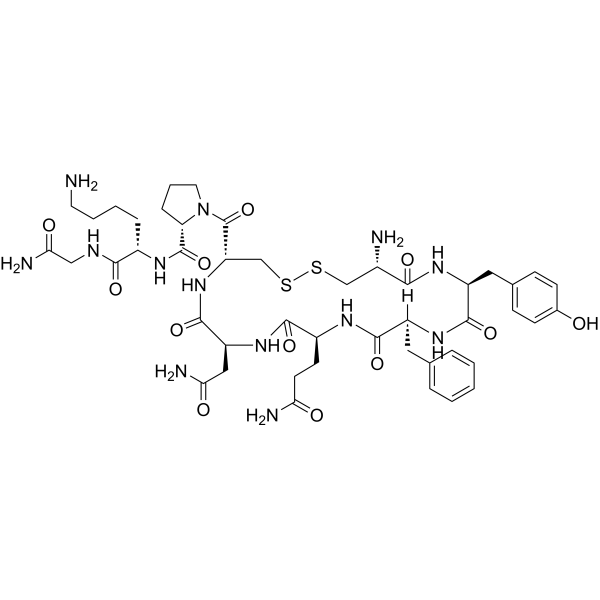
    Endomorphin 1
    3 Publications Verification

    Opioid Receptor Neurological Disease
    Endomorphin 1, a high affinity, highly selective agonist of the μ-opioid receptor (Ki: 1.11 nM), displays reasonable affinities for kappa3 binding sites, with Ki value between 20 and 30 nM. Endomorphin 1 has antinociceptive properties .
    Endomorphin 1
  • HY-168366

    Opioid Receptor Neurological Disease
    R-6890 is a Brorphine-related opioid receptor antagonist that exhibits differential binding activities toward rat opioid receptors (IC50=4.6 nM (0.05 M Tris; pH 7.4) and 170 nM (0.05 M Tris+0.1 M NaCl)). R-6890 displaces bound labeled opioids from receptors, and its binding affinity is affected by environmental factors, decreasing in the presence of NaCl. R-6890 crosses the blood-brain barrier (BBB) and exerts analgesic effects in the warm water-induced tail-flick reflex model of male Wistar rats .
    R-6890
  • HY-124831

    Neurotensin Receptor Neurological Disease
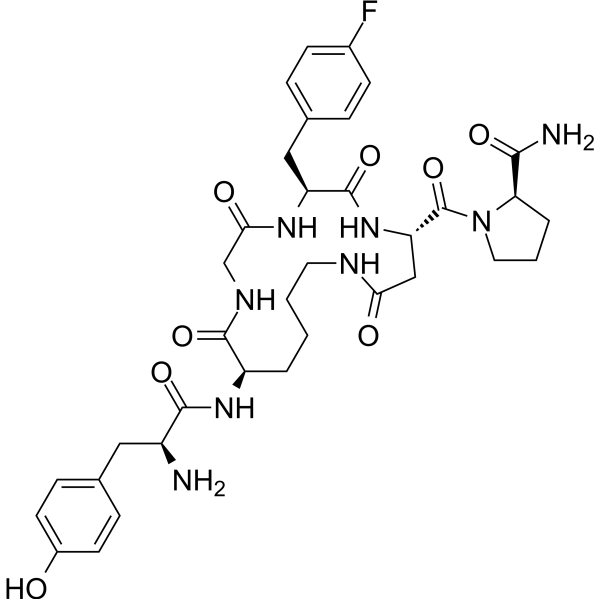
    NTRC-844 (compound 8) is a selective antagonist of neurotensin receptor type 2 (NTS2),with the EC50 of 238 nM. NTRC-844 plays an important role in analgesic animal research .
    NTRC-844
  • HY-P1441A

    Sodium Channel Neurological Disease
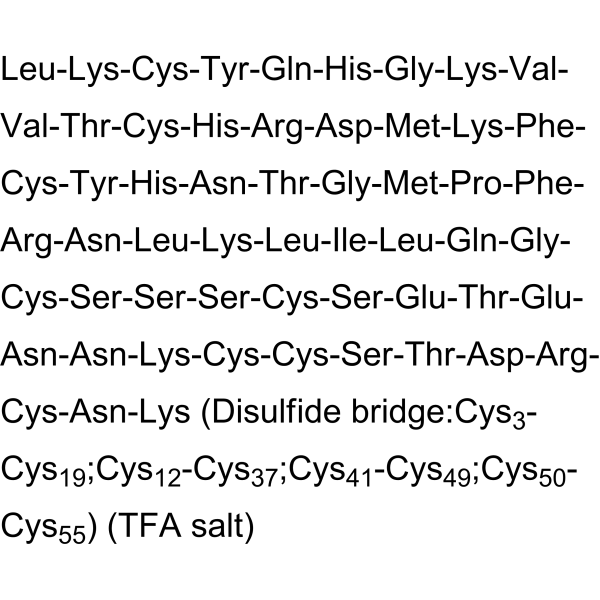
    Mambalgin 1 TFA is a selective ASIC1a inhibitor (IC50 values are 192 and 72 nM for human ASIC1a and ASIC1a/1b dimer, respectively). Mambalgin 1 TFA binds to closed/inactive channel. Mambalgin 1 TFA is selective for ASIC1a over ASIC2a, ASIC3, TRPV1, P2X2, 5-HT3, Nav1.8, Cav3.2 and Kv1.2 channels. Mambalgin 1 TFA increases latency of withdrawal response in mouse tail-flick and paw-flick tests.
    Mambalgin 1 TFA
  • HY-122189

    (-)-Akuammine; Vincamajoridine

    Others Neurological Disease
    Akuammine is an indole alkaloid that has been found in Picralima nitida and has analgesic activity. It selectively binds to the μ- and κ-opioid receptors over the δ-opioid receptor (Kis=0.3, 1.68, and 10.4 μM for the human receptors, respectively). Akuammine inhibits forskolin-induced cAMP production in HEK293 cells expressing human μ- or κ-opioid receptors (IC50s=2.6 and 0.073 μM, respectively). It increases the latency to withdrawal in the tail-flick or hot plate test in mice when administered at a dose of 60 mg/kg.
    Akuammine
  • HY-173030

    Opioid Receptor Neurological Disease
    Opioid receptor agonist 1 (Compound 2638-28) is the orally active agonist for opioid receptor that exhibits good affinity to MOR, DOR and KOR with Ki of 5, 24 and 212 nM, respectively. Opioid receptor agonist 1 exhibits analgesic activity in mouse warm water tail flick models and acetic acid writhing models .
    Opioid receptor agonist 1
  • HY-P0185A
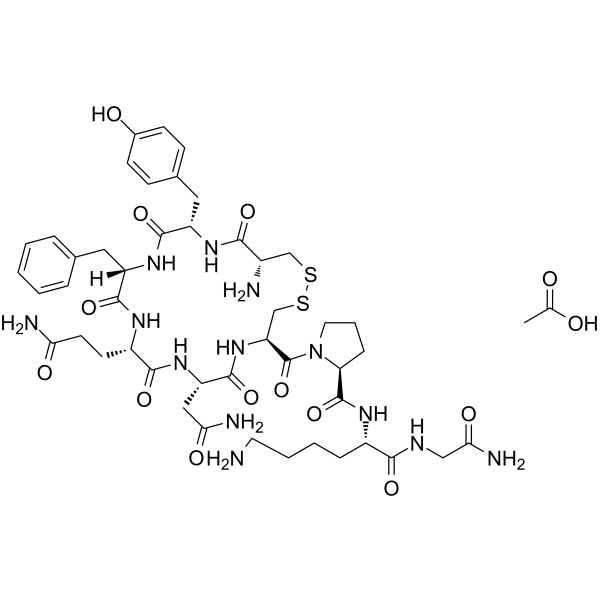
    Endomorphin 1 acetate
    3 Publications Verification

    Opioid Receptor Neurological Disease
    Endomorphin 1 acetate, a high affinity, highly selective agonist of the μ-opioid receptor (Ki: 1.11 nM), displays reasonable affinities for kappa3 binding sites, with Ki value between 20 and 30 nM. Endomorphin 1 acetate has antinociceptive properties .
    Endomorphin 1 acetate
  • HY-P10203

    Opioid Receptor Inflammation/Immunology
    μ/κ/δ opioid receptor agonist 1 is a μ opioid receptor (MOR), κ opioid receptor (KOR), and δ opioid receptor (DOR) agonist. μ/κ/δ opioid receptor agonist 1 produces a strong and long-lasting analgesic effect through peripheral MOR and KOR in the tail-flick test .
    μ/κ/δ opioid receptor agonist 1
  • HY-118775

    5-HT Receptor Others
    LEK 8804 is a compound with 5-HT1A receptor agonist and 5-HT2 receptor antagonist properties, and has the activity of modulating related receptor-mediated behavioral responses. LEK 8804 can induce spontaneous tail-flick response in rats in a dose-dependent manner, showing complete 5-HT1A agonist activity, and can inhibit 5-HTP-induced head twitch response in mice, probably through antagonism of 5-HT2 receptors rather than agonism of 5-HT1A receptors.
    LEK 8804
  • HY-103216A

    Adrenergic Receptor Neurological Disease
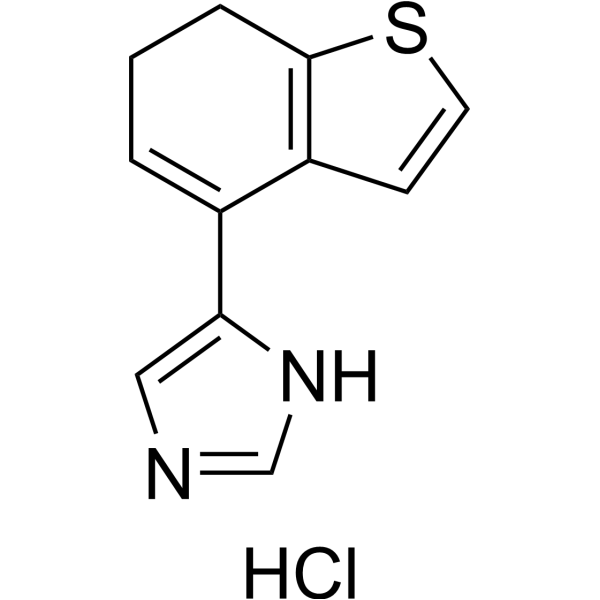
    RWJ-52353 hydrochloride is an orally potent, highly selective α2D adrenergic receptor agonist (Ki: 1.5 nM) with potential analgesic effects. RWJ-52353 hydrochloride demonstrated analgesic activity in abdominal tests in rats and mice, and improved agitation in mice in the hot plate test and tail flick test. RWJ-52353 hydrochloride also regulates the organic cation transporter (OCT) subtype, inhibiting rOCT1 and rOCT2 with IC50s of 100 μM and 20 μM respectively; it also activates rOCT3, affecting [3H]-1- in cells. Methyl-4-phenylpyridinium ([3H]MPP) transport .
    RWJ52353 hydrochloride
  • HY-119925

    Drug Intermediate Neurological Disease
    Amaralin is a sesquiterpene lactone with analgesic activity, which exists in the leaves and stems of Helenium amarum (Raf.) H. Rock. When administered subcutaneously, Amaralin produces analgesic effects in the mouse tail-flick test. When administered subcutaneously, Amaralin inhibits acetic acid-induced writhing syndrome in mice. Amaralin can be used for pain-related research .
    Amaralin
  • HY-182584

    5-HT Receptor Neurological Disease
    S 15931 is a 5-HT1A receptor inhibitor. S 15931 inhibits the late-phase hindpaw licking response induced by formalin and the abdominal writhing response induced by acetic acid in Mus musculus. S 15931 abolishes the spontaneous tail-flick response induced by 8-OH-DPAT in Rattus norvegicus and potentiates the analgesic effect of morphine. S 15931 is applicable for pain-related research .
    S 15931
  • HY-181605

    Opioid Receptor Neurological Disease
    MOR antagonist 2 hydrochloride is a blood-brain barrier-permeable μ-opioid receptor (MOR) antagonist, with an IC50 of 28.37 nM, an EC50 of 4.25 nM, and a Ki of 0.18 nM against MOR. MOR antagonist 2 hydrochloride stabilizes the inactive conformation of MOR to reduce receptor activation levels. MOR antagonist 2 hydrochloride antagonizes analgesic effects in the mouse warm-water tail-flick test. MOR antagonist 2 hydrochloride induces fewer opioid withdrawal symptoms (wet dog shakes, paw tremors) in mice with opioid withdrawal symptoms. MOR antagonist 2 hydrochloride can be used for the research of opioid use disorder .
    MOR antagonist 2 hydrochloride
  • HY-P1336A

    Deltorphin 1 TFA; Deltorphin C TFA; [D-Ala2] Deltorphin I TFA

    Opioid Receptor Neurological Disease
    Deltorphin I TFA (Deltorphin 1 TFA; Deltorphin C TFA; [D-Ala2] Deltorphin I TFA) is a high-affinity, selective δ-opioid receptor agonist that targets the δ1 and δ2 opioid receptor subtypes. Deltorphin I TFA produces analgesic effects in the rat spinal cord. Deltorphin I TFA increases the pain threshold in rats. Deltorphin I TFA can be used in studies related to nociception (acute pain) .
    Deltorphin I TFA

Inquiry Online

Your information is safe with us. * Required Fields.

Salutation


Country or Region *

Applicant Name *


Organization Name *

Department *


Email Address *


Product Name *

Cat. No.


Requested quantity *

Phone Number *


Remarks

Inquiry Online

Inquiry Information

Product Name:
Cat. No.:
Quantity:
MCE Japan Authorized Agent:

