



Simufilam dihydrochloride
Based on 1 publication(s) in Google Scholar
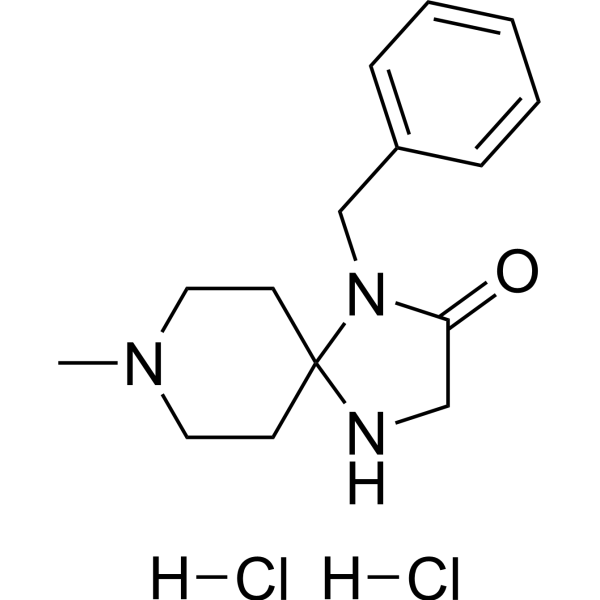
Simufilam dihydrochloride (PTI-125 dihydrochloride) is an orally active FLNA modulator. Simufilam dihydrochloride restores NMDAR signaling and Arc expression. Simufilam dihydrochloride inhibits overactive mTOR signaling by restoring the normal conformation of FLNA, improves insulin sensitivity, reduces Aβ42-induced neuroinflammation and tau protein hyperphosphorylation. Simufilam dihydrochloride can be used for research of Alzheimer's disease.
For research use only. We do not sell to patients.
- CAS No.: 2480226-06-8
- Formula: C15H23Cl2N3O
- Molecular Weight:332.27
-
Storage:
Please store the product under the recommended conditions in the Certificate of Analysis.

To place orders, for customer services and technical support, please contact: MedChemExpress USA
Tel: 609-228-6898 E-mail: [email protected] [email protected]


-
 Biological Activity
-
Chemical Information
- Protocols
- Purity & Documentation
- References
-
 Help & FAQs




Publications Citing Use of MedChemExpress (MCE) Simufilam dihydrochloride
MoreAll iGluR Isoforms
More

Biological Activity
Description
In Vitro
Simufilam (1 nM; 1 h) dihydrochloride reduces FLNA-α7nAChR/TLR4 associations, dissociates Aβ42-α7nAChR complexes, restores α7nAChR/NMDAR/IR function, and decreases tau phosphorylation in postmortem human AD brain slices[2].
Simufilam (1 pM-1 nM; 1 h) dihydrochloride dose-dependently reduces FLNA-α7nAChR/TLR4 associations, Aβ42-α7nAChR complexes, tau phosphorylation, and tau nitration, while restoring NMDAR signaling and Arc expression in postmortem human AD hippocampal slices[3].
MedChemExpress (MCE) has not independently confirmed the accuracy of these methods. They are for reference only. Further protocols information, click here.
In Vivo
Simufilam dihydrochloride (30 mg/kg/d; p.o.; 2 months) reduces FLNA-α7nAChR/TLR4 associations, tau phosphorylation, Aβ42 deposits, and NFTs, improves NMDAR/IR function and synaptic plasticity, and enhances spatial/working memory and nesting behavior in 3xTg AD mice[3].
MedChemExpress (MCE) has not independently confirmed the accuracy of these methods. They are for reference only.


Chemical Information
-
CAS No. 2480226-06-8
-
Molecular Weight 332.27
-
Formula C15H23Cl2N3O
-
SMILES
O=C1N(CC2=CC=CC=C2)C3(CCN(C)CC3)NC1.[H]Cl.[H]Cl
-
Synonyms
PTI-125 dihydrochloride
-
Shipping
Room temperature in continental US; may vary elsewhere.
-
Storage
Please store the product under the recommended conditions in the Certificate of Analysis.


Publications (1)
-
Journal Impact Factor
-
Most Recent
-
J Neurooncol
Single-cell RNA-seq reveals diverse molecular signatures associated with Methotrexate resistance in primary central nervous system lymphoma cells. [Abstract]2025 Mar;172(1):163-173. PMID: 39636551

Protocols
-
RNA extraction experimental
By lysing cells, releasing RNA, and removing impurities such as proteins and DNA, high-purity RNA products are finally obtained. The commonly used traditional method is the guanidine isothiocyanate/phenol/chloroform method (Trizol), which is suitable for a variety of animal materials including animal tissues, microorganisms, cultured cells, etc., and most plant materials.
-
Research Protocol for Endocrine Diseases
Endocrine diseases often arise from disrupted hormone production, hormone signaling, or target-tissue responsiveness; for diabetes-focused endocrine disease models, insulin signaling regulates glucose uptake, hepatic glucose output, lipid metabolism, and β-cell compensation. Type 2 diabetes develops through interacting defects in insulin resistance, β-cell dysfunction, adipose inflammation, hepatic glucose overproduction, altered incretin signaling, and ectopic lipid metabolism. A major unresolved question is whether endocrine dysfunction is driven primarily by target-tissue insulin resistance, intrinsic β-cell failure, immune/inflammatory stress, or combined multi-organ failure that differs by disease stage.
-
Research Protocol for Neurological Diseases
PINK1/Parkin-mediated mitophagy pathway is a mitochondrial quality-control signaling axis in which mitochondrial depolarization stabilizes PINK1 on damaged mitochondria, activates Parkin recruitment and E3 ubiquitin ligase activity, promotes ubiquitination of outer mitochondrial membrane proteins, recruits selective autophagy adaptors, and drives lysosomal degradation of damaged mitochondria. In neurological disease research, this pathway is experimentally important because neurons, especially dopaminergic neurons, are highly dependent on mitochondrial integrity, and defective mitochondrial turnover can lead to mitochondrial dysfunction, oxidative stress, impaired neuronal survival, α-synuclein accumulation, and neuroinflammatory damage-associated signals. The genetic disease link is strongest in Parkinson’s disease because mutations in PRKN/parkin cause autosomal recessive juvenile parkinsonism, mutations in PINK1 cause hereditary early-onset Parkinson’s disease, and Drosophila studie
-
Alzheimer’s Disease Modeling
Alzheimer’s Disease (AD) is a neurodegenerative disorder characterized by a progressive decline in cognitive functions and loss of specific types of neurons and synapses. Alzheimer's symptoms can be simulated in mice by injecting drugs (such as Aβ) or genetically modified.


Purity & Documentation
References
[1]. Wang HY, et al. Simufilam suppresses overactive mTOR and restores its sensitivity to insulin in Alzheimer's disease patient lymphocytes. Front Aging. 2023 Jun 29;4:1175601. [Content Brief]
[2]. Wang HY, et al. Reducing amyloid-related Alzheimer's disease pathogenesis by a small molecule targeting filamin A. J Neurosci. 2012 Jul 18;32(29):9773-84. [Content Brief]
[3]. Wang HY, et al. PTI-125 binds and reverses an altered conformation of filamin A to reduce Alzheimer's disease pathogenesis. Neurobiol Aging. 2017 Jul;55:99-114. [Content Brief]

Calculators
Concentration (start) × Volume (start) = Concentration (final) × Volume (final)


Simufilam dihydrochloride Related Classifications
HY-139142A Related Classifications
 Powered by Bioz