



17β-Hydroxywortmannin
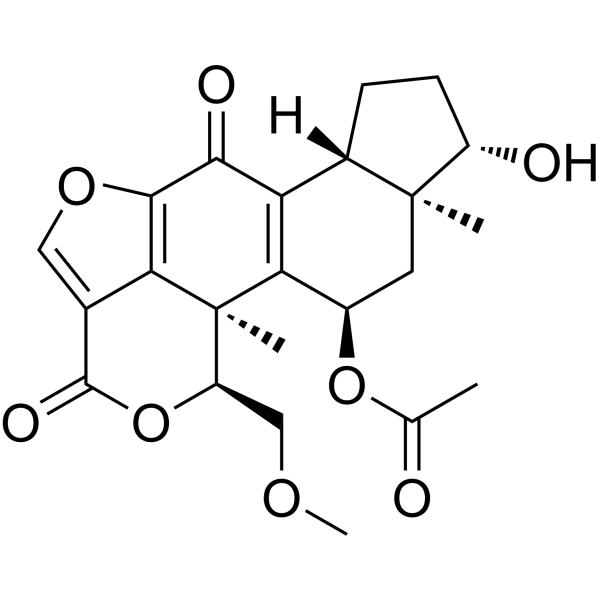
17β-Hydroxywortmannin (Wortmannin-17β-ol) is an orally active inhibitor for phosphatidylinositol-3-kinase (PI-3-kinase) with an IC50 of 0.5 nM, suppresses the osteoclast resorption with an IC50 of 10 nM. 17β-Hydroxywortmannin exhibits antitumor activity.
For research use only. We do not sell to patients.
- CAS No.: 58053-83-1
- Formula: C23H26O8
- Molecular Weight:430.45
-
Storage:
Please store the product under the recommended conditions in the Certificate of Analysis.

To place orders, for customer services and technical support, please contact: MedChemExpress USA
Tel: 609-228-6898 E-mail: [email protected] [email protected]


-
 Biological Activity
-
Chemical Information
- Protocols
- Purity & Documentation
- References
-
 Help & FAQs




Biological Activity
Description
IC50 & Target
|
PI3K 0.5 nM (IC50) |
Cellular Effect
|
Cell Line

|
Type | Value | Description | References |
|---|---|---|---|---|
| LNCaP | IC50 |
1.464 μM
Compound: 2, 17-hydroxywortmannin
|
Growth inhibition of human LNCap cells
Growth inhibition of human LNCap cells
|
[PMID: 18269228] |
In Vivo
17β-Hydroxywortmannin (2.5 mg/kg/week, i.v. for 2 weeks) exhibits antitumor efficacy towards U87MG glioma with a therapeutic index of 26 in human tumor xenografted nude mice[2].
MedChemExpress (MCE) has not independently confirmed the accuracy of these methods. They are for reference only.


Chemical Information
-
CAS No. 58053-83-1
-
Molecular Weight 430.45
-
Formula C23H26O8
-
SMILES
C[C@@]12C3=C(C(C4=C1C(C(O[C@@H]2COC)=O)=CO4)=O)[C@@]5([H])[C@](C[C@H]3OC(C)=O)([C@H](CC5)O)C
-
Synonyms
Wortmannin-17β-ol
-
Shipping
Room temperature in continental US; may vary elsewhere.
-
Storage
Please store the product under the recommended conditions in the Certificate of Analysis.


Purity & Documentation
References
[1]. Hall TJ, et al., Wortmannin, a potent inhibitor of phosphatidylinositol 3-kinase, inhibits osteoclastic bone resorption in vitro. Calcif Tissue Int. 1995 Apr;56(4):336-8. [Content Brief]
[2]. Zask A, et al., Synthesis and structure-activity relationships of ring-opened 17-hydroxywortmannins: potent phosphoinositide 3-kinase inhibitors with improved properties and anticancer efficacy. J Med Chem. 2008 Mar 13;51(5):1319-23. [Content Brief]

Calculators
Concentration (start) × Volume (start) = Concentration (final) × Volume (final)


17β-Hydroxywortmannin Related Classifications
HY-126083 Related Classifications
 Powered by Bioz