



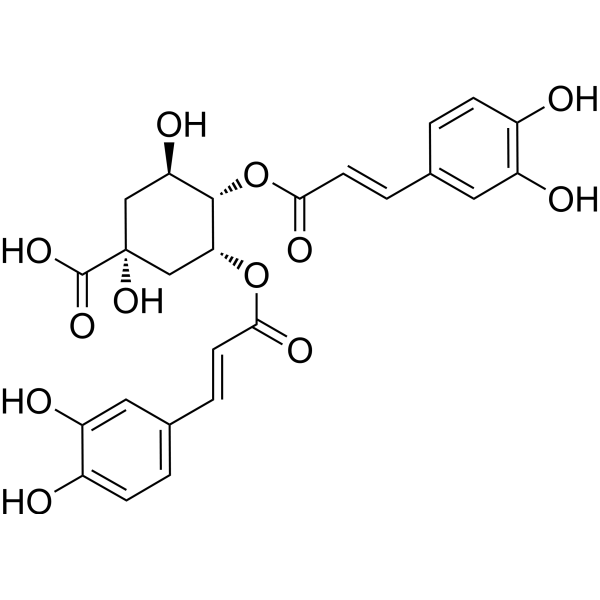
4,5-Di-O-caffeoylquinic acid
Based on 1 publication(s) in Google Scholar
4,5-Di-O-caffeoylquinic acid (4,5-di-O-CQA) is a natural product with multiple activities including anti-inflammatory, antioxidant, and antibacterial properties. 4,5-Di-O-caffeoylquinic acid induces intracellular Ca2+ influx, and inhibits hypoxia-induced COX-2 expression and cell migration via the TRPV1-mediated pathway. 4,5-Di-O-caffeoylquinic acid scavenges DPPH free radicals, inhibits Cu2+-mediated LDL oxidation, and reduces the production of TBARS. 4,5-Di-O-caffeoylquinic acid promotes intracellular ATP production, inhibits Aβ42 aggregation and β-sheet conversion, and protects neuroblastoma cells. 4,5-Di-O-caffeoylquinic acid inhibits the growth of Bacillus shigae. 4,5-Di-O-caffeoylquinic acid can be used in studies related to atherosclerosis, Alzheimer's disease, and bacterial infections.
For research use only. We do not sell to patients.
- Purity : 98%
- CAS No.: 89886-30-6
- Formula: C25H24O12
- Molecular Weight:516.45
-
Storage:
-20°C, protect from light
* In solvent : -80°C, 6 months; -20°C, 1 month (protect from light)

To place orders, for customer services and technical support, please contact: MedChemExpress USA
Tel: 609-228-6898 E-mail: [email protected] [email protected]


-
 Biological Activity
-
Chemical Information
- Purity & Documentation
- References
-
 Help & FAQs


Publications Citing Use of MedChemExpress (MCE) 4,5-Di-O-caffeoylquinic acid
More

Biological Activity
Description
IC50 & Target
[1]|
TRPV1 69.34 μM (EC50) |
COX-2 |
Cellular Effect
|
Cell Line

|
Type | Value | Description | References |
|---|---|---|---|---|
| HEK-293T | EC50 |
69.34 μM
|
Activation of TRPV1 inducing intracellular Ca2+ influx in TRPV1-expressing human embryonic kidney HEK 293T cells assessed via dose-response analysis using Fura-2AM imaging and fluorescence plate reader assays.
Activation of TRPV1 inducing intracellular Ca2+ influx in TRPV1-expressing human embryonic kidney HEK 293T cells assessed via dose-response analysis using Fura-2AM imaging and fluorescence plate reader assays.
|
2882267 |
In Vitro
4,5-Di-O-caffeoylquinic acid (4,5-di-O-CQA) (0.1-500 μM) activates TRPV1 in TRPV1-expressing HEK 293T cells, with an EC50 of 69.34 μM[1].
4,5-Di-O-caffeoylquinic acid (3-30 μM; 1 h pre-incubation, 18 h hypoxic incubation) inhibits hypoxia-induced COX-2 expression in A549 cells via a TRPV1-mediated pathway; it also suppresses hypoxia-induced migration of A549 cells through a TRPV1-mediated pathway[1].
4,5-Di-O-caffeoylquinic acid (1-20 μM; 48 h) exerts a dose-dependent protective effect against Aβ42-induced toxicity in SH-SY5Y human neuroblastoma cells[4].
4,5-Di-O-caffeoylquinic acid (compound 5) potently scavenges DPPH free radicals with an IC50 value of 10.4 μM; it also potently inhibits Cu2+-mediated lipid peroxidation of human LDL with an IC50 value of 2.3 μM[2].
4,5-Di-O-caffeoylquinic acid (2.5 μM; up to 10 h) prolongs the lag phase of conjugated diene formation during Cu2+-mediated oxidation of human low-density lipoprotein (LDL), exhibiting potent inhibitory activity against the initiation stage of LDL oxidation[2].
4,5-Di-O-caffeoylquinic acid (4,5-di-CQA) (compound 11) (5-20 μM; 48 h) promotes ATP production in human dopaminergic neuroblastoma SH-SY5Y cells[3].
4,5-Di-O-caffeoylquinic acid (4,5-di-O-CQA) potently inhibits Aβ42 aggregation in a cell-free system with an IC50 of 0.1 μM; it potently suppresses the formation of Aβ42 fibrils after 24 h of incubation in a cell-free system; and it blocks the conformational transition of Aβ42 from random coil to β-sheet structure[4].
4,5-Di-O-caffeoylquinic acid (4,5-diCQA) potently inhibits the growth of Bacillus shigae in a concentration-dependent manner, with an IC50 of 222.45 μg/mL[5].
MedChemExpress (MCE) has not independently confirmed the accuracy of these methods. They are for reference only.
-
Cell Line:human pulmonary epithelial A549 cells
-
Concentration:3, 10, 30 μM
-
Incubation Time:1 h pre-incubation; 18 h hypoxic incubation
-
Result:Suppressed hypoxia-induced COX-2 protein expression in A549 cells in a dose-dependent manner.
Lost inhibitory effect on hypoxia-induced COX-2 protein expression when co-treated with 5 μM capsazepine.
-
Cell Line:human pulmonary epithelial A549 cells
-
Concentration:30 μM
-
Incubation Time:1 h pre-incubation; 18 h hypoxic incubation during migration assay
-
Result:Significantly inhibited hypoxia-induced increases in A549 cell migration.
Lost antimigratory effect when co-treated with 5 μM capsazepine.
-
Cell Line:human neuroblastoma SH-SY5Y cells
-
Concentration:1 μM; 10 μM; 20 μM
-
Incubation Time:48 h
-
Result:Provided dose-dependent protection against Aβ42-induced toxicity, with 20 μM restoring cell viability to 78.9% of vehicle-treated cells.
Showed no cytotoxicity to SH-SY5Y cells at 20 μM.


Chemical Information
-
CAS No. 89886-30-6
-
Appearance Solid
-
Molecular Weight 516.45
-
Formula C25H24O12
-
Color Off-white to light yellow
-
SMILES
O=C(/C=C/C1=CC(O)=C(O)C=C1)O[C@H]2[C@@H](C[C@@](C[C@H]2OC(/C=C/C3=CC=C(C(O)=C3)O)=O)(C(O)=O)O)O
-
Synonyms
4,5-di-O-CQA
-
Structure Classification
-
Initial Source
-
Shipping
Room temperature in continental US; may vary elsewhere.
-
Storage
-20°C, protect from light
* In solvent : -80°C, 6 months; -20°C, 1 month (protect from light)


Publications (1)
-
Journal Impact Factor
-
Most Recent
-
Chem Pharm Bull
Chromatographic Evaluation and Characterization of Constituents of Sunflower Seed Extract Used as Food Additives. [Abstract]2024;72(1):93-97. PMID: 38233137


Purity & Documentation
-
Data Sheet (308 KB)
-
SDS (252 KB)
- English - EN (252 KB)
- Français - FR (252 KB)
- Deutsch - DE (252 KB)
- Norwegian - NO (252 KB)
- Español - ES (252 KB)
- Swedish - SV (252 KB)
- Italian - IT (252 KB)
- Korean - KR (252 KB)
- Portuguese - PT (252 KB)
-
Handling Instructions (2659 KB)
References
[1]. Kim Y, et al. 4,5-Di-O-Caffeoylquinic Acid from Ligularia fischeri Suppresses Inflammatory Responses Through TRPV1 Activation. Phytother Res. 2017 Oct;31(10):1564-1570. [Content Brief]
[5]. Han J, et al. Comparison of anti-bacterial activity of three types of di-O-caffeoylquinic acids in Lonicera japonica flowers based on microcalorimetry. Chinese journal of natural medicines. 2014 Feb;12(2):108-13. [Content Brief]

Calculators
Concentration (start) × Volume (start) = Concentration (final) × Volume (final)


4,5-Di-O-caffeoylquinic acid Related Classifications
HY-N11077 Related Classifications
 Powered by Bioz