



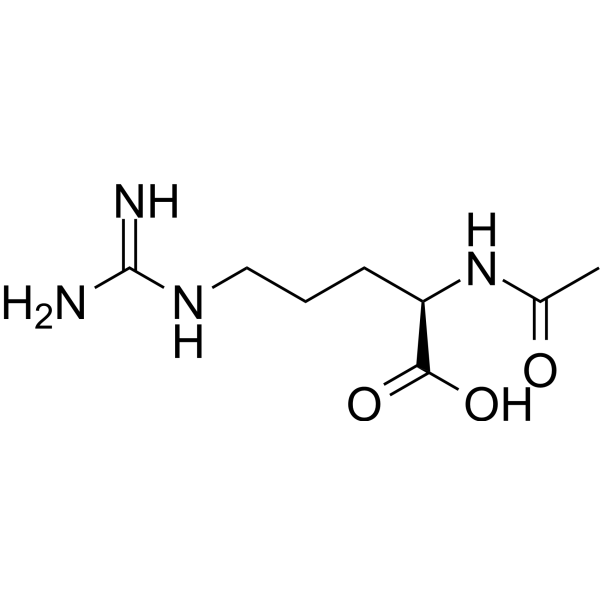
N-Acetyl-L-arginine
Based on 1 publication(s) in Google Scholar
N-Acetyl-L-arginine (Ac-Arg-OH) is one of the guanidino compounds found elevated in the serum of a hemodialyzed renal insufficient (uremic) pediatric population. N-Acetyl-L-arginine shows synergistic activity with glycine buffer. N-Acetyl-L-arginine suppresses the aggregation of intravenous immunoglobulins with a minimum decrease in transition temperature. N-Acetyl-L-arginine dramatically reduces IL-1 expression in the presence of silicone oil. N-Acetyl-L-arginine also demonstrates colloidal stability.
연구목적의 판매만을 진행합니다. 환자를 대상으로 한 판매는 하지 않습니다.
- Purity : 99.97%
- CAS No.: 155-84-0
- 화학식: C8H16N4O3
- 분자량:216.24
-
보관:Powder -20°C, 3 years , 4°C, 2 years ; In solvent -80°C, 2 years , -20°C, 1 year

To place orders, for customer services and technical support, please contact: MedChemExpress USA
Tel: 609-228-6898 E-mail: [email protected] [email protected]


-
 Biological Activity
-
Chemical Information
-
용액&용해도
- Protocol
- 순도&문서
- References
-
 Help & FAQs



Publications Citing Use of MedChemExpress (MCE) N-Acetyl-L-arginine
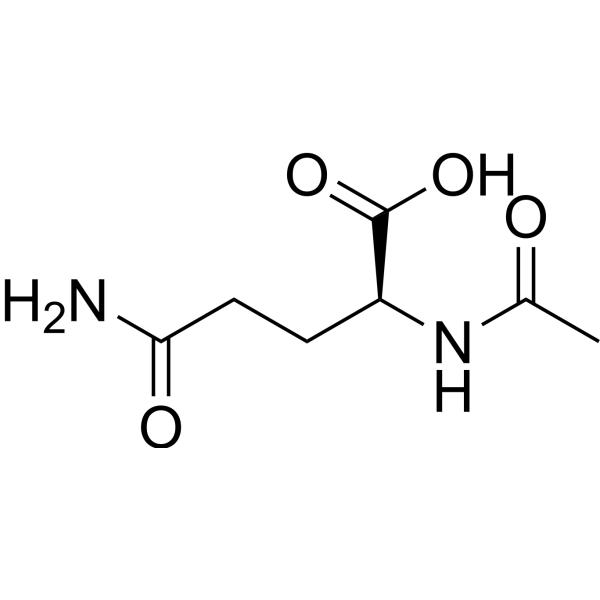
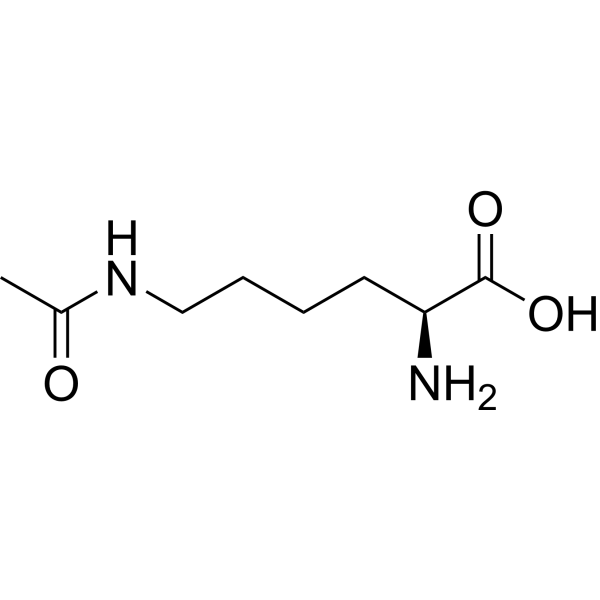
MoreAll Endogenous Metabolite Isoforms
More

Biological Activity
제품 설명
IC50 & Target
|
Human Endogenous Metabolite |
In Vitro
N-Acetyl-L-arginine (Compound NALA) (25-150 mM) increases the transition temperatures of 5 mg/mL Etanercept (HY-108847)[2].
N-Acetyl-L-arginine (50-150 mM) exhibits identical protein unfolding incidents and shows the least or almost no change in Tm in overlaid thermograms of IgG[3].
N-Acetyl-L-arginine (150 mM, 5 d) remains the highest in monomeric content at both pH 4 and 7 and has the fewest aggregates at pH 4[3].
MedChemExpress (MCE) has not independently confirmed the accuracy of these methods. They are for reference only. Further protocols information, click here.
In Vivo
MedChemExpress (MCE) has not independently confirmed the accuracy of these methods. They are for reference only.


Chemical Information
-
CAS No. 155-84-0
-
Appearance Solid
-
분자량 216.24
-
화학식 C8H16N4O3
-
Color White to off-white
-
SMILES
O=C(C)N[C@@H](C(O)=O)CCCNC(N)=N
-
Synonyms
Ac-Arg-OH
-
Structure Classification
-
선적
Room temperature in continental US; may vary elsewhere.
-
보관
Powder -20°C 3 years 4°C 2 years In solvent -80°C 2 years -20°C 1 year


Publications (1)
-
Journal Impact Factor
-
Most Recent


용액&용해도
In Vitro:
H2O : 50 mg/mL (231.22 mM; Need ultrasonic)
DMSO : 14.29 mg/mL (66.08 mM; Need ultrasonic; Hygroscopic DMSO has a significant impact on the solubility of product, please use newly opened DMSO)
Please refer to the solubility information to select the appropriate solvent. Once prepared, please aliquot and store the solution to prevent product inactivation from repeated freeze-thaw cycles.
Storage method and period of stock solution: -80°C, 2 years; -20°C, 1 year. When stored at -80°C, please use it within 2 years. When stored at -20°C, please use it within 1 year.
* Note: If you choose water as the stock solution, please dilute it to the working solution, then filter and sterilize it with a 0.22 μm filter before use.
Please refer to the solubility information to select the appropriate solvent. Once prepared, please aliquot and store the solution to prevent product inactivation from repeated freeze-thaw cycles.
Storage method and period of stock solution: -80°C, 2 years; -20°C, 1 year. When stored at -80°C, please use it within 2 years. When stored at -20°C, please use it within 1 year.
* Note: If you choose water as the stock solution, please dilute it to the working solution, then filter and sterilize it with a 0.22 μm filter before use.
Concentration (start) × Volume (start) = Concentration (final) × Volume (final)
In Vivo:
Select the appropriate dissolution method based on your experimental animal and administration route.
- For the following dissolution methods, please ensure to first prepare a clear stock solution using an In Vitro approach and then sequentially add co-solvents:
- To ensure reliable experimental results, the clarified stock solution can be appropriately stored based on storage conditions. As for the working solution for In Vivo experiments, it is recommended to prepare freshly and use it on the same day.
- The percentages shown for the solvents indicate their volumetric ratio in the final prepared solution. If precipitation or phase separation occurs during preparation, heat and/or sonication can be used to aid dissolution.
Add each solvent one by one: 10% DMSO 40% PEG300 5% Tween-80 45% Saline
Solubility: ≥ 1.43 mg/mL (6.61 mM); Clear solution
This protocol yields a clear solution of ≥ 1.43 mg/mL (saturation unknown).
Taking 1 mL working solution as an example, add 100 μL DMSO stock solution (14.3 mg/mL) to 400 μL PEG300, and mix evenly; then add 50 μL Tween-80 and mix evenly; then add 450 μL Saline to adjust the volume to 1 mL.
Preparation of Saline: Dissolve 0.9 g sodium chloride in ddH₂O and dilute to 100 mL to obtain a clear Saline solution.
Add each solvent one by one: 10% DMSO 90% (20% SBE-β-CD in Saline)
Solubility: ≥ 1.43 mg/mL (6.61 mM); Clear solution
This protocol yields a clear solution of ≥ 1.43 mg/mL (saturation unknown).
Taking 1 mL working solution as an example, add 100 μL DMSO stock solution (14.3 mg/mL) to 900 μL 20% SBE-β-CD in Saline, and mix evenly.
Preparation of 20% SBE-β-CD in Saline (4°C, storage for one week): 2 g SBE-β-CD powder is dissolved in 10 mL Saline, completely dissolve until clear.
For the following dissolution methods, please prepare the working solution directly:
It is recommended to prepare fresh solutions and use them promptly within a short period of time.
The percentages shown for the solvents indicate their volumetric ratio in the final prepared solution. If precipitation or phase separation occurs during preparation, heat and/or sonication can be used to aid dissolution.
Add each solvent one by one: PBS
Solubility: 130 mg/mL (601.18 mM); Clear solution; Need ultrasonic
In Vivo Dissolution Calculator
Please enter the basic information of animal experiments:
-
-
-
-
Recommended: Prepare an additional quantity of animals to account for potential losses during experiments.
Working solution concentration: 0.22 mg/mL
This product has good water solubility, please refer to the measured solubility data in water/PBS/Saline for details.

Protocol
-
How to Select the Route of Administration for Mammals
Route-of-administration selection in mammals is a pharmacokinetic, pharmacodynamic, formulation, animal-welfare, and translational decision, not a default technical choice. The selected route should match the study goal: intravenous dosing is most useful when complete systemic exposure and rapid onset are required, oral dosing is most translational for orally intended medicines but is affected by absorption and first-pass metabolism, subcutaneous or intramuscular dosing can provide slower systemic exposure, and intraperitoneal dosing can be useful in rodent proof-of-concept studies but may have limited clinical translation. Published route-comparison studies show that the same compound can produce different exposure, onset, bioavailability, tissue distribution, and tolerability depending on route; therefore, route choice should be supported by pilot pharmacokinetic or pharmacodynamic evidence when the literature is insufficient. Unresolved questions include how to standardize route sel
-
RNA extraction experimental
By lysing cells, releasing RNA, and removing impurities such as proteins and DNA, high-purity RNA products are finally obtained. The commonly used traditional method is the guanidine isothiocyanate/phenol/chloroform method (Trizol), which is suitable for a variety of animal materials including animal tissues, microorganisms, cultured cells, etc., and most plant materials.


순도&문서
-
Data Sheet (273 KB)
-
SDS (393 KB)
- English - EN (393 KB)
- Français - FR (393 KB)
- Deutsch - DE (393 KB)
- Norwegian - NO (393 KB)
- Español - ES (393 KB)
- Swedish - SV (393 KB)
- Italian - IT (393 KB)
- Korean - KR (393 KB)
- Portuguese - PT (393 KB)
-
Handling Instructions (2659 KB)
References
[1]. De Deyn PP, et al. Serum guanidino compound levels in uremic pediatric patients treated with hemodialysis or continuous cycle peritoneal dialysis. Correlations between nerve conduction velocities and altered guanidino compound concentrations. Nephron. 1995;69(4):411-7. [Content Brief]
[2]. Kim, N. A., et al., (2022). Enhanced protein aggregation suppressor activity of N-acetyl-l-arginine for agitation-induced aggregation with silicone oil and its impact on innate immune responses. International journal of biological macromolecules, 216, 42–51. [Content Brief]
[3]. Kim, N. A., et al., (2021). N-Acetylated-L-arginine (NALA) is an enhanced protein aggregation suppressor under interfacial stresses and elevated temperature for protein liquid formulations. International journal of biological macromolecules, 166, 654–664. [Content Brief]


Complete Stock Solution Preparation Table
Please refer to the solubility information to select the appropriate solvent. Once prepared, please aliquot and store the solution to prevent product inactivation from repeated freeze-thaw cycles.
Storage method and period of stock solution: -80°C, 2 years; -20°C, 1 year. When stored at -80°C, please use it within 2 years. When stored at -20°C, please use it within 1 year.
| Optional Solvent | Concentration Solvent Mass | 1 mg | 5 mg | 10 mg | 25 mg |
|---|---|---|---|---|---|
| DMSO / H2O | 1 mM | 4.6245 mL | 23.1225 mL | 46.2449 mL | 115.6123 mL |
| 5 mM | 0.9249 mL | 4.6245 mL | 9.2490 mL | 23.1225 mL | |
| 10 mM | 0.4624 mL | 2.3122 mL | 4.6245 mL | 11.5612 mL | |
| 15 mM | 0.3083 mL | 1.5415 mL | 3.0830 mL | 7.7075 mL | |
| 20 mM | 0.2312 mL | 1.1561 mL | 2.3122 mL | 5.7806 mL | |
| 25 mM | 0.1850 mL | 0.9249 mL | 1.8498 mL | 4.6245 mL | |
| 30 mM | 0.1541 mL | 0.7707 mL | 1.5415 mL | 3.8537 mL | |
| 40 mM | 0.1156 mL | 0.5781 mL | 1.1561 mL | 2.8903 mL | |
| 50 mM | 0.0925 mL | 0.4624 mL | 0.9249 mL | 2.3122 mL | |
| 60 mM | 0.0771 mL | 0.3854 mL | 0.7707 mL | 1.9269 mL | |
| H2O | 80 mM | 0.0578 mL | 0.2890 mL | 0.5781 mL | 1.4452 mL |
| 100 mM | 0.0462 mL | 0.2312 mL | 0.4624 mL | 1.1561 mL |
* Note: If you choose water as the stock solution, please dilute it to the working solution, then filter and sterilize it with a 0.22 μm filter before use.


N-Acetyl-L-arginine Related Classifications
HY-W014130 Related Classifications
 Powered by Bioz