



Anisodamine
Based on 2 publication(s) in Google Scholar
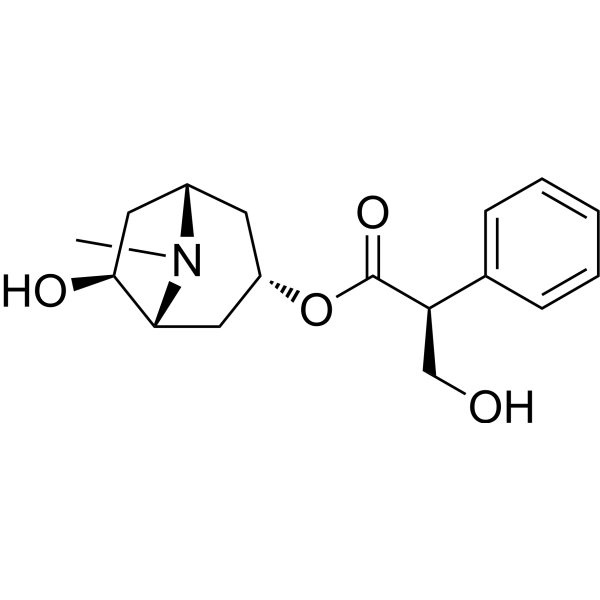
Anisodamine (6-Hydroxyhyoscyamine), a belladonna alkaloid, is a non-subtype-selective muscarinic, and also a nicotinic cholinoceptor antagonist. Anisodamine employs in traditional Chinese medicine for many ailments, mainly to improve the microcirculation in states of shock, and also in organophosphate poisoning.
For research use only. We do not sell to patients.
- Purity : 99.02%
- CAS No.: 55869-99-3
- Formula: C17H23NO4
- Molecular Weight:305.37
-
Storage:Powder -20°C, 3 years ; In solvent -80°C, 6 months , -20°C, 1 month

To place orders, for customer services and technical support, please contact: MedChemExpress USA
Tel: 609-228-6898 E-mail: [email protected] [email protected]


-
 Biological Activity
-
Chemical Information
-
Solvent & Solubility
- Purity & Documentation
- References
-
 Help & FAQs


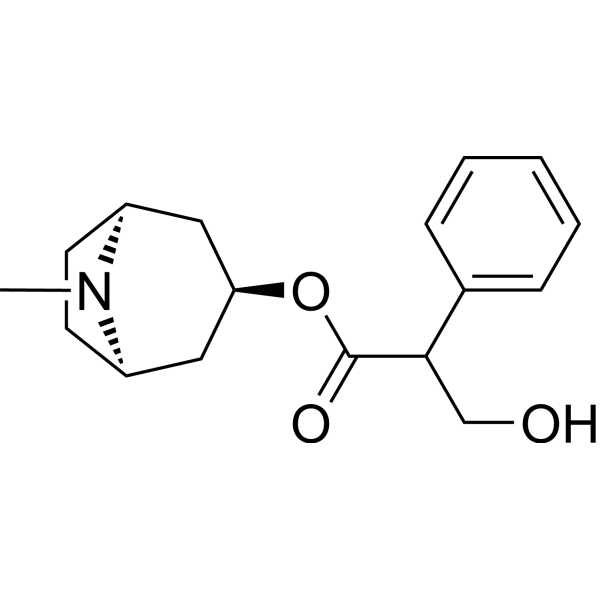
Publications Citing Use of MedChemExpress (MCE) Anisodamine
More

Biological Activity
Description
IC50 & Target
Nicotinic cholinoceptor[1]
In Vitro
Anisodamine (100 μg/mL; 20 minutes; RAW264.7 cells) pretreatment for 20 minutes before Ach results in significantly attenuates average fluorescence intensity of α-bungarotoxin binding compared with Ach alone[2].
Anisodamine action might be through blockade of muscarinic receptors and thus allowing more endogenous ACh binding to the α-7nAChR[2].
MedChemExpress (MCE) has not independently confirmed the accuracy of these methods. They are for reference only. .
In Vivo
MedChemExpress (MCE) has not independently confirmed the accuracy of these methods. They are for reference only.
-
Animal Model:LPS-Induced Shock Mice[2]
-
Dosage:50 mg/kg
-
Administration:I.p.
-
Result:Markedly decreased the mortality to 20%.


Chemical Information
-
CAS No. 55869-99-3
-
Appearance Solid
-
Molecular Weight 305.37
-
Formula C17H23NO4
-
Color White to off-white
-
SMILES
CN1[C@H]2[C@@H](O)C[C@@H]1C[C@H](OC([C@@H](C3=CC=CC=C3)CO)=O)C2
-
Synonyms
6-Hydroxyhyoscyamine
-
Structure Classification
-
Initial Source
-
Shipping
Room temperature in continental US; may vary elsewhere.
-
Storage
Powder -20°C 3 years In solvent -80°C 6 months -20°C 1 month


Publications (2)
-
Journal Impact Factor
-
Most Recent
-
Mol Metab
Vagal control of the brain-esophagus axis ameliorates stress-induced esophageal motility dysfunction in male mice. [Abstract]2026 May 26:102384. PMID: 42203107 -
J Integr Neurosci
The Neuroprotective Role of a Caspase-1 Inhibitor Against Apoptosis via Inhibition of Glial Hyperactivation in a Mouse Model of Epilepsy. [Abstract]2026 May 9;25(5):49777. PMID: 42216646


Solvent & Solubility
In Vitro:
DMSO : 100 mg/mL (327.47 mM; Need ultrasonic; Hygroscopic DMSO has a significant impact on the solubility of product, please use newly opened DMSO)
H2O : 25 mg/mL (81.87 mM; Need ultrasonic)
Please refer to the solubility information to select the appropriate solvent. Once prepared, please aliquot and store the solution to prevent product inactivation from repeated freeze-thaw cycles.
Storage method and period of stock solution: -80°C, 6 months; -20°C, 1 month. When stored at -80°C, please use it within 6 months. When stored at -20°C, please use it within 1 month.
* Note: If you choose water as the stock solution, please dilute it to the working solution, then filter and sterilize it with a 0.22 μm filter before use.
Please refer to the solubility information to select the appropriate solvent. Once prepared, please aliquot and store the solution to prevent product inactivation from repeated freeze-thaw cycles.
Storage method and period of stock solution: -80°C, 6 months; -20°C, 1 month. When stored at -80°C, please use it within 6 months. When stored at -20°C, please use it within 1 month.
* Note: If you choose water as the stock solution, please dilute it to the working solution, then filter and sterilize it with a 0.22 μm filter before use.
Concentration (start) × Volume (start) = Concentration (final) × Volume (final)
In Vivo:
Select the appropriate dissolution method based on your experimental animal and administration route.
- For the following dissolution methods, please ensure to first prepare a clear stock solution using an In Vitro approach and then sequentially add co-solvents:
- To ensure reliable experimental results, the clarified stock solution can be appropriately stored based on storage conditions. As for the working solution for In Vivo experiments, it is recommended to prepare freshly and use it on the same day.
- The percentages shown for the solvents indicate their volumetric ratio in the final prepared solution. If precipitation or phase separation occurs during preparation, heat and/or sonication can be used to aid dissolution.
Add each solvent one by one: 10% DMSO 40% PEG300 5% Tween-80 45% Saline
Solubility: ≥ 2.5 mg/mL (8.19 mM); Clear solution
This protocol yields a clear solution of ≥ 2.5 mg/mL (saturation unknown).
Taking 1 mL working solution as an example, add 100 μL DMSO stock solution (25.0 mg/mL) to 400 μL PEG300, and mix evenly; then add 50 μL Tween-80 and mix evenly; then add 450 μL Saline to adjust the volume to 1 mL.
Preparation of Saline: Dissolve 0.9 g sodium chloride in ddH₂O and dilute to 100 mL to obtain a clear Saline solution.
Add each solvent one by one: 10% DMSO 90% (20% SBE-β-CD in Saline)
Solubility: ≥ 2.5 mg/mL (8.19 mM); Clear solution
This protocol yields a clear solution of ≥ 2.5 mg/mL (saturation unknown).
Taking 1 mL working solution as an example, add 100 μL DMSO stock solution (25.0 mg/mL) to 900 μL 20% SBE-β-CD in Saline, and mix evenly.
Preparation of 20% SBE-β-CD in Saline (4°C, storage for one week): 2 g SBE-β-CD powder is dissolved in 10 mL Saline, completely dissolve until clear.
In Vivo Dissolution Calculator
Please enter the basic information of animal experiments:
-
-
-
-
Recommended: Prepare an additional quantity of animals to account for potential losses during experiments.
Working solution concentration: 0.22 mg/mL
This product has good water solubility, please refer to the measured solubility data in water/PBS/Saline for details.


Purity & Documentation
-
Data Sheet (275 KB)
-
SDS (393 KB)
- English - EN (393 KB)
- Français - FR (393 KB)
- Deutsch - DE (393 KB)
- Norwegian - NO (393 KB)
- Español - ES (393 KB)
- Swedish - SV (393 KB)
- Italian - IT (393 KB)
- Korean - KR (393 KB)
- Portuguese - PT (393 KB)
-
Handling Instructions (2659 KB)
References
[1]. Eisenkraft A, et al. Possible role for anisodamine in organophosphate poisoning. Br J Pharmacol. 2016 Jun;173(11):1719-27. [Content Brief]
[2]. Liu C, et al. Antishock effect of anisodamine involves a novel pathway for activating alpha7 nicotinic acetylcholine receptor. Crit Care Med. 2009;37(2):634-641. [Content Brief]


Complete Stock Solution Preparation Table
Please refer to the solubility information to select the appropriate solvent. Once prepared, please aliquot and store the solution to prevent product inactivation from repeated freeze-thaw cycles.
Storage method and period of stock solution: -80°C, 6 months; -20°C, 1 month. When stored at -80°C, please use it within 6 months. When stored at -20°C, please use it within 1 month.
| Optional Solvent | Concentration Solvent Mass | 1 mg | 5 mg | 10 mg | 25 mg |
|---|---|---|---|---|---|
| H2O / DMSO | 1 mM | 3.2747 mL | 16.3736 mL | 32.7472 mL | 81.8679 mL |
| 5 mM | 0.6549 mL | 3.2747 mL | 6.5494 mL | 16.3736 mL | |
| 10 mM | 0.3275 mL | 1.6374 mL | 3.2747 mL | 8.1868 mL | |
| 15 mM | 0.2183 mL | 1.0916 mL | 2.1831 mL | 5.4579 mL | |
| 20 mM | 0.1637 mL | 0.8187 mL | 1.6374 mL | 4.0934 mL | |
| 25 mM | 0.1310 mL | 0.6549 mL | 1.3099 mL | 3.2747 mL | |
| 30 mM | 0.1092 mL | 0.5458 mL | 1.0916 mL | 2.7289 mL | |
| 40 mM | 0.0819 mL | 0.4093 mL | 0.8187 mL | 2.0467 mL | |
| 50 mM | 0.0655 mL | 0.3275 mL | 0.6549 mL | 1.6374 mL | |
| 60 mM | 0.0546 mL | 0.2729 mL | 0.5458 mL | 1.3645 mL | |
| 80 mM | 0.0409 mL | 0.2047 mL | 0.4093 mL | 1.0233 mL | |
| DMSO | 100 mM | 0.0327 mL | 0.1637 mL | 0.3275 mL | 0.8187 mL |
* Note: If you choose water as the stock solution, please dilute it to the working solution, then filter and sterilize it with a 0.22 μm filter before use.


Anisodamine Related Classifications
HY-N0584 Related Classifications
 Powered by Bioz