



Morantel tartrate

Based on 1 Customer Validation
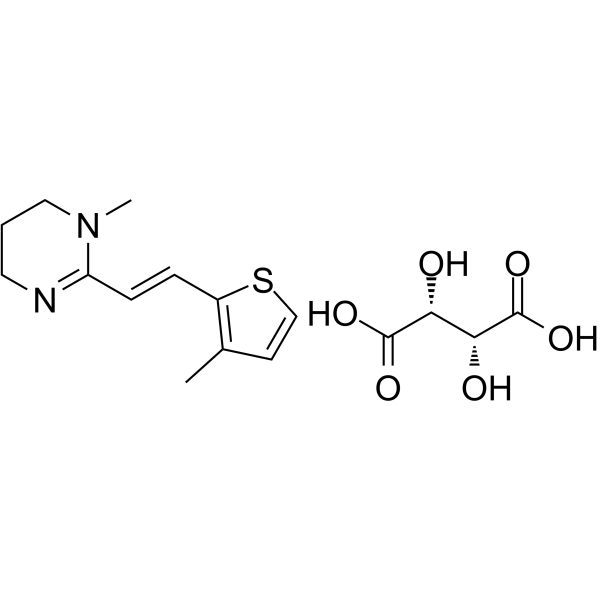
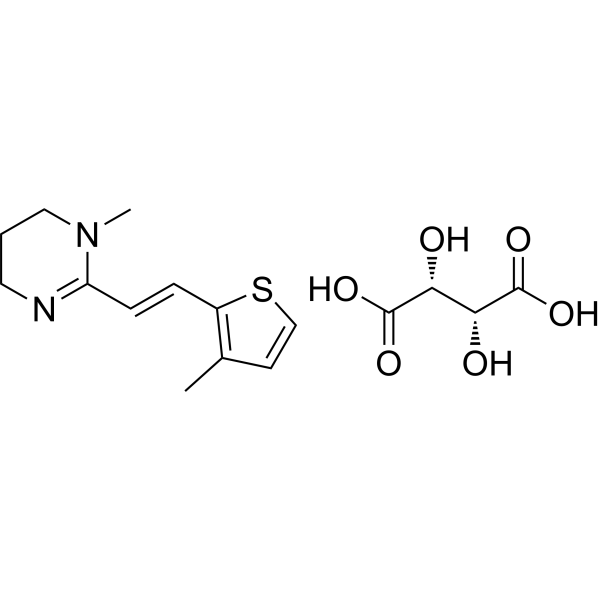
Morantel tartrate is an anthelmintic agent. Sustained-release three-layer composite tablets of Morantel tartrate are administered orally and release after exposure to rumen fluid. Morantel tartrate reduces the fecal egg output and worm burden of gastrointestinal nematodes in Hereford calves. Morantel tartrate is used in research related to gastrointestinal nematode infections.
For research use only. We do not sell to patients.
- Purity : 99.01%
- CAS No.: 26155-31-7
- Formula: C16H22N2O6S
- Molecular Weight:370.42
-
Storage:Powder -20°C, 3 years , 4°C, 2 years ; In solvent -80°C, 6 months , -20°C, 1 month

To place orders, for customer services and technical support, please contact: MedChemExpress USA
Tel: 609-228-6898 E-mail: [email protected] [email protected]


-
 Biological Activity
-
Chemical Information
-
Solvent & Solubility
- Purity & Documentation
- References
-
 Help & FAQs


All Parasite Isoforms
More

Biological Activity
Description
In Vivo
Morantel tartrate (9.7 mg/kg; administered 3 times to calves) reduces gastrointestinal nematode infections in calves (lowering the average fecal egg count to 36.3 e/g), and increases the body weight of dairy cows by 28.8 kg and calves by 11.1 kg under grazing conditions[2].
MedChemExpress (MCE) has not independently confirmed the accuracy of these methods. They are for reference only.
-
Animal Model:Hereford (cows: similar genetic background; calves: aged 41-142 days at study start)[2]
-
Dosage:9.7 mg/kg
-
Administration:bolus; 2 times (cows); 3 times (calves)
-
Result:Increased average total weight gain of treated cows by 48.1 kg (average daily gain 0.38 kg) over 127 days, representing a 28.8 kg weight gain advantage over control cows (significance at 10%).
Showed no significant difference in fecal nematode egg counts between treated and control cows, with an overall average of 1.2 eggs per gram (e/g) over the study period.
Increased average total weight gain of treated calves by 95.8 kg (average daily gain 0.75 kg) over 127 days, representing an 11.1 kg weight gain advantage over control calves (P < .01).
Reduced fecal nematode egg counts of treated calves to an overall average of 36.3 e/g over the study period (compared to 89.2 e/g for control calves), with counts significantly lower (P < .01) than control calves on all sampling dates after the first pre-treatment sampling, declining from a pre-treatment high of 54.8 e/g to 13.3 e/g in September.


Chemical Information
-
CAS No. 26155-31-7
-
Appearance Solid
-
Molecular Weight 370.42
-
Formula C16H22N2O6S
-
Color Off-white to light yellow
-
SMILES
CC1=C(/C=C/C2=NCCCN2C)SC=C1.O=C(O)[C@H](O)[C@@H](O)C(O)=O
-
Shipping
Room temperature in continental US; may vary elsewhere.
-
Storage
Powder -20°C 3 years 4°C 2 years In solvent -80°C 6 months -20°C 1 month


Solvent & Solubility
In Vitro:
DMSO : 125 mg/mL (337.45 mM; Need ultrasonic; Hygroscopic DMSO has a significant impact on the solubility of product, please use newly opened DMSO)
Please refer to the solubility information to select the appropriate solvent. Once prepared, please aliquot and store the solution to prevent product inactivation from repeated freeze-thaw cycles.
Storage method and period of stock solution: -80°C, 6 months; -20°C, 1 month. When stored at -80°C, please use it within 6 months. When stored at -20°C, please use it within 1 month.
Please refer to the solubility information to select the appropriate solvent. Once prepared, please aliquot and store the solution to prevent product inactivation from repeated freeze-thaw cycles.
Storage method and period of stock solution: -80°C, 6 months; -20°C, 1 month. When stored at -80°C, please use it within 6 months. When stored at -20°C, please use it within 1 month.
Concentration (start) × Volume (start) = Concentration (final) × Volume (final)
In Vivo:
Select the appropriate dissolution method based on your experimental animal and administration route.
- For the following dissolution methods, please ensure to first prepare a clear stock solution using an In Vitro approach and then sequentially add co-solvents:
- To ensure reliable experimental results, the clarified stock solution can be appropriately stored based on storage conditions. As for the working solution for In Vivo experiments, it is recommended to prepare freshly and use it on the same day.
- The percentages shown for the solvents indicate their volumetric ratio in the final prepared solution. If precipitation or phase separation occurs during preparation, heat and/or sonication can be used to aid dissolution.
Add each solvent one by one: 10% DMSO 40% PEG300 5% Tween-80 45% Saline
Solubility: ≥ 2.08 mg/mL (5.62 mM); Clear solution
This protocol yields a clear solution of ≥ 2.08 mg/mL (saturation unknown).
Taking 1 mL working solution as an example, add 100 μL DMSO stock solution (20.8 mg/mL) to 400 μL PEG300, and mix evenly; then add 50 μL Tween-80 and mix evenly; then add 450 μL Saline to adjust the volume to 1 mL.
Preparation of Saline: Dissolve 0.9 g sodium chloride in ddH₂O and dilute to 100 mL to obtain a clear Saline solution.
Add each solvent one by one: 10% DMSO 90% (20% SBE-β-CD in Saline)
Solubility: ≥ 2.08 mg/mL (5.62 mM); Clear solution
This protocol yields a clear solution of ≥ 2.08 mg/mL (saturation unknown).
Taking 1 mL working solution as an example, add 100 μL DMSO stock solution (20.8 mg/mL) to 900 μL 20% SBE-β-CD in Saline, and mix evenly.
Preparation of 20% SBE-β-CD in Saline (4°C, storage for one week): 2 g SBE-β-CD powder is dissolved in 10 mL Saline, completely dissolve until clear.
In Vivo Dissolution Calculator
Please enter the basic information of animal experiments:
-
-
-
-
Recommended: Prepare an additional quantity of animals to account for potential losses during experiments.
Please enter your animal formula composition:
-
%DMSO +
Recommended: Keep the proportion of DMSO in working solution below 2% if your animal is weak.
-
%+
-
+%Tween-80 + +
-
%Saline +
The co-solvents required include: DMSO, . All of co-solvents are available by MedChemExpress (MCE). , Tween 80. All of co-solvents are available by MedChemExpress (MCE).
Working solution concentration: 0.22 mg/mL
Method for preparing stock solution: mg drug dissolved in μL DMSO. Stock solution concentration: mg/mL.
1. Take μL DMSO stock solution;
2. Add μL .
μL , mix evenly;
3. Then add μL Tween 80, mix evenly;
4. Then add μL
Please ensure that the stock solution in the first step is dissolved to a clear state, and add co-solvents in sequence. You can use ultrasonic heating (ultrasonic cleaner, recommended frequency 20-40 kHz), vortexing, etc. to assist dissolution.


Purity & Documentation
-
Data Sheet (272 KB)
-
SDS (393 KB)
- English - EN (393 KB)
- Français - FR (393 KB)
- Deutsch - DE (393 KB)
- Norwegian - NO (393 KB)
- Español - ES (393 KB)
- Swedish - SV (393 KB)
- Italian - IT (393 KB)
- Korean - KR (393 KB)
- Portuguese - PT (393 KB)
-
Handling Instructions (2659 KB)
References
[1]. Lanusse CE, et al. Morantel tartrate release from a long-acting intraruminal device in cattle: pharmacokinetics and gastrointestinal distribution. J Vet Pharmacol Ther. 1992;15(2):117-123. [Content Brief]
[2]. Ciordia H, et al. Effect of an anthelmintic program with morantel tartrate on the performance of beef cattle. J Anim Sci. 1982;54(6):1111-1114. [Content Brief]


Complete Stock Solution Preparation Table
Please refer to the solubility information to select the appropriate solvent. Once prepared, please aliquot and store the solution to prevent product inactivation from repeated freeze-thaw cycles.
Storage method and period of stock solution: -80°C, 6 months; -20°C, 1 month. When stored at -80°C, please use it within 6 months. When stored at -20°C, please use it within 1 month.
| Optional Solvent | Concentration Solvent Mass | 1 mg | 5 mg | 10 mg | 25 mg |
|---|---|---|---|---|---|
| DMSO | 1 mM | 2.6996 mL | 13.4982 mL | 26.9964 mL | 67.4910 mL |
| 5 mM | 0.5399 mL | 2.6996 mL | 5.3993 mL | 13.4982 mL | |
| 10 mM | 0.2700 mL | 1.3498 mL | 2.6996 mL | 6.7491 mL | |
| 15 mM | 0.1800 mL | 0.8999 mL | 1.7998 mL | 4.4994 mL | |
| 20 mM | 0.1350 mL | 0.6749 mL | 1.3498 mL | 3.3745 mL | |
| 25 mM | 0.1080 mL | 0.5399 mL | 1.0799 mL | 2.6996 mL | |
| 30 mM | 0.0900 mL | 0.4499 mL | 0.8999 mL | 2.2497 mL | |
| 40 mM | 0.0675 mL | 0.3375 mL | 0.6749 mL | 1.6873 mL | |
| 50 mM | 0.0540 mL | 0.2700 mL | 0.5399 mL | 1.3498 mL | |
| 60 mM | 0.0450 mL | 0.2250 mL | 0.4499 mL | 1.1248 mL | |
| 80 mM | 0.0337 mL | 0.1687 mL | 0.3375 mL | 0.8436 mL | |
| 100 mM | 0.0270 mL | 0.1350 mL | 0.2700 mL | 0.6749 mL |


Morantel tartrate Related Classifications
HY-B1073 Related Classifications
 Powered by Bioz