



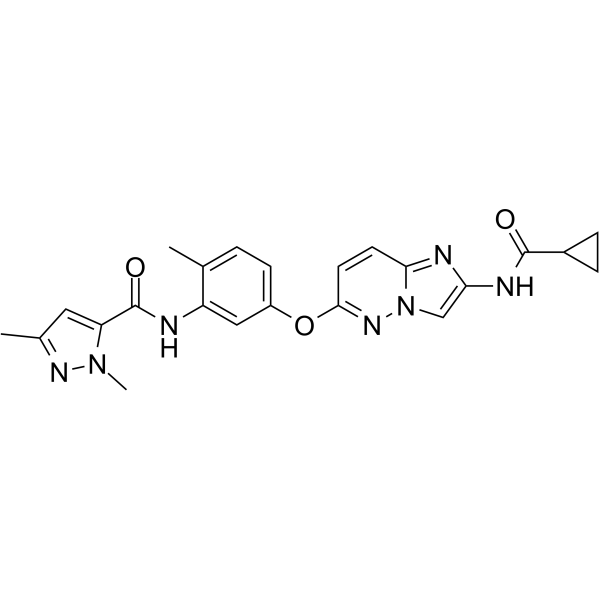
TAK-593
Based on 1 publication(s) in Google Scholar
TAK-593 is a potent VEGFR and PDGFR family inhibitor with IC50s of 3.2, 0.95, 1.1, 4.3 and 13 nM for VEGFR1, VEGFR2, VEGFR3, PDFGRα and PDFGRβ, respectively.
For research use only. We do not sell to patients.
- Purity : 99.88%
- CAS No.: 1005780-62-0
- Formula: C23H23N7O3
- Molecular Weight:445.47
-
Storage:Powder -20°C, 3 years , 4°C, 2 years ; In solvent -80°C, 2 years , -20°C, 1 year

To place orders, for customer services and technical support, please contact: MedChemExpress USA
Tel: 609-228-6898 E-mail: [email protected] [email protected]


-
 Biological Activity
-
Chemical Information
-
Solvent & Solubility
- Purity & Documentation
- References
-
 Help & FAQs


-
HY-10330
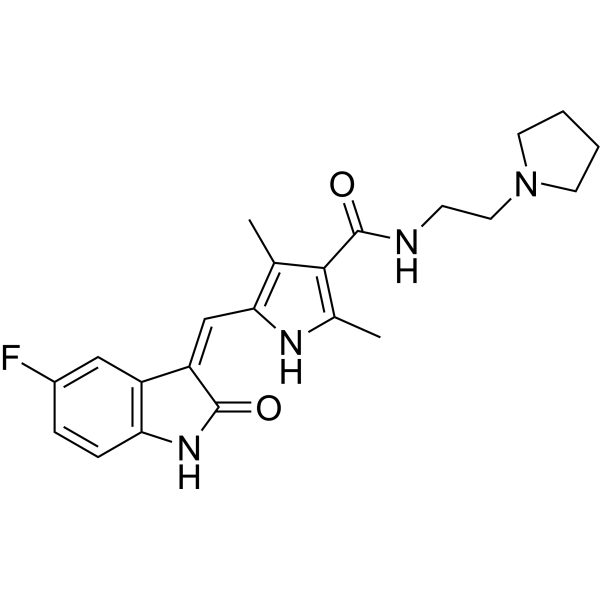
ToceranibRTK Inhibitor -
HY-10873
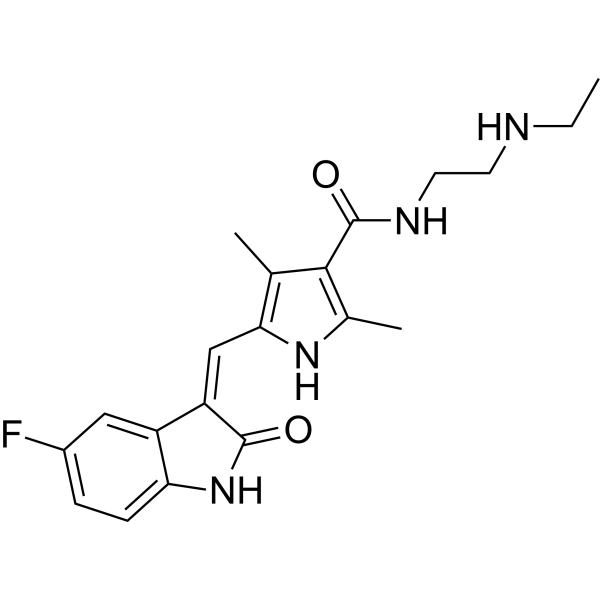
N-Desethyl SunitinibSunitinib Metabolite -
HY-18179
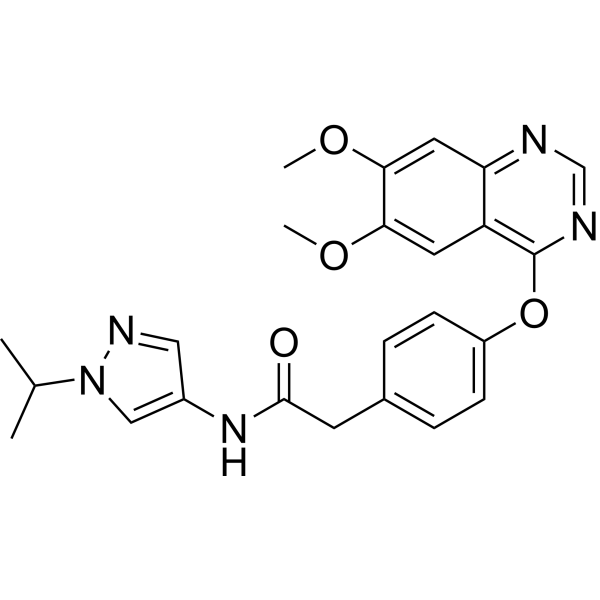
AZD2932c-Kit Inhibitor -
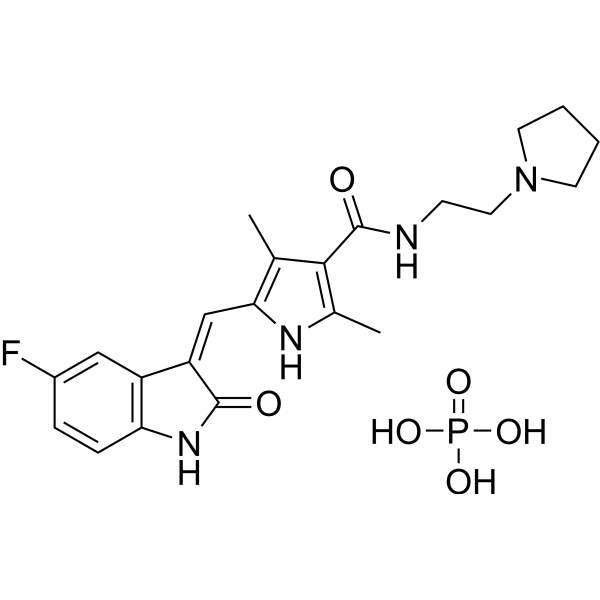
HY-10330A
Toceranib phosphateRTK Inhibitor -
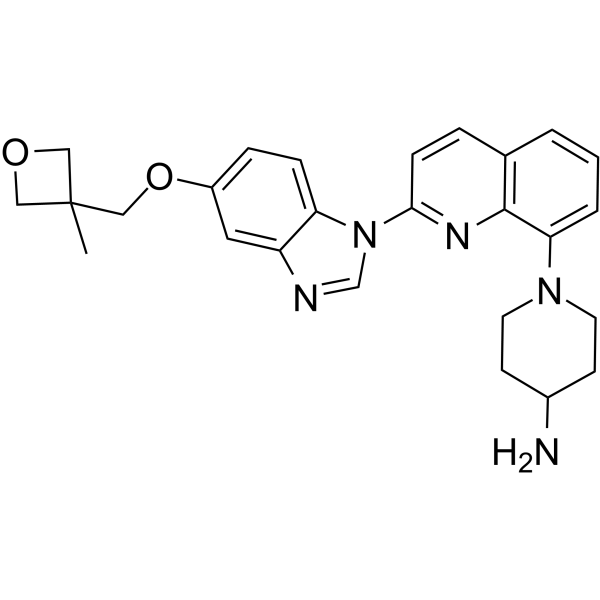
HY-13223
CrenolanibFLT3 Inhibitor -
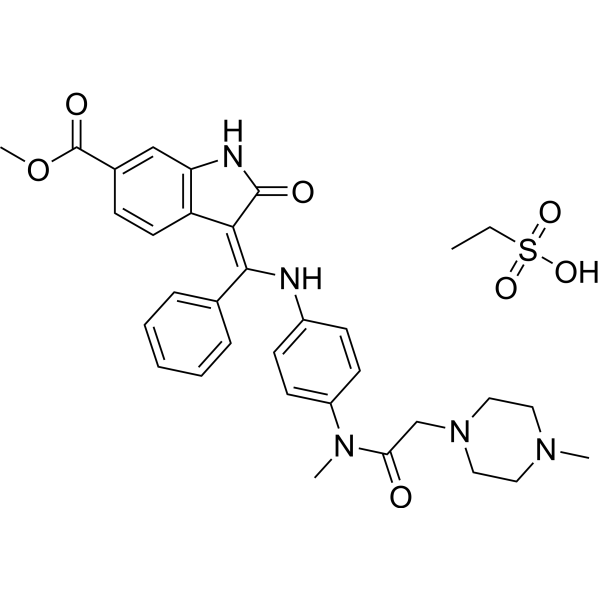
HY-11106
Nintedanib esylatePDGFR/VEGFR/FGFR Inhibitor -
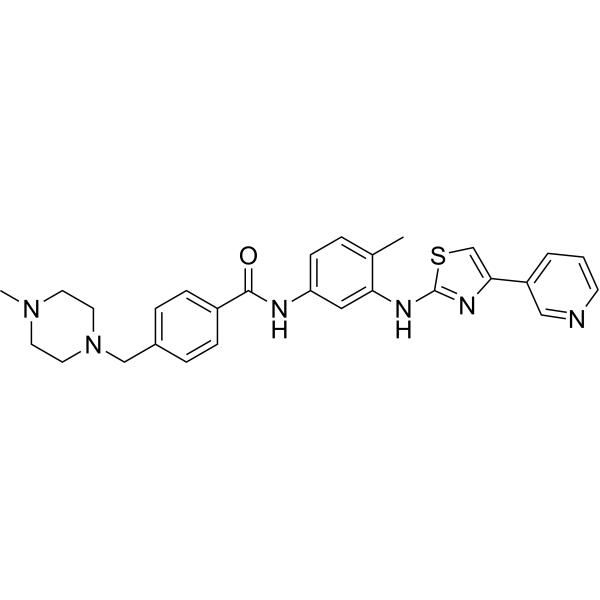
HY-10209
Masitinibc-Kit Inhibitor -
HY-12050
CP-673451PDGFR Inhibitor -
HY-112306
RipretinibKIT/PDGFRA Inhibitor -
HY-10255
Sunitinib MalateTyrosine Kinase Inhibitor -
HY-10501A
SU14813 maleateMultiple RTK Inhibitor -

HY-10330R
Toceranib (Standard)Reference Standard
Publications Citing Use of MedChemExpress (MCE) TAK-593
MoreAll VEGFR Isoforms
More

Biological Activity
Description
IC50 & Target
[1]|
VEGFR1 3.2 nM (IC50) |
VEGFR2 0.95 nM (IC50) |
VEGFR3 1.1 nM (IC50) |
PDGFRα 4.3 nM (IC50) |
PDGFRβ 13 nM (IC50) |
PDGFRαV561D 1 nM (IC50) |
Cellular Effect
|
Cell Line

|
Type | Value | Description | References |
|---|---|---|---|---|
| HUVEC | IC50 |
0.3 nM
Compound: 23a, TAK-593
|
Antiproliferative activity against VEGF-stimulated HUVECs after 5 days by WST-8 assay
Antiproliferative activity against VEGF-stimulated HUVECs after 5 days by WST-8 assay
|
[PMID: 23498918] |
In Vitro
TAK-593 inhibits growth of HUVEC with an IC50 of 0.30 nM. It shows potent inhibitory activity against VEGFR (VEGFR1-3: IC50=3.2, 0.95, 1.1 nM) and PDGFR (PDGFRα, β: IC50=4.3, 13 nM) families. Against other kinases, the IC50 values of TAK-593 are above 100 nM, except for Fms (IC50=10 nM) and Ret (IC50=18 nM) kinases[1]. TAK-593 potently inhibits VEGF- and PDGF-stimulated cellular phosphorylation and proliferation of human umbilical vein endothelial cells and human coronary artery smooth muscle cells. TAK-593 also potently inhibits VEGF-induced tube formation of endothelial cells co-cultured with fibroblasts[2].
MedChemExpress (MCE) has not independently confirmed the accuracy of these methods. They are for reference only. .
In Vivo
MedChemExpress (MCE) has not independently confirmed the accuracy of these methods. They are for reference only.
Clinical Trial
| NCT Number | Sponsor | Condition | Start Date |
Phase
|
|---|---|---|---|---|
| NCT01329991 | Plexxikon| | 2011-05 | PHASE1 |


Chemical Information
-
CAS No. 1005780-62-0
-
Appearance Solid
-
Molecular Weight 445.47
-
Formula C23H23N7O3
-
Color White to light yellow
-
SMILES
O=C(C1=CC(C)=NN1C)NC2=CC(OC3=NN4C(C=C3)=NC(NC(C5CC5)=O)=C4)=CC=C2C
-
Shipping
Room temperature in continental US; may vary elsewhere.
-
Storage
Powder -20°C 3 years 4°C 2 years In solvent -80°C 2 years -20°C 1 year


Publications (1)
-
Journal Impact Factor
-
Most Recent
-
Science
2017 Dec 1;358(6367):eaan4368. PMID: 29191878


Solvent & Solubility
In Vitro:
DMSO : 100 mg/mL (224.48 mM; Need ultrasonic; Hygroscopic DMSO has a significant impact on the solubility of product, please use newly opened DMSO)
Please refer to the solubility information to select the appropriate solvent. Once prepared, please aliquot and store the solution to prevent product inactivation from repeated freeze-thaw cycles.
Storage method and period of stock solution: -80°C, 2 years; -20°C, 1 year. When stored at -80°C, please use it within 2 years. When stored at -20°C, please use it within 1 year.
Please refer to the solubility information to select the appropriate solvent. Once prepared, please aliquot and store the solution to prevent product inactivation from repeated freeze-thaw cycles.
Storage method and period of stock solution: -80°C, 2 years; -20°C, 1 year. When stored at -80°C, please use it within 2 years. When stored at -20°C, please use it within 1 year.
Concentration (start) × Volume (start) = Concentration (final) × Volume (final)
In Vivo:
Select the appropriate dissolution method based on your experimental animal and administration route.
- For the following dissolution methods, please ensure to first prepare a clear stock solution using an In Vitro approach and then sequentially add co-solvents:
- To ensure reliable experimental results, the clarified stock solution can be appropriately stored based on storage conditions. As for the working solution for In Vivo experiments, it is recommended to prepare freshly and use it on the same day.
- The percentages shown for the solvents indicate their volumetric ratio in the final prepared solution. If precipitation or phase separation occurs during preparation, heat and/or sonication can be used to aid dissolution.
Add each solvent one by one: 10% DMSO 40% PEG300 5% Tween-80 45% Saline
Solubility: ≥ 2.5 mg/mL (5.61 mM); Clear solution
This protocol yields a clear solution of ≥ 2.5 mg/mL (saturation unknown).
Taking 1 mL working solution as an example, add 100 μL DMSO stock solution (25.0 mg/mL) to 400 μL PEG300, and mix evenly; then add 50 μL Tween-80 and mix evenly; then add 450 μL Saline to adjust the volume to 1 mL.
Preparation of Saline: Dissolve 0.9 g sodium chloride in ddH₂O and dilute to 100 mL to obtain a clear Saline solution.
Add each solvent one by one: 10% DMSO 90% (20% SBE-β-CD in Saline)
Solubility: ≥ 2.5 mg/mL (5.61 mM); Clear solution
This protocol yields a clear solution of ≥ 2.5 mg/mL (saturation unknown).
Taking 1 mL working solution as an example, add 100 μL DMSO stock solution (25.0 mg/mL) to 900 μL 20% SBE-β-CD in Saline, and mix evenly.
Preparation of 20% SBE-β-CD in Saline (4°C, storage for one week): 2 g SBE-β-CD powder is dissolved in 10 mL Saline, completely dissolve until clear.
In Vivo Dissolution Calculator
Please enter the basic information of animal experiments:
-
-
-
-
Recommended: Prepare an additional quantity of animals to account for potential losses during experiments.
Please enter your animal formula composition:
-
%DMSO +
Recommended: Keep the proportion of DMSO in working solution below 2% if your animal is weak.
-
%+
-
+%Tween-80 + +
-
%Saline +
The co-solvents required include: DMSO, . All of co-solvents are available by MedChemExpress (MCE). , Tween 80. All of co-solvents are available by MedChemExpress (MCE).
Working solution concentration: 0.22 mg/mL
Method for preparing stock solution: mg drug dissolved in μL DMSO. Stock solution concentration: mg/mL.
1. Take μL DMSO stock solution;
2. Add μL .
μL , mix evenly;
3. Then add μL Tween 80, mix evenly;
4. Then add μL
Please ensure that the stock solution in the first step is dissolved to a clear state, and add co-solvents in sequence. You can use ultrasonic heating (ultrasonic cleaner, recommended frequency 20-40 kHz), vortexing, etc. to assist dissolution.


Purity & Documentation
-
Data Sheet (278 KB)
-
SDS (394 KB)
- English - EN (394 KB)
- Français - FR (394 KB)
- Deutsch - DE (394 KB)
- Norwegian - NO (394 KB)
- Español - ES (394 KB)
- Swedish - SV (394 KB)
- Italian - IT (394 KB)
- Korean - KR (394 KB)
- Portuguese - PT (394 KB)
-
Handling Instructions (2659 KB)
References
[1]. Miyamoto N, et al. Discovery of N-[5-({2-[(cyclopropylcarbonyl)amino]imidazo[1,2-b]pyridazin-6-yl}oxy)-2-methylphenyl]-1,3-dimethyl-1H-pyrazole-5-carboxamide (TAK-593), a highly potent VEGFR2 kinase inhibitor. Bioorg Med Chem. 2013 Apr 15;21(8):2333-2345. [Content Brief]
[2]. Awazu Y, et al. Anti-angiogenic and anti-tumor effects of TAK-593, a potent and selective inhibitor of vascular endothelial growth factor and platelet-derived growth factor receptor tyrosine kinase. Cancer Sci. 2013 Apr;104(4):486-94. [Content Brief]


Complete Stock Solution Preparation Table
Please refer to the solubility information to select the appropriate solvent. Once prepared, please aliquot and store the solution to prevent product inactivation from repeated freeze-thaw cycles.
Storage method and period of stock solution: -80°C, 2 years; -20°C, 1 year. When stored at -80°C, please use it within 2 years. When stored at -20°C, please use it within 1 year.
| Optional Solvent | Concentration Solvent Mass | 1 mg | 5 mg | 10 mg | 25 mg |
|---|---|---|---|---|---|
| DMSO | 1 mM | 2.2448 mL | 11.2241 mL | 22.4482 mL | 56.1205 mL |
| 5 mM | 0.4490 mL | 2.2448 mL | 4.4896 mL | 11.2241 mL | |
| 10 mM | 0.2245 mL | 1.1224 mL | 2.2448 mL | 5.6121 mL | |
| 15 mM | 0.1497 mL | 0.7483 mL | 1.4965 mL | 3.7414 mL | |
| 20 mM | 0.1122 mL | 0.5612 mL | 1.1224 mL | 2.8060 mL | |
| 25 mM | 0.0898 mL | 0.4490 mL | 0.8979 mL | 2.2448 mL | |
| 30 mM | 0.0748 mL | 0.3741 mL | 0.7483 mL | 1.8707 mL | |
| 40 mM | 0.0561 mL | 0.2806 mL | 0.5612 mL | 1.4030 mL | |
| 50 mM | 0.0449 mL | 0.2245 mL | 0.4490 mL | 1.1224 mL | |
| 60 mM | 0.0374 mL | 0.1871 mL | 0.3741 mL | 0.9353 mL | |
| 80 mM | 0.0281 mL | 0.1403 mL | 0.2806 mL | 0.7015 mL | |
| 100 mM | 0.0224 mL | 0.1122 mL | 0.2245 mL | 0.5612 mL |


TAK-593 Related Classifications
HY-15506 Related Classifications
 Powered by Bioz