



Autophagy Activator
-
Semaglutide sodium
 0 ImagesCat. No.: HY-114118CCAS No.: 2924330-56-1
Semaglutide sodium is a long-acting, selective, competitive GLP-1R agonist that can penetrate the blood-brain barrier. After activating GLP-1R, Semaglutide sodium promotes insulin secretion, inhibits gastric emptying and appetite, and at the same time enhances autophagy, inhibits oxidative stress and apoptosis. Semaglutide sodium also regulates mitochondrial function and lipid metabolism (such as reducing de novo lipogenesis in the liver). Semaglutide sodium has activities such as lowering blood sugar, reducing weight, neuroprotection (such as improving motor function in Parkinson's disease models, reducing α-synuclein aggregation) and improving hepatic steatosis. Semaglutide sodium can be used for the study of neurodegenerative diseases and liver diseases such as type 2 diabetes, obesity, Parkinson's disease, metabolic associated fatty liver disease (MASLD), and cancer.
-
AR493
 0 ImagesCat. No.: HY-174157CAS No.: 1290546-06-3
AR493 is an autophagy activator acting on AMPK (adenosine monophosphate-activated protein kinase). AR493 regulates pathways related to cellular energy sensing and increases autophagy levels. AR493 is promising for research of aging-associated diseases (such as diabetes, neurodegenerative diseases) and autophagy regulation.
-
VEGFR2 AUTOTAC-1
 0 ImagesCat. No.: HY-187534
VEGFR2 AUTOTAC-1 is a VEGFR2 AUTOTAC degrader. VEGFR2 AUTOTAC-1 recruits p62, activates the autophagy-lysosome pathway through the p62-LC3 axis cascade, forms a ternary complex with VEGFR2 and p62, and drives UPS-independent post-translational degradation of VEGFR2. VEGFR2 AUTOTAC-1 induces G1 phase arrest and endogenous apoptosis in cells via the mitochondrial and caspase apoptotic pathways, thereby inhibiting cancer cell proliferation, migration and malignant phenotypes; meanwhile, it inhibits endothelial cell tube formation, migration and endothelial-mesenchymal transition by regulating E-cadherin and MMP2. VEGFR2 AUTOTAC-1 is applicable to research related to triple-negative breast cancer.(Pink: VEGFR2 target protein ligand (HY-187558); Blue: p62 ligand (HY-W014292); Black: Linker)
-
Atractyloside potassium salt (Standard)
 0 ImagesCat. No.: HY-N1462RCAS No.: 102130-43-8
Atractyloside (potassium salt) (Standard) is the analytical standard of Atractyloside (potassium salt). This product is intended for use in research and analytical applications. Atractyloside potassium salt is a powerful and specific inhibitor of mitochondrial ADP/ATP transport. Atractyloside potassium salt inhibits chloride channels from mitochondrial membranes of rat heart. Atractyloside potassium salt activates autophagy, inhibits ANT2, mTOR and promotes the activation of p-AMPK. Atractyloside potassium salt has anti-cancer effects on non-small cell lung cancer and can inhibit liver steatosis. Atractylodesin potassium salt has nephrotoxicity.
-
Isoginkgetin (Standard)
 0 Images
Isoginkgetin (Standard) is the analytical standard of Isoginkgetin. This product is intended for research and analytical applications. Isoginkgetin is a pre-mRNA splicing inhibitor inhibitor. Isoginkgetin also inhibits activities of both Akt, NF-κB and MMP-9. Isoginkgetin inhibits the activity of the 20S proteasome, induces apoptosis and activates autophagy.
-
α-Neoendorphin (porcine)
 0 ImagesCat. No.: HY-P11656CAS No.: 77739-20-9
α-Neoendorphin porcine is a peptide. α-Neoendorphin porcine effectively alleviates UVB-induced skin photoaging via activating mTOR-Beclin-1-mediated autophagy, reducing UVB-triggered ROS production, inhibiting the MAPK pathway and MMP activity, and promoting type I procollagen synthesis. α-Neoendorphin porcine exerts anti-aging and anti-wrinkle effects on skin cells. α-Neoendorphin porcine can be used in studies related to skin photoaging.
-
Sodium propionate-13C2
 0 ImagesCat. No.: HY-B1773AS2CAS No.: 83587-75-1
Sodium propionate-13C-2 is the 13C-labeled Propionate sodium (HY-B1773A). Sodium propionate is an orally active short-chain fatty acid. Sodium propionate can be produced by intestinal bacteria from the metabolism of dietary fiber. Sodium propionate increases PPAR-γ, inhibits NF-κB activation, and reduces COX-2 expression and NO production. Sodium propionate also induces Apoptosis and Autophagy. Sodium propionate reduces HSV-1-induced keratitis. Sodium propionate has anticancer effects against glioblastoma. Sodium propionate exhibits neuroprotective, antioxidant, and anti-inflammatory activities. Sodium propionate can be used in the research of spinal cord injury and Alzheimer's disease.
-
Plantamajoside (Standard)
 0 ImagesCat. No.: HY-N0031RCAS No.: 104777-68-6
Plantamajoside (Standard) is the analytical standard of Plantamajoside. This product is intended for use in research and analytical applications. Plantamajoside is an orally active phenylpropanoid glycoside. Plantamajoside can be isolated from Plantago asiatica L.(Plantaginaceae). Plantamajoside inactivates NF-κB, PI3K/akt, induces Apoptosis, and improves Autophagy. Plantamajoside regulates MAPK, integrin-linked kinase/c-Src. Plantamajoside inhibits multiple cancers, improves lung and kidney damage. Plantamajoside has neuroprotective and anti-inflammatory effects.
-
CX-5461 hydrochloride
 0 ImagesCat. No.: HY-13323BCAS No.: 2101314-20-7
CX-5461 hydrochloride is a selective, orally active RNA polymerase I inhibitor. CX-5461 hydrochloride disrupts the formation of the SL1-rDNA complex, thereby blocking the transcription initiation of ribosomal RNA without altering the activity of RNA polymerase II, DNA replication, or protein translation processes. CX-5461 hydrochloride upregulates the expression of p21, MDM2, Sestrin1/2, and phosphorylated AMPKα, and reduces the level of phosphorylated Akt. CX-5461 hydrochloride induces G2/G2/M cell cycle arrest, Autophagy, Apoptosis, and cellular senescence, and activates CHK1, CHK2, and RPA. CX-5461 hydrochloride can be used in research related to osteosarcoma, cervical cancer, hematologic malignancies, high-grade serous ovarian cancer, and solid tumors.
-
PX-478 free base
 0 ImagesCat. No.: HY-Z16784CAS No.: 685847-78-3
PX-478 free base is a multifunctional HIF-1α inhibitor with properties including radiosensitization, autophagy activation, and lipid accumulation inhibition. PX-478 free base also blocks hypoxia-induced VEGF production and regulates β-cell phenotypes under hypoxic conditions. PX-478 free base induces cell cycle arrest and DNA damage, restores autophagic function, reduces foam cell formation, and maintains glucose homeostasis. PX-478 free base is widely used in research on related diseases such as human tumors (e.g., prostate cancer), type 2 diabetes, and atherosclerosis.
-
EIPA (Standard)
 0 ImagesSynonyms: L593754 (Standard); MH 12-43 (Standard); Ethylisopropylamiloride (Standard)
EIPA (Standard) is the analytical standard of EIPA. This product is intended for research and analytical applications. EIPA (L593754) is an orally active TRPP3 channel inhibitor with an IC50 of 10.5 μM. EIPA also enhances autophagy by inhibiting Na+/H+-exchanger 3 (NHE3). EIPA inhibits macropinocytosis as well. EIPA can be used in the research of inflammation and cancers, such as gastric cancer, colon carcinoma, pancreatic carcinoma.
-
L-Azetidine-2-carboxylic acid (Standard)
 0 Images
L-Azetidine-2-carboxylic acid is a proline analog. L-Azetidine-2-carboxylic acid upregulates the lipid autophagy marker LC3-II via activation of the PERK pathway. L-Azetidine-2-carboxylic acid increases pro-apoptotic BAX protein. L-Azetidine-2-carboxylic acid induces ATF6 cleavage and upregulates phosphorylated eIF2α levels. L-Azetidine-2-carboxylic acid induces ER stress, inducing protein misfolding and aggregation. L-Azetidine-2-carboxylic acid shows teratogenic, pro-inflammatory and pro-apoptotic effects.
-
6-Azuridine (Standard)
 0 ImagesSynonyms: 6-Azauridine (Standard)
6-Azuridine (Standard) is the analytical standard of 6-Azuridine. This product is intended for research and analytical applications. 6-Azuridine (6-Azauridine) is an orally active purine nucleoside analogue. 6-Azuridine activates autophagic flux, induces Apoptosis that depends on AMPK and p53. 6-Azuridine exhibit both antitumor and antiviral activities.
-
PX-478 (Standard)
 0 ImagesCat. No.: HY-10231RCAS No.: 685898-44-6
PX-478 (Standard) is the analytical standard of PX-478 (HY-10231). This product is intended for research and analytical applications. PX-478 is a multifunctional HIF-1α inhibitor with properties including radiosensitization, autophagy activation, and lipid accumulation inhibition. PX-478 also blocks hypoxia-induced VEGF production and regulates β-cell phenotypes under hypoxic conditions. PX-478 induces cell cycle arrest and DNA damage, restores autophagic function, reduces foam cell formation, and maintains glucose homeostasis. PX-478 is widely used in research on related diseases such as human tumors (e.g., prostate cancer), type 2 diabetes, and atherosclerosis.
-
9-CCN
 0 ImagesCat. No.: HY-164014CAS No.: 596592-83-5
9-CCN is a lipid compound that specifically targets macrophages. 9-CCN can be used in the study of cardiovascular and cerebrovascular diseases.
-
Sodium propionate-13C-1
 0 ImagesCat. No.: HY-B1773AS1CAS No.: 83587-76-2
Sodium propionate-13C-1 is the 13C-labeled Propionate sodium (HY-B1773A). Sodium propionate is an orally active short-chain fatty acid. Sodium propionate can be produced by intestinal bacteria from the metabolism of dietary fiber. Sodium propionate increases PPAR-γ, inhibits NF-κB activation, and reduces COX-2 expression and NO production. Sodium propionate also induces Apoptosis and Autophagy. Sodium propionate reduces HSV-1-induced keratitis. Sodium propionate has anticancer effects against glioblastoma. Sodium propionate exhibits neuroprotective, antioxidant, and anti-inflammatory activities. Sodium propionate can be used in the research of spinal cord injury and Alzheimer's disease.
-
N-Methylnuciferine iodide
 0 ImagesCat. No.: HY-N3182ACAS No.: 53098-68-3
N-Methylnuciferine iodide, an alkaloid from Lotus Plumule, ameliorate lipopolysaccharide-induced depression-like behavior.
-
6-(1-Hydroxyethyl)-5,6-dihydrochelerythrine
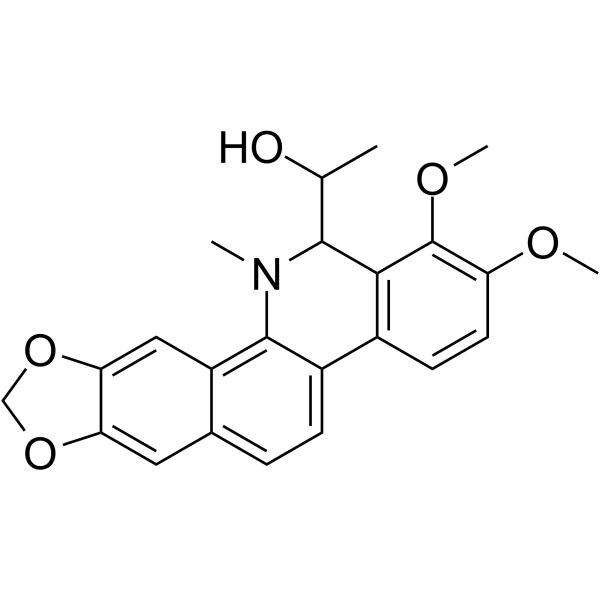 0 ImagesCat. No.: HY-N10365CAS No.: 2715007-88-6
6-(1-Hydroxyethyl)-5,6-dihydrochelerythrine, a alkaloid, significantly perturbates the features of cellular organelles including early endosomes, mitochondria and autophagosomes (Parkinson’s Disease patient-derived olfactory cells).
-
UA8967
 0 ImagesCat. No.: HY-118598CAS No.: 17511-50-1
UA8967 is a membrane-active antitumor agent. UA8967 exhibits enhanced cytotoxicity against cancer cells harboring a deletion of the tumor suppressor gene DPC4. By disrupting the integrity of the cytoplasmic membrane, UA8967 triggers early caspase-independent autophagy and ultimately leads to non-apoptotic cell lytic death. UA8967 can be used in research on colon cancer and pancreatic cancer.
-
Chlorpromazine (Standard)
 0 Images
Chlorpromazine (Standard) is the analytical standard of Chlorpromazine (HY-12708). This product is intended for research and analytical applications. Chlorpromazine is an orally active, blood-brain barrier-transparent antipsychotic agent that effectively antagonises D2 dopamine receptors and 5-HT2A, which is widely used in schizophrenia and other psychiatric disorders. Chlorpromazine exerts anti-cancer activity through a variety of pathways, including anti-proliferation, induction of autophagy and cycle arrest (G2-M phase), inhibition of cytochrome c oxidase (CcO), inhibition of tumour growth and metastasis, and inhibition of tumour immune escape. Chlorpromazine also blocks hNav1.7 channels (IC50=25.9 μM; concentration-dependent) and HERG potassium channels (IC50=21.6 μM), which has potential for analgesic and cardiac arrhythmic studies. Chlorpromazine also can inhibit clathrin-mediated endocytosis.



