



HSV
Herpes simplex virus
HSV (Herpes simplex virus) can be spread when an infected person is producing and shedding the virus. Herpes simplex can be spread through contact with saliva, such as sharing drinks. Symptoms of herpes simplex virus infection include watery blisters in the skin or mucous membranes of the mouth, lips or genitals. Lesions heal with ascab characteristic of herpetic disease. As neurotropic and neuroinvasive viruses, HSV-1 and -2 persist in the body by becoming latent and hiding from the immune system in the cell bodies of neurons. After the initial or primary infection, some infected people experience sporadic episodes of viral reactivation or outbreaks.
HSV Isoform Specific Products
All Product Categories
-
HSV Related Products (362)
Related Products (362)

-
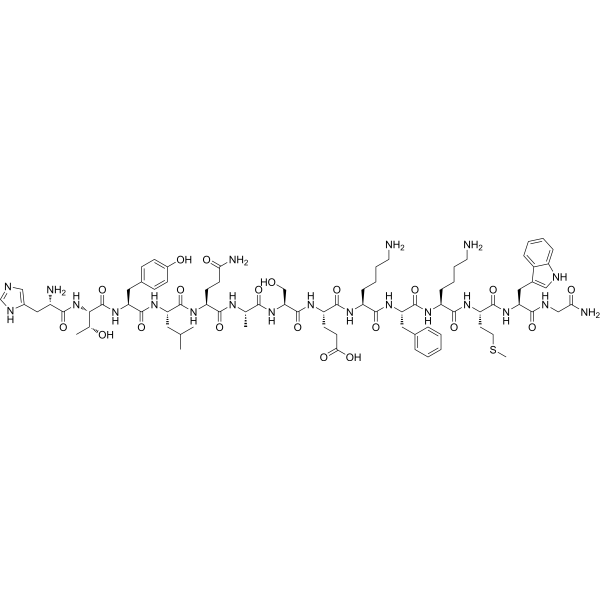
HSV Isoform Comparison
-
ISIS 1082
 0 ImagesCat. No.: HY-177638CAS No.: 141442-28-6
-
TL-119
 0 ImagesCat. No.: HY-P11022CAS No.: 55599-68-3Synonyms: A-3302-BTL-119 (A-3302-B) is a polypeptide. TL-119 can be isolated from the bacteria Micromonospora sp. MAG 9-7 and Saccharomonospora sp. CNQ-490. TL-119 inhibits TRPV-1. TL-119 exhibits antiviral activity against HSV-2. TL-119 possesses anticancer activity against gastric cancer and colorectal cancer.
-
2-Methoxy-1,6-dimethyl-5-vinyl-9,10-dihydrophenanthren-7-ol
 0 ImagesCat. No.: HY-N13837CAS No.: 2266586-31-42-Methoxy-1,6-dimethyl-5-vinyl-9,10-dihydrophenanthren-7-ol (Compound 1) is a 9,10-dihydrophenanthrene derivative. 2-Methoxy-1,6-dimethyl-5-vinyl-9,10-dihydrophenanthren-7-ol can be isolated from Juncus compressus. 2-Methoxy-1,6-dimethyl-5-vinyl-9,10-dihydrophenanthren-7-ol exhibits anticancer activity against cervical and ovarian cancers. 2-Methoxy-1,6-dimethyl-5-vinyl-9,10-dihydrophenanthren-7-ol can be used for HSV-2 virus research.
-
Oxytetracycline-d3
 0 ImagesCat. No.: HY-B0275S1Oxytetracycline-d3 is the deuterium labeled Oxytetracycline (HY-B0275). Oxytetracycline is an antibiotic belonging to the tetracycline class. Oxytetracycline potent inhibits Gram-negative and Gram-positive bacteria. Oxytetracycline is a protein synthesis inhibitor and prevents the binding from aminoacil-tRNA to the complex m-ribosomal RNA. Oxytetracycline also possesses anti-HSV-1 activity.
-
16-epi-Latrunculin B
 0 ImagesCat. No.: HY-101848ACAS No.: 444911-05-116-epi-latrunculin B is anticancer agent, which can inhibit the growth of HeLa cells with IC50 value of 3.9 uM. 16-epi-latrunculin B has antiviral activity against HSV-1 (ED50 of 1 µg/mL).
-
Retrocyclin-101
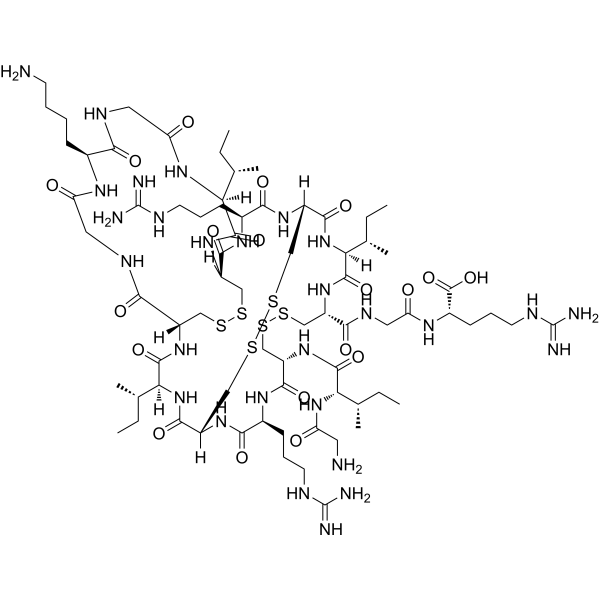 0 ImagesCat. No.: HY-P5642CAS No.: 536757-16-1Synonyms: RC-101Retrocyclin-101 (RC-101) is a synthetic cyclic θ-defensin, a broad-spectrum antimicrobial peptide with anti-pathogen (covering viruses, bacteria and fungi) activity and anti-inflammatory activity. Retrocyclin-101 exhibits significant inhibitory activity against HIV, SARS-CoV-2, flaviviruses, influenza viruses, HSV-1/2, Staphylococcus aureus and others. Retrocyclin-101 inhibits TLR4 and TLR2-mediated signal transduction and reduces pro-inflammatory cytokine expression.
-
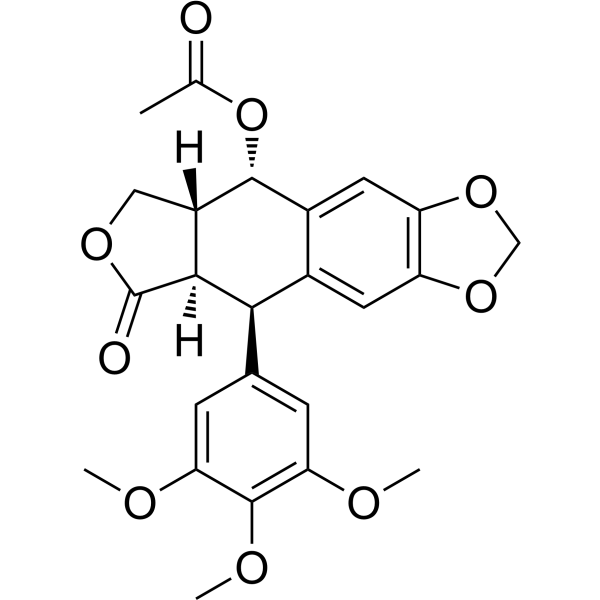
Ganoderone A
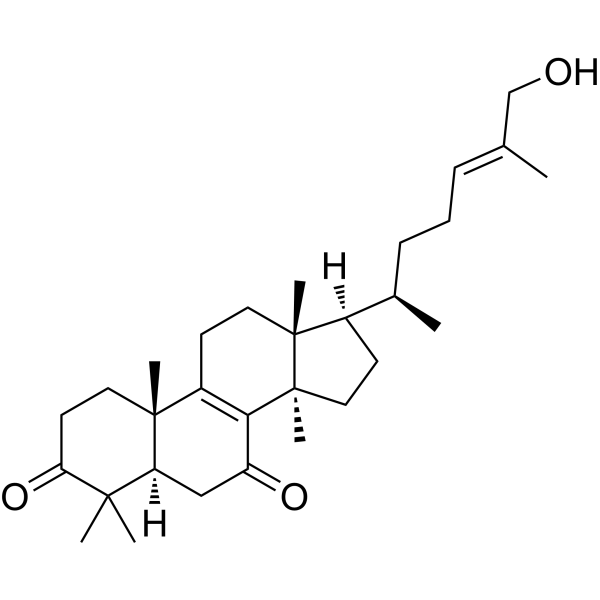 0 ImagesCat. No.: HY-111243CAS No.: 873061-79-1
-
Ganciclovir sodium (Standard)
 0 ImagesSynonyms: BW 759 sodium (Standard); 2'-Nor-2'-deoxyguanosine sodium (Standard)Ganciclovir (sodium) (Standard) is the analytical standard of Ganciclovir (sodium). This product is intended for research and analytical applications. Ganciclovir (BW 759) sodium, a nucleoside analogue, is an orally active antiviral agent with activity against CMV. Ganciclovir sodium also has activity in vitro against members of the herpes group and some other DNA viruses. Ganciclovir sodium inhibits the in vitro replication of human herpes viruses (HSV 1 and 2, CMV) and adenovirus serotypes 1, 2, 4, 6, 8, 10, 19, 22 and 28. Ganciclovir sodium has an IC50 of 5.2 μM for feline herpesvirus type-1 (FHV-1) and can diffuse into the brain[1][2][3].
-
Didemnin C
 0 ImagesCat. No.: HY-130564CAS No.: 77327-06-1Didemnin C is a cyclic depsipeptide. Didemnin C inhibits the proliferation of herpes simplex virus (HSV) and exhibits activity against both RNA viruses and DNA viruses. Didemnin C is cytotoxic to cancer cells. Didemnin C can be used in studies related to herpes simplex virus type 2 infection and cancer.
-
North-methanocarbathymidine
 0 ImagesCat. No.: HY-104083CAS No.: 156126-12-4Synonyms: N-MCTNorth-methanocarbathymidine (N-MCT) is a potent antiviral agent. North-methanocarbathymidine inhibits DNA synthesis. North-methanocarbathymidine demonstrates potent antiviral activity against HSV-1, HSV-2 and KSHV. North-methanocarbathymidine exhibits anticancer activity against colon adenocarcinoma expressing HSV-tk.
-
Imiquimod dihydrochloride
 0 ImagesCat. No.: HY-B0180CCAS No.: 2995277-02-4Synonyms: R 837 dihydrochloride
-
P-536
 0 ImagesCat. No.: HY-105111CAS No.: 93426-60-9P-536 is a ACE inhibitor that also inhibits herpes simplex virus HSV-1 thymidine kinase and Trypanosoma cruzi RNA polymerase. By inhibiting the renin-angiotensin system, downregulating the expression of AT1R and NOX4, and reducing oxidative stress (decreasing plasma hydrogen peroxide (H2O2) and 8-isoprostaglandin levels), P-536 effectively reduces systolic blood pressure and improves vascular reactivity. P-536 also inhibits the replication of DNA/RNA viruses such as HSV-1 by blocking nucleotide metabolism and nucleic acid synthesis, competitively inhibits RNA synthesis in Trypanosoma cruzi, and inhibits amastigote replication, thereby impeding its growth. P-536 is suitable for research on hypertension, insulin resistance, and Chagas disease.
-
Cytarabine-13C,15N2
 0 ImagesCat. No.: HY-13605S1Synonyms: Cytosine β-D-arabinofuranoside-13C,15N2; Cytosine arabinoside-13C,15N2; Ara-C-13C,15N2Cytarabine-13C,15N2 (Cytosine β-D-arabinofuranoside-13C,15N2) is the 13C- and 15N-labeled Cytarabine (HY-13605). Cytarabine, a nucleoside analog, causes S phase cell cycle arrest and inhibits DNA polymerase. Cytarabine inhibits DNA synthesis with an IC50 of 16 nM. Cytarabine has antiviral effects against HSV. Cytarabine shows anti-orthopoxvirus activity.
-
PAV-174
 0 ImagesCat. No.: HY-180881PAV-174 is a potent antiviral agent that targets a host protein. PAV-174 prevents Herpes simplex virus (HSV-1) infection in cells (IC50 of 0.02 μM in Vero cells) and human brain organoids. PAV-174 inhibits oxidized macrophage migration inhibitory factor (oxMIF)-induced tau phosphorylation in vitro and in vivo independent of infection. PAV-174 reduces HSV-1-induced tau phosphorylation via the Akt/GSK3β signaling pathway. PAV-174 can be used for Alzheimer’s disease research.
-
Oosporein (Standard)
 0 ImagesOosporein (Standard) is the analytical standard of Oosporein (HY-N7719). This product is intended for research and analytical applications. Oosporein is a microbial metabolite and a red crystalline toxin produced by various fungi. Oosporein can promote the reproduction of fungi in host bodies by inhibiting insect immunity, and possesses multiple activities such as antibacterial, antiviral (HSV), and insecticidal effects. Oosporein can inhibit plant growth. In addition, Oosporein can also induce apoptosis, cell membrane damage, oxidative stress, and mitochondrial damage. Oosporein has certain antitumor activity.
-
Mer-NF5003F
 0 ImagesCat. No.: HY-137985CAS No.: 149598-70-9Synonyms: Stachybotrydial; F 1839M; StachybotrydialMer-NF5003F (Stachybotrydial; F 1839M), a sesquiterpene isolated from Stachybotrys, inhibits avian medulloblastoma virus (AMV) protease (IC50=7.8 μM). Mer-NF5003F inhibits sialyltransferase 6N (ST6N), ST3O, and ST3N (IC50=0.61, 6.7, and 10 μg/mL, respectively), and fucosyltransferase (IC50=11.3 μg/mL). Mer-NF5003F has in vitro activity against herpes simplex virus HSV-1 (IC50=4.32 μg/mL) and multidrug-resistant Plasmodium falciparum K1 strain (IC50=0.85 μg/mL).



