



P-glycoprotein
P-gp; Pgp; Multidrug resistance protein 1; MDR1; ATP-binding cassette sub-family B member 1; ABCB1; Cluster of differentiation 243; CD243
P-glycoprotein (P-gp) also known as multidrug resistance protein 1 (MDR1) is an important protein of the cell membrane that pumps many foreign substances out of cells. More formally, it is an ATP-dependent efflux pump with broad substrate specificity. P-gp is extensively distributed and expressed in the intestinal epithelium where it pumps xenobiotics (such as toxins or drugs) back into the intestinal lumen, in liver cells where it pumps them into bile ducts, in the cells of the proximal tubular of the kidney where it pumps them into urine-conducting ducts, and in the capillary endothelial cells comprising the blood–brain barrier and blood-testis barrier, where it pumps them back into the capillaries. Some cancer cells also express large amounts of P-gp, which renders these cancers multi-drug resistant. P-gp is an ATP-dependent drug efflux pump for xenobiotic compounds with broad substrate specificity. It is responsible for decreased drug accumulation in multidrug-resistant cells and often mediates the development of resistance to anticancer drugs. This protein also functions as a transporter in the blood–brain barrier.
All Product Categories
-
P-glycoprotein Inhibitors
(279)
View all products
-
P-glycoprotein Agonists
(2)
View all products
-
P-glycoprotein Antagonist
(1)
View all products
-
P-glycoprotein Activators
(4)
View all products
-
P-glycoprotein Modulators
(24)
View all products
-
P-glycoprotein Inducer
(1)
View all products
-
P-glycoprotein Controls
(3)
View all products
-
P-glycoprotein Substrates
(22)
View all products
-
P-glycoprotein Ligands
(2)
View all products
-
P-glycoprotein Related Products (379)
Related Products (379)

-
Antibodies (3)
-
Hypophyllanthin (Standard)
 0 ImagesCat. No.: HY-N4108RCAS No.: 33676-00-5Hypophyllanthin (Standard) is the analytical standard of Hypophyllanthin. This product is intended for research and analytical applications. Hypophyllanthin is a major lignan in Phyllanthus spp, with strong anti-inflammatory activity. Hypophyllanthin directly inhibits P-glycoprotein (P-gp) activity and did not interfere with multidrug resistance protein 2 (MRP2) activity.
-
(Rac)-Verapamil-d7 (hydrochloride)
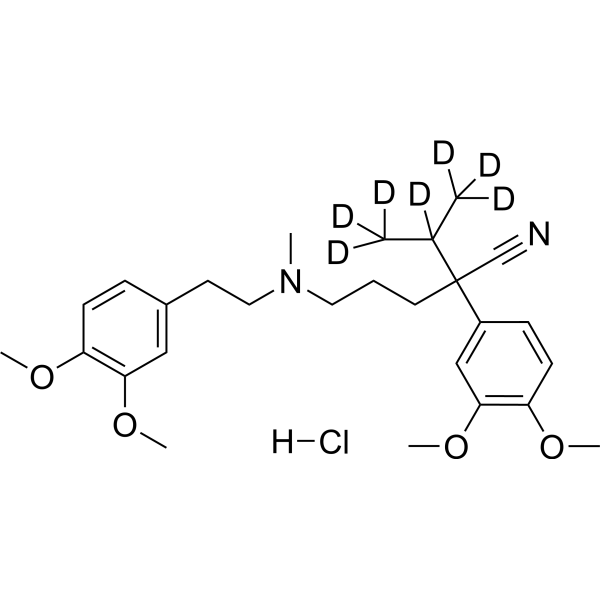 0 Images(Rac)-Verapamil-d7 (hydrochloride) is the deuterium labeled (Rac)-Verapamil.
-
P-gp inhibitor 27
 0 ImagesCat. No.: HY-168711P-gp inhibitor 27 (Compound D2) is an inhibitor for P-glycoprotein (P-gp), that downregulates the expression of P-gp and MRP1, increases the Rh123 accumulation in A2780/T cell, and reverses multidrug resistance to Paclitaxel (HY-B0015) (EC50 is 88 nM) and Cisplatin (HY-17394).
-
Quinidine gluconic acid
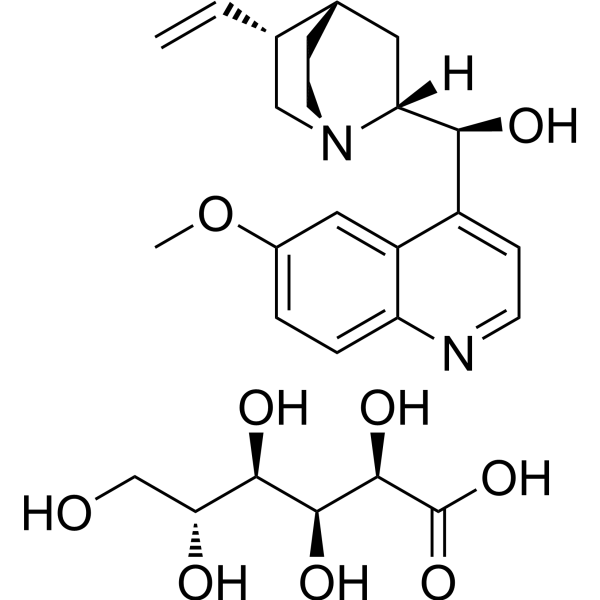 0 ImagesQuinidine gluconic acid is an orally active antiarrhythmic agent. Quinidine gluconic acid reduces the expression level of P-gp, inhibits P-gp-mediated efflux, increases the intracellular accumulation of P-gp substrates, induces PARP cleavage and Caspase-3 activation, and elevates the proportion of Apoptotic cells at the sub-G1 phase. Quinidine gluconic acid exerts sustained block and open-channel block effects on IK(f). Quinidine gluconic acid alters the urinary metabolic ratio of Amphetamine, modulates the Pentylenetetrazol-induced seizure threshold, and regulates the anticonvulsant effect of Dextromethorphan. Quinidine gluconic acid can be used in studies related to uterine sarcoma and seizures.
-
C3N-Dbn-Trp2
 0 ImagesCat. No.: HY-162714CAS No.: 2631659-57-7C3N-Dbn-Trp2 is an inhibitor for ATP-binding cassette transporter ABCB1. C3N-Dbn-Trp2 inhibits the ABCB1-mediated Rhodamine 123 (HY-D0816) efflux in cells HEK293T and HCT-15 with IC50 of 5.9 µM and 2.2 µM. C3N-Dbn-Trp2 inhibits the Doxorubicin (HY-15142A) efflux, enhances the cytotoxicity of Doxorubicin in ABCB1-expressing cells.
-
Levomilnacipran
 0 ImagesCat. No.: HY-14794ACAS No.: 96847-54-0Synonyms: (1S,2R)-Milnacipran; F2695Levomilnacipran ((1S,2R)-Milnacipran) is the enantiomer of Milnacipran (HY-B0168) and a strong substrate of P-gp that can cross the blood-brain barrier. Levomilnacipran is a serotonin and norepinephrine reuptake inhibitor, with IC50 values of 10.5 nM and 19.0 nM, and Ki values of 92.2 nM and 1.2 nM for human norepinephrine transporter (NET) and serotonin transporter (SERT), respectively. Levomilnacipran has antidepressant and anxiolytic activities. Levomilnacipran hydrochloride can be used for the research of depression.
-
P-gp inhibitor 17
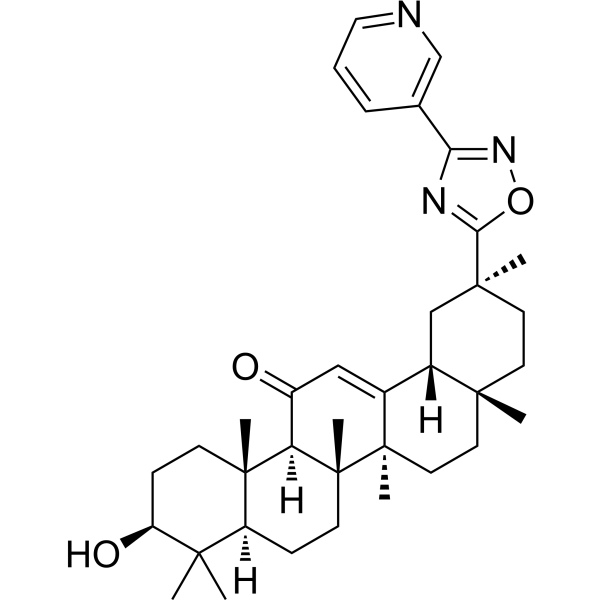 0 ImagesCat. No.: HY-162040CAS No.: 2556388-58-8P-gp inhibitor 17 (compound 2g) is a P-gp inhibitor directly interacted with the transmembrane domain of P-gp. P-gp inhibitor 17 can be used for P-gp-mediated multidrug-resistant in tumor cells study.
-
P-gp/CDK2-IN-1
 0 ImagesCat. No.: HY-161776P-gp/CDK2-IN-1 (Compound 4j) is an inhibitor for is inhibitor for P-glycoprotein (P-gp) and for cyclin-dependent kinase-2 (CDK2). P-gp/CDK2-IN-1 inhibits the proliferation of cancer cells SW-480 and MCF-7 wit IC50 of 38.6 μM and 26.6 μM. P-gp/CDK2-IN-1 exhibits antioxidant efficacy with EC50 of 580 μM in DPPH experiment.
-
P-gp inhibitor 13
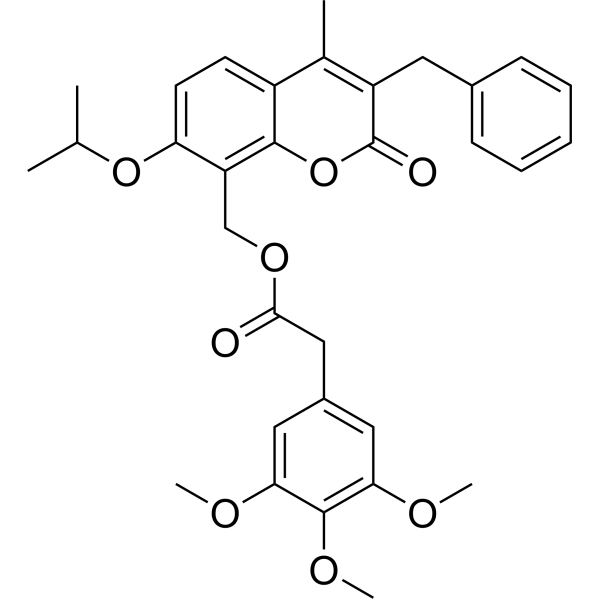 0 ImagesCat. No.: HY-149981CAS No.: 3041121-57-4P-gp inhibitor 13 is a P-gp inhibitor. P-gp inhibitor 13 can reverse P-glycoprotein-mediated paclitaxel resistance in A2780/T cell. P-gp inhibitor 13 can be used for the research of advanced acute myeloid leukemia.

-
PGP/FSP1-IN-1
 0 ImagesCat. No.: HY-184489CAS No.: 328265-32-3PGP/FSP1-IN-1 is a dual PGP and FSP1 inhibitor and ferroptosis inducer that inhibits the oxidoreductase activity of FSP1. PGP/FSP1-IN-1 competes with NAD (P) H for binding to the pocket of FSP1 and induces FSP1 self-assembly, thereby directly blocking the catalytic function of the relevant enzyme. PGP/FSP1-IN-1 promotes lipid peroxidation and significantly enhances cellular sensitivity to ferroptosis when GPX4 activity is impaired or glutathione synthesis is inhibited. PGP/FSP1-IN-1 can be used in cancer research.
-
DHW-221
 0 ImagesCat. No.: HY-130133CAS No.: 2378831-21-9DHW-221 is a potent orally active dual PI3K/mTOR inhibitor, exhibiting low nanomolar potency against all four Class I PI3K isoforms and mTOR (PI3Kα, IC50 = 0.50 nM; PI3Kβ, IC50 = 1.9 nM; PI3Kγ, IC50 = 1.8 nM; PI3Kδ, IC50 = 0.74 nM; mTOR, IC50 = 3.9 nM). DHW-221 exerts antitumor effects by blocking the PI3K/Akt/mTOR pathway and inducing mitochondrial apoptosis and paraptosis (via Endoplasmic Reticulum (ER) stress and MAPK signaling) and arrests cell cycle, thereby inhibiting cell migration, invasion and angiogenesis. DHW-221 inhibits tumor growth in both the A549/Taxol (HY-B0015) and the HCC827 xenograft mouse models. DHW-221 can be used for non-small cell lung cancer (NSCLC), colon and breast cancer research.
-
(R)-OY-101
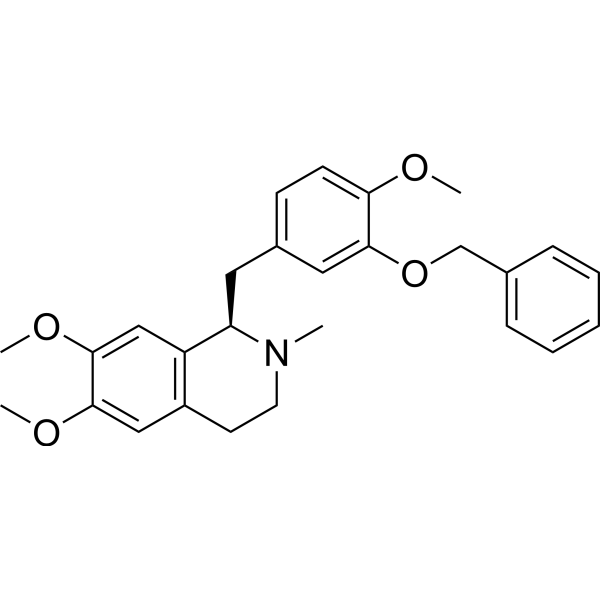 0 ImagesCat. No.: HY-149053BCAS No.: 23495-82-1(R)-OY-101 is an orally active and specific inhibitor of P-gp. (R)-OY-101 increases tumor sensitivity to anticancer agents. (R)-OY-101 has good activity in reversing tumor resistance and promoting apoptosis and can be used in cancer related research.

-
Antitumor agent-200
 0 ImagesCat. No.: HY-173182CAS No.: 3046118-64-0Antitumor agent-200 (Compound 2g) is a microtubule synthesis inhibitor. By binding to the colchicine site of tubulin, it causes G2/M cell cycle arrest and generates reactive oxygen species (ROS). Antitumor agent-200 exhibits significant inhibitory activity against MCF7/ADR and KBV200 cell lines with overexpression of P-glycoprotein (P-gp), with drug resistance indices (DRI) of 0.83 and 0.58 respectively. In the MCF-7 xenograft model, Antitumor agent-200 (25 mg/kg, intraperitoneal injection) can achieve a tumor growth inhibition rate of 57.2%. Antitumor agent-200 can be used in the research of the anti-cancer field.
-
Solamargine (Standard)
 0 ImagesCat. No.: HY-N0069RCAS No.: 20311-51-7Synonyms: Solamargin (Standard); δ-Solanigrine (Standard)Solamargine (Standard) is the analytical standard of Solamargine. This product is intended for research and analytical applications. Solamargine, a derivative from the steroidal solasodine in Solanum species, exhibits anticancer activities in numerous types of cancer. Solamargine induces non-selective cytotoxicity and P-glycoprotein inhibition. Solamargine significantly inhibits migration and invasion of HepG2 cells by down-regulating MMP-2 and MMP-9 expression and activity.
-
Antibacterial agent 356
 0 ImagesCat. No.: HY-184587Antibacterial agent 356 is an orally active antibacterial agent. Antibacterial agent 356 binds to the Mrr1 transcription factor, inhibits the expression of the MDR1 efflux pump gene, reduces the efflux of Rhodamine 123, and increases the accumulation of intracellular substrates in drug-resistant Candida albicans cells. Antibacterial agent 356 induces mitochondrial membrane potential reduction and ROS accumulation in Candida albicans, inhibits the yeast-hypha transition process, and suppresses its biofilm formation. Antibacterial agent 356 reverses efflux pump-mediated drug resistance in azole-resistant Candida albicans with overexpressed Mdr1. Antibacterial agent 356 improves the survival rate of Galleria mellonella larvae infected with azole-resistant Candida albicans*CA632, and reduces the renal fungal load and renal tissue damage in infected BALB/c mice. Antibacterial agent 356 can be used for the research of Candida albicans infection.
-
NSC 23925B
 0 ImagesCat. No.: HY-117593CAS No.: 1369591-04-7NSC 23925B is a P-glycoprotein (P-gp) inhibitor, as well as the most biologically active isomer of NSC23925 (HY-19626), which reverses and prevents P-glycoprotein-mediated multidrug resistance in cancer cells. NSC 23925B shows weak inhibition against most CYP450 enzymes (IC50 > 10 μM), and exhibits moderate inhibitory activity against CYP2B6 and CYP2D6 with IC50 values of 8.589 μM and 1.407 μM, respectively. NSC 23925B can be used for the research of multidrug-resistant cancers.
-
Doxorubamine
 0 ImagesCat. No.: HY-180935CAS No.: 760899-08-9Doxorubamine is a Doxorubicin (HY-15142A) derivative. Doxorubamine is a poor substrate of P-glycoprotein. Doxorubamine efficiently kills agent-sensitive ovarian cancer.
-
ARN25657
 0 ImagesCat. No.: HY-176287ARN25657 is a dual-acting D3R/GSK-3β modulator. ARN25657 has both partial D3R agonist activity (EC50 = 15.2 nM, Ki =1.5 nM) and potent GSK-3β inhibitor activity (IC50 = 19.3 nM). ARN25657 exhibits excellent GSK-3β selectivity over FYN, PKA, and CDK5/p35. ARN25657 inhibits P-glycoprotein (P-gP)-mediated acetoxymethyl calcein efflux and improves in vitro ADME properties while maintaining a balanced dual-target profile. ARN25657 is useful for studying bipolar disorder and related neuropsychiatric disorders.




