



Quinidine gluconic acid
Based on 24 publication(s) in Google Scholar
Quinidine gluconic acid is an orally active antiarrhythmic agent. Quinidine gluconic acid reduces the expression level of P-gp, inhibits P-gp-mediated efflux, increases the intracellular accumulation of P-gp substrates, induces PARP cleavage and Caspase-3 activation, and elevates the proportion of Apoptotic cells at the sub-G1 phase. Quinidine gluconic acid exerts sustained block and open-channel block effects on IK(f). Quinidine gluconic acid alters the urinary metabolic ratio of Amphetamine, modulates the Pentylenetetrazol-induced seizure threshold, and regulates the anticonvulsant effect of Dextromethorphan. Quinidine gluconic acid can be used in studies related to uterine sarcoma and seizures.
For research use only. We do not sell to patients.
- CAS No.: 7054-25-3
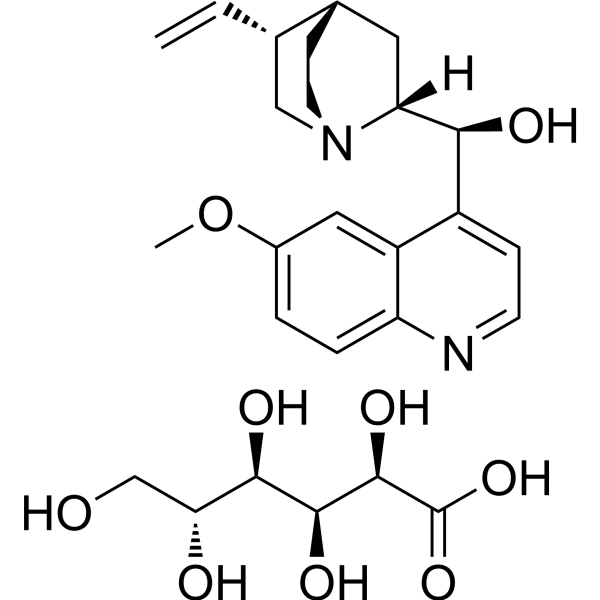
- Formula: C26H36N2O9
- Molecular Weight:520.57
-
Storage:
Please store the product under the recommended conditions in the Certificate of Analysis.

To place orders, for customer services and technical support, please contact: MedChemExpress USA
Tel: 609-228-6898 E-mail: [email protected] [email protected]


-
 Biological Activity
-
Chemical Information
- Protocols
- Purity & Documentation
- References
-
 Help & FAQs


Publications Citing Use of MedChemExpress (MCE) Quinidine gluconic acid
More- Nat Commun. 2024 Jun 19;15(1):5230. [Abstract]
- Adv Sci (Weinh). 2025 Aug 19:e05666. [Abstract]
- J Hazard Mater. 2021 Aug 15:416:125764. [Abstract]
- Environ Int. 2019 Jun:127:694-703. [Abstract]
- Anal Chem. 2025 Nov 18;97(45):25158-25167. [Abstract]
- J Med Chem. 2021 Mar 11;64(5):2725-2738. [Abstract]
- J Med Chem. 2020 Oct 8;63(19):11085-11099. [Abstract]
- Environ Pollut. 2024 Aug 15:355:124214. [Abstract]
- Pharmaceutics. 2025 Mar 26;17(4):423. [Abstract]
- J Agric Food Chem. 2022 Mar 2;70(8):2520-2528. [Abstract]
- Cell Mol Life Sci. 2025 Nov 25;82(1):419. [Abstract]
- RSC Adv. 2019 May 23;9(28):16136-16146. [Abstract]
- Front Pharmacol. 2020 Jul 31:11:1038. [Abstract]
- Cell Calcium. 2026 Mar:134:103125. [Abstract]
- Virol J. 2024 Aug 8;21(1):181. [Abstract]
- J Anim Sci. 2022 Apr 1;100(4):skac069. [Abstract]
- Andrology. 2025 Oct;13(7):1805-1815. [Abstract]
- AAPS J. 2021 Jun 28;23(4):91. [Abstract]
- Food Chem Toxicol. 2022 Nov:169:113431. [Abstract]
- Vet Microbiol. 2026 May:316:110992. [Abstract]
- Pharmacol Res Perspect. 2021 Oct;9(5):e00879. [Abstract]
- Pharmacol Res Perspect. 2020 Apr;8(2):e00575. [Abstract]
- Eur J Drug Metab Pharmacokinet. 2022 Sep;47(5):639-652. [Abstract]
- Chemosphere. 2021 Dec:284:131347. [Abstract]
 Customer Validation & Images

-
Flow Cytometry
-
Bio/Physico-chemical Assay
-
WB
-
RT-PCR
-
Bio/Physico-chemical Assay
All Caspase Isoforms
More

Biological Activity
Description
IC50 & Target
|
Caspase 3 |
In Vitro
Quinidine (10 μM; 24 h) gluconic acid potentiates Paclitaxel (HY-B0015)-induced cytotoxicity in P-gp-positive MES-SA/DX5 uterine sarcoma cells (reducing paclitaxel IC50 to 80.56 nM) but does not alter paclitaxel cytotoxicity in P-gp-negative MES-SA uterine sarcoma cells[1].
Quinidine (10 μM; 24 h) gluconic acid significantly increases the sub-G1 apoptotic portion in paclitaxel-treated P-gp-positive MES-SA/DX5 uterine sarcoma cells, enhancing paclitaxel-induced apoptosis[1].
Quinidine inhibits the in vitro metabolism of Debrisoquine in rat liver microsomes, with lower potency than observed in human liver microsomes[3].
MedChemExpress (MCE) has not independently confirmed the accuracy of these methods. They are for reference only.
-
Cell Line:P-gp-negative MES-SA uterine sarcoma cells, P-gp-positive MES-SA/DX5 uterine sarcoma cells
-
Concentration:10 μM
-
Incubation Time:24 h
-
Result:Did not significantly alter the cytotoxicity of paclitaxel in MES-SA cells, with paclitaxel IC50 remaining comparable to paclitaxel alone (19 nM vs. 18 nM).
Strongly potentiated paclitaxel-induced cytotoxicity in MES-SA/DX5 cells, reducing the IC50 of paclitaxel from 13851 nM to 81 nM.
Showed no significant cytotoxicity up to 100 μM in either cell line.\nShowed concentration-dependent cytotoxicity with docetaxel against MES-SA cells.
Enhanced docetaxel-induced cytotoxicity in MES-SA/DX5 cells more potently than hydrocinchonine, alongside cinchonine.
Showed no significant cytotoxicity up to 100 μM in either cell line.
-
Cell Line:P-gp-positive MES-SA/DX5 uterine sarcoma cells (paclitaxel-treated)
-
Concentration:10 μM
-
Incubation Time:24 h
-
Result:Significantly increased the sub-G1 apoptotic portion (G0 = 27.19) in paclitaxel-treated MES-SA/DX5 cells, whereas paclitaxel alone induced minimal sub-G1 accumulation (G0 = 0.05).
In Vivo
Quinidine (10-30 mg/kg; intraperitoneal injection; single administration) gluconic acid significantly elevates the threshold of pentylenetetrazol-induced tonic convulsions in male NMRI mice[4].
MedChemExpress (MCE) has not independently confirmed the accuracy of these methods. They are for reference only.
-
Animal Model:Lewis (male, 175-225 g)[3]
-
Dosage:80 mg/kg
-
Administration:p.o.; single dose
-
Result:Reduced urinary excretion of p-hydroxyamphetamine to 7.2% of vehicle-control levels in the 0-24 h collection period.
Reduced urinary excretion of p-hydroxyamphetamine to 24.1% of vehicle-control levels in the 24-48 h collection period.
Increased amphetamine excretion to 542% of control levels in the 24-48 h period.
Excreted an average of 0.40 μmol p-hydroxyamphetamine and 7.80 μmol amphetamine in the 0-24 h period.
Excreted an average of 3.60 μmol amphetamine and a significantly reduced amount of p-hydroxyamphetamine relative to controls in the 24-48 h period.
Achieved total combined excretion of amphetamine and p-hydroxyamphetamine over 48 h equal to 79.7% of the administered dose, which was not significantly different from control groups.
-
Animal Model:NMRI (male, 5-6 weeks old, 25-30 g)[4]
-
Dosage:10 mg/kg; 20 mg/kg; 30 mg/kg
-
Administration:i.p.; single dose
-
Result:Did not alter the pentylenetetrazole threshold dose for onset of myoclonic twitch.
Significantly increased the pentylenetetrazole threshold dose for onset of tonic hind limb extension compared to saline-treated controls (p < 0.05).


Chemical Information
-
CAS No. 7054-25-3
-
Molecular Weight 520.57
-
Formula C26H36N2O9
-
SMILES
C=C[C@H]1C[N@](CC[C@H]1C2)[C@@]2([H])[C@@H](O)C3=CC=NC4=CC=C(OC)C=C34.OC[C@@H](O)[C@@H](O)[C@H](O)[C@@H](O)C(O)=O
-
Shipping
Room temperature in continental US; may vary elsewhere.
-
Storage
Please store the product under the recommended conditions in the Certificate of Analysis.


Publications (24)
-
Journal Impact Factor
-
Most Recent
-
Nat Commun
Small molecule in situ resin capture provides a compound first approach to natural product discovery. [Abstract]2024 Jun 19;15(1):5230. PMID: 38898025 -
Adv Sci (Weinh)
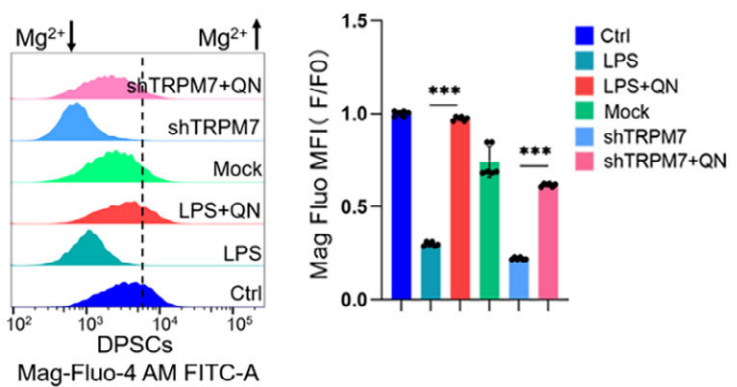
LPS-Induced Mitochondrial Damage via SLC41A1-Mediated Magnesium Ion Efflux Leads to the Pyroptosis of Dental Stem Cells. [Abstract]2025 Aug 19:e05666. PMID: 40831212
Quinidine gluconic acid purchased from MedChemExpress. Usage Cited in: Adv Sci (Weinh). 2025 Aug 19:e05666. [Abstract]
Quinidine rescued [Mg2⁺]i levels in LPS‐treated or TRPM7‐silenced DPSCs and SCAP.
-
J Hazard Mater
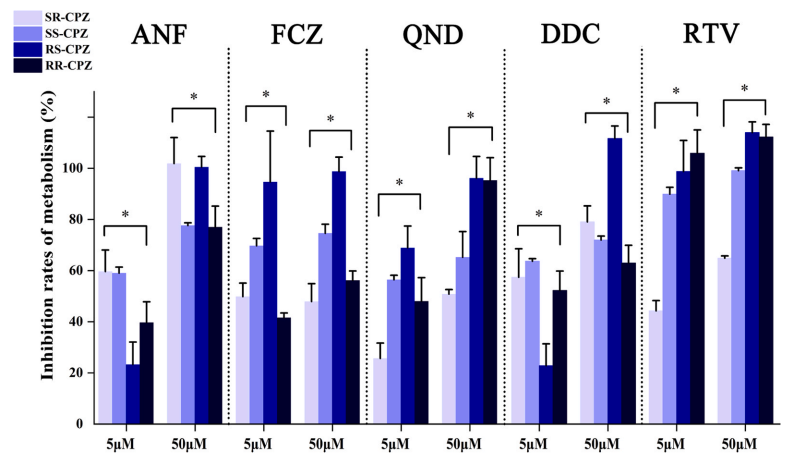
Stereostructure-activity mechanism of cyproconazole by cytochrome P450 in rat liver microsomes: A combined experimental and computational study. [Abstract]2021 Aug 15:416:125764. PMID: 33827004
Quinidine gluconic acid purchased from MedChemExpress. Usage Cited in: J Hazard Mater. 2021 Aug 15:416:125764. [Abstract]
Effects of CYP enzymes inhibitors on metabolic rates of cyproconazole stereoisomers in the in vitro incubation mixtures with RLMs. The asterisks (*) indicates the significant difference in metabolic rates under inhibition compared to the control.
-
Environ Int
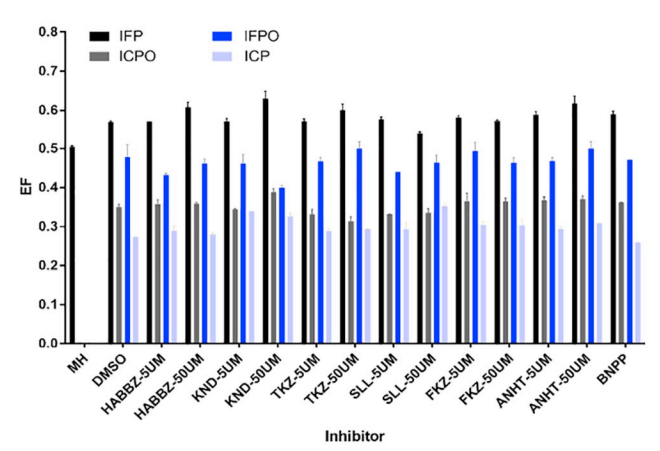
2019 Jun:127:694-703. PMID: 30991225
Quinidine gluconic acid purchased from MedChemExpress. Usage Cited in: Environ Int. 2019 Jun:127:694-703. [Abstract]
CYP2D6 has contributed in the enantioselectivity of IFP and ICPO because the EF value of the KND-supplemented group follows a doseeffect relationship and the difference in the EF values was over 10% relative to the DMSO control group.
-
Anal Chem
A Computational Integration Strategy Driven by Chemical Similarity Uncovers Comprehensive Metabolic Profiles of Small Bioactive Peptides via UHPLC-HRMS for Doping Control. [Abstract]2025 Nov 18;97(45):25158-25167. PMID: 41202118 -
J Med Chem
Development of an In Silico Prediction Model for P-glycoprotein Efflux Potential in Brain Capillary Endothelial Cells toward the Prediction of Brain Penetration. [Abstract]2021 Mar 11;64(5):2725-2738. PMID: 33619967 -
J Med Chem
Screening and Reverse-Engineering of Estrogen Receptor Ligands as Potent Pan-Filovirus Inhibitors. [Abstract]2020 Oct 8;63(19):11085-11099. PMID: 32886512 -
Environ Pollut
Assessing environmental and human health risks: Insight from the enantioselective metabolism and degradation of fenpropidin. [Abstract]2024 Aug 15:355:124214. PMID: 38801883 -
Pharmaceutics
Plasma Protein Binding, Biostability, Metabolite Profiling, and CYP450 Phenotype of TPB15 Across Different Species: A Novel Smoothened Inhibitor for TNBC Therapy. [Abstract]2025 Mar 26;17(4):423. PMID: 40284418 -
J Agric Food Chem
Enantioselective Metabolic Mechanism and Metabolism Pathway of Pydiflumetofen in Rat Liver Microsomes: In Vitro and In Silico Study. [Abstract]2022 Mar 2;70(8):2520-2528. PMID: 35184556 -
Cell Mol Life Sci
2025 Nov 25;82(1):419. PMID: 41288707 -
RSC Adv
Identification of key transporters mediating uptake of aconitum alkaloids into the liver and kidneys and the potential mechanism of detoxification by active ingredients of liquorice. [Abstract]2019 May 23;9(28):16136-16146. PMID: 35521419 -
Front Pharmacol
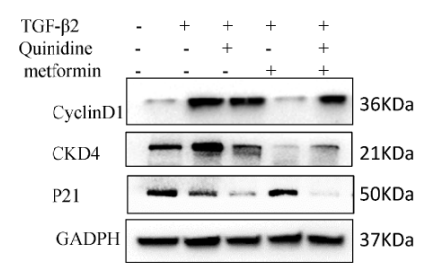
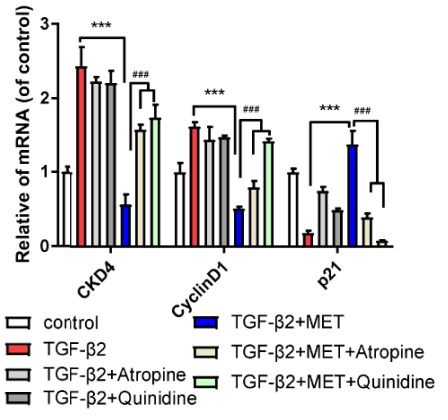
Eye Drops of Metformin Prevents Fibrosis After Glaucoma Filtration Surgery in Rats via Activating AMPK/Nrf2 Signaling Pathway. [Abstract]2020 Jul 31:11:1038. PMID: 32903813
Quinidine gluconic acid purchased from MedChemExpress. Usage Cited in: Front Pharmacol. 2020 Jul 31:11:1038. [Abstract]
Cell cycle relative proteins/genes (CyclinD1, CDK4, P21 and P27) level were assessed in HConFs after Quinidine treatment by western blot.
Quinidine gluconic acid purchased from MedChemExpress. Usage Cited in: Front Pharmacol. 2020 Jul 31:11:1038. [Abstract]
Cell cycle relative proteins/genes (CyclinD1, CDK4, P21 and P27) level were assessed in HConFs after Atropine/Quinidine treatment by qRT-PCR.
-
Cell Calcium
MONNA alleviates MPTP-induced Parkinson's disease in zebrafish by activating TFEB dependently on ER Calcium. [Abstract]2026 Mar:134:103125. PMID: 41637953 -
Virol J
2024 Aug 8;21(1):181. PMID: 39118175 -
J Anim Sci
2022 Apr 1;100(4):skac069. PMID: 35247050 -
Andrology
Pharmacological inhibition of KSper impairs flagellar pH homeostasis of human spermatozoa. [Abstract]2025 Oct;13(7):1805-1815. PMID: 39498893 -
AAPS J
Cannabinoid Interactions with Cytochrome P450 Drug Metabolism: a Full-Spectrum Characterization. [Abstract]2021 Jun 28;23(4):91. PMID: 34181150 -
Food Chem Toxicol
The "steric-like" inhibitory effect and mechanism of doxycycline on florfenicol metabolism: Interaction risk. [Abstract]2022 Nov:169:113431. PMID: 36116547 -
Vet Microbiol
The Chinese medicine monomer Schisandrin C inhibits PRRSV infection by regulating the OGT-PI3K/AKT/mTOR signaling pathway. [Abstract]2026 May:316:110992. PMID: 41865607 -
Pharmacol Res Perspect
Effects of membrane transport activity and cell metabolism on the unbound drug concentrations in the skeletal muscle and liver of drugs: A microdialysis study in rats. [Abstract]2021 Oct;9(5):e00879. PMID: 34628723 -
Pharmacol Res Perspect
Applicability of free drug hypothesis to drugs with good membrane permeability that are not efflux transporter substrates: A microdialysis study in rats. [Abstract]2020 Apr;8(2):e00575. PMID: 32266794 -
Eur J Drug Metab Pharmacokinet
Evaluation of an Ussing Chamber System Equipped with Rat Intestinal Tissues to Predict Intestinal Absorption and Metabolism in Humans. [Abstract]2022 Sep;47(5):639-652. PMID: 35733077 -
Chemosphere
A proposed "steric-like effect" for the slowdown of enrofloxacin antibiotic metabolism by ciprofloxacin, and its mechanism. [Abstract]2021 Dec:284:131347. PMID: 34323809


Purity & Documentation
References
[1]. Lee SY, et al. Hydrocinchonine, cinchonine, and quinidine potentiate paclitaxel-induced cytotoxicity and apoptosis via multidrug resistance reversal in MES-SA/DX5 uterine sarcoma cells. Environ Toxicol. 2011 Aug;26(4):424-31. [Content Brief]
[2]. Kehl SJ, et al. Quinidine-induced inhibition of the fast transient outward K+ current in rat melanotrophs. Br J Pharmacol. 1991;103(3):1807-1813. [Content Brief]
[3]. Moody DE, et al. Quinidine inhibits in vivo metabolism of amphetamine in rats: impact upon correlation between GC/MS and immunoassay findings in rat urine. J Anal Toxicol. 1990;14(5):311-317. [Content Brief]
[4]. Jamali H, et al. Effect of dextromethorphan/quinidine on pentylenetetrazole- induced clonic and tonic seizure thresholds in mice. Neurosci Lett. 2020;729:134988. [Content Brief]

Calculators
Concentration (start) × Volume (start) = Concentration (final) × Volume (final)


Quinidine gluconic acid Related Classifications
HY-B1751F Related Classifications
 Powered by Bioz