



Antibiotic
Antibiotics are a class of secondary metabolites produced from microorganisms, animals or plants. Some of them exhibit anti-bacterial, anti-fungal, anthelmintic, anti-tumor or immunosuppressive activities with a wealth of structural classes such as β-lactams, macrolide and polyether. As major sources of antibiotics, streptomycetes, penicillium and marine organisms produce a wide variety of commercially important polyketide compounds including the well-known macrolide, polyene and polyether antibiotics with wide range of activities. Antibiotics such as penicillin, cephalosporin, streptomycin, and tetracycline can be used in the treatment of human and veterinary diseases. However, antibiotic resistance is also a growing threat to global public health.
Antibiotic Isoform Specific Products
-
Antibiotic
(2773)
View all products
-
Aminoglycoside
(46)
View all products
-
Glycopeptide
(20)
View all products
-
Lipopeptide
(7)
View all products
-
Macrolide
(76)
View all products
-
Oxazolidinone
(16)
View all products
-
Quinolone
(101)
View all products
-
Tetracycline
(42)
View all products
-
β-lactam
(200)
View all products
All Product Categories
-
Antibiotic Related Products (3536)
Related Products (3536)

-
Related Compound Screening Libraries (1)
-
Antibiotic Isoform Comparison
-
L-threo-β-Hydroxyaspartic acid
 0 ImagesCat. No.: HY-W441968CAS No.: 7298-98-8L-threo-β-Hydroxyaspartic acid is an amino acid antibiotic. L-threo-β-Hydroxyaspartic acid has the activity of inhibiting Bacillus subtilis, Xanthomonas oryzae, Mycobacterium phlei and Botrytis cinerea.
-
Argimicin A
 0 ImagesCat. No.: HY-N5167CAS No.: 321846-46-2Argimicin A is an antibiotic that can be isolated from Sphingomonas sp.. Argimicin A exhibits algicidal activity against toxic cyanobacteria, inhibits M. viridis and M. aeruginosa with IC50s of 12 ng/mL and 100 ng/mL.
-
Amythiamicin B
 0 ImagesCat. No.: HY-125419CAS No.: 156620-48-3Amythiamicin B is a trisubstituted pyridine thiopeptide with antibiotic properties against Gram-positive bacteria and activity against Plasmodium falciparum.
-
Olivanic acid
 0 ImagesCat. No.: HY-N14919CAS No.: 64761-66-6Olivanic acid is a β -lactam antibiotic. Olivanic acid has the effect of anti -Gram-positive bacteria and anti-Gram-negative bacteria. Olivanic acid inhibits β-lactamase.
-
Sitafloxacin-d4
 0 ImagesCat. No.: HY-B0395SSynonyms: DU6859a-d4Sitafloxacin-d4 (DU6859a-d4) is deuterium labeled Sitafloxacin. Sitafloxacin (DU6859a) is a potent, orally active fluoroquinolone antibiotic. Sitafloxacin shows antichlamydial activity and antibacterial activities against a broad range of gram-positive and gram-negative bacteria, including anaerobic bacteria, as well as against atypical pathogens. Sitafloxacin can be used for the research of respiratory tract infection and urinary tract infection.
-
Macquarimicin C
 0 ImagesCat. No.: HY-N14836CAS No.: 165561-12-6Macquarimicin C is an antibiotic.
-
Obafluorin
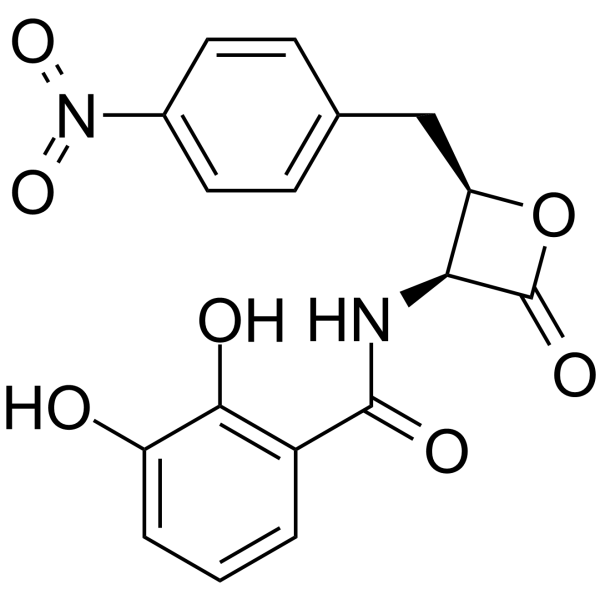 0 ImagesObafluorin is a β-lactone antibiotic. Obafluorin inhibits threonyl-tRNA synthetase (PfThrRS) with an IC50 of 4.3 nM. Obafluorin inhibits the aminoacylation activity of EcThrRS and ObaO. Obafluorin exhibits Fe3+-enhanced antibacterial activity. Obafluorin can be used in studies related to infections caused by bacterial and parasites such as Plasmodium.
-
Polymyxin B2 Sulfate
 0 ImagesCat. No.: HY-A0248CCAS No.: 108965-69-1Polymyxin B2 Sulfate is a polypeptide antibiotic with particularly potent antibacterial activity against Gram-negative bacteria. Polymyxin B2 Sulfate kills bacteria by binding to lipopolysaccharide molecules on the bacterial cell membrane, disrupting membrane integrity and causing leakage of intracellular contents. Polymyxin B2 Sulfate is used in studies related to Pseudomonas aeruginosa infection and acute enteritis.
-
Leucinostatin H
 0 ImagesCat. No.: HY-137323CAS No.: 109539-58-4Leucinostatin H is a polypeptide antibiotic discovered in Paecilomyces marquandii, characterized by a tertiary amine-oxide terminal group. Leucinostatin H exhibits inhibitory activity against Gram-positive bacteria, such as Bacillus subtilis, B. cereus, and Staphylococcus aureus (MIC 10-100 μg/mL). Leucinostatin H holds potential for research in anti-infective and plant disease control applications.
-
8"-Hydroxypactamycin
 0 ImagesCat. No.: HY-N14397CAS No.: 104820-97-58''-Hydroxypactamycin is an antibiotic found in Streptomyces SIPI-A-3-0121.
-
Nimorazole (Standard)
 0 ImagesNimorazole (Standard) is the analytical standard of Nimorazole. This product is intended for research and analytical applications. Nimorazole (K-1900), a 2-nitroimidazole, is a hypoxic cell-radiation sensitizer. Nimorazole has anti-infective and anti-protozoal against trichomoniasis. Nimorazole has the potential for head and neck cancer.
-
Mycinamicin Ⅳ
 0 ImagesCat. No.: HY-N14503CAS No.: 73684-71-6Monamycin IV is an ester peptide antibiotic. Monamycin IV has activity against Gram-positive bacteria.
-
Clavamycin E
 0 ImagesCat. No.: HY-N14003CAS No.: 103059-96-7Clavamycin E is a clavam antibiotic.
-
Rifabutin-d6
 0 ImagesCat. No.: HY-17025S1Synonyms: Ansamycin-d6; LM-427-d6Rifabutin-d6 (Ansamycin-d6) is deuterium labeled Rifabutin. Rifabutin (Ansamycin) is a semisynthetic ansamycin antibiotic with potent antimycobacterial properties. Rifabutin inhibits DNA-dependent RNA polymerase.
-
Urdamycin B
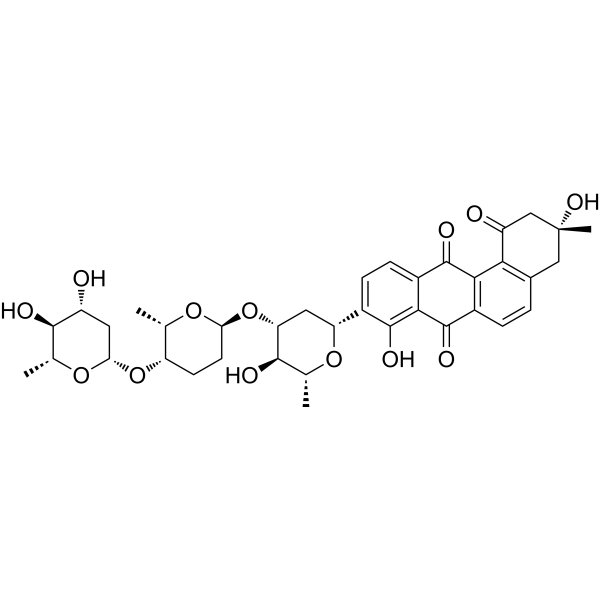 0 ImagesCat. No.: HY-N8519CAS No.: 104542-46-3Urdamycin B is an antibiotic that effectively inhibits fungi and bacteria. Urdamycin B also exhibits anti-proliferative activity against mouse leukemia cells L1210. Urdamycin B can be obtained from the metabolic products of Streptomyces fradiae. Urdamycin B can be used for research on cancer as well as bacterial and fungal infections.
-
Niclosamide-d3
 0 ImagesCat. No.: HY-B0497S2CAS No.: 2665663-60-3Synonyms: BAY2353-d3Niclosamide-d3 (BAY2353-d3) is deuterium labeled Niclosamide. Niclosamide (BAY2353) is an orally active antihelminthic agent used in parasitic infection research. Niclosamide is a STAT3 inhibitor with an IC50 of 0.25 μM in HeLa cells. Niclosamide has biological activities against cancer, inhibits DNA replication in Vero E6 cells.
-
Cefadroxil-13C6
 0 ImagesCat. No.: HY-B1190S2Synonyms: BL-S 578-13C6Cefadroxil-13C6 (BL-S 578-13C6) is 13C labeled Cefadroxil (HY-B1190). Cefadroxil is an orally active broad-spectrum cephalosporin antibiotic. Cefadroxil inhibits bacterial cell wall synthesis and enhances the expression of glutamate transporter-1. Cefadroxil is dependent on the intestinal peptide transporter PepT1 for small intestinal absorption. Cefadroxil has inhibitory and bactericidal activity against a variety of Gram-positive and Gram-negative bacteria and has analgesic effects on neuropathic pain.
-
BK-218
 0 ImagesCat. No.: HY-19071CAS No.: 110008-56-5BK-218 is an orally active cephalosporin antibiotic that binds to penicillin-binding proteins (PBPs) and has a greater inhibitory effect than Cephalexin (HY-B0200) and Cefoxitin (HY-B1825). BK-218 has similar antibacterial activity to Cefamandole (HY-B1128) and can be used in the development of antibacterial drugs.
-
TAN-1057C
 0 ImagesCat. No.: HY-167651CAS No.: 128126-46-5TAN-1057C is a potent antibiotic which exhibits antibacterial activity against Gram-negative and Gram-positive bacteria, including Methicillin (HY-121544)-resistant Staphylococcus aureus.
-
Nortopixantrone
 0 ImagesCat. No.: HY-105165CAS No.: 156090-17-4Synonyms: BBR 3438 free baseNortopixantrone (BBR 3438 free base) is a 9-aza-anthrapyrazole-based antineoplastic antibiotic. Nortopixantrone plays an important role in cacner research.



