



Aquaporin
AQP
Aquaporins (AQPs) are integral membrane proteins that facilitate the transport of water across biological membranes along an osmotic gradient. There have been 13 AQP isoforms (AQP0-AQP12) identified in humans and rodents to date. AQP0-2, 4-6 and 8 are generally considered to be exclusively water channels, whereas AQP3, 7, 9 and 10 are referred to as aquaglyceroporins, as they are also permeated by glycerol. AQPs usually adopt a tetramer conformation within the cell membrane, with each monomer consisting of a single aqueous pore that is permeable to water. The movement of water and solutes through AQP channels is a passive process that is dependent on the concentration of the transported molecule.
All Product Categories
-
Aquaporin Related Products (30)
Related Products (30)

-
Antibodies (6)
- 1
- 2
-
Bacopaside I (Standard)
 0 ImagesCat. No.: HY-N4246RCAS No.: 382148-47-2Bacopaside I (Standard) is the analytical standard of Bacopaside I. This product is intended for research and analytical applications. Bacopaside I is an orally active aquaporin AQP1 inhibitor and PKC modulator with neuroprotective and anticancer activities. Bacopaside I specifically blocks the water channel and cGMP-gated ion channel activities of AQP1 without affecting AQP4, thereby inhibiting the migration of colon cancer cells expressing AQP1. Bacopaside I activates the Akt pathway by interacting with PI3K, specifically inhibits MAO-A, effectively alleviates neuron necrosis and apoptosis induced by oxygen-glucose deprivation, reduces oxidative stress, and regulates the surface expression of neuroreceptors. When combined with Bacopaside II (HY-N6016), Bacopaside I significantly reduces the viability, proliferation and invasion ability of breast cancer cells, and binds to the pregnane X receptor (PXR). Bacopaside I is applicable to the research of colon cancer, breast cancer, vascular dementia, cerebral ischemia and other related diseases.
-
Bacopaside II (Standard)
 0 ImagesCat. No.: HY-N6016RCAS No.: 382146-66-9Bacopaside II (Standard) is the analytical standard of Bacopaside II. This product is intended for research and analytical applications. Bacopaside II, an extract from the medicinal herb Bacopa monnieri, blocks the Aquaporin-1 (AQP1) water channel and impairs migration of cells that express AQP1. Bacopaside II induces cell cycle arrest and apoptosis.
-
HTS13286
 0 ImagesHTS13286 is a novel AQP9 inhibitor. HTS13286 prevents the LPS-induced increase of NO. HTS13286 reduces glucose output. HTS13286 can be used in the research of endotoxin shock.
-
AQP4 (205-215)
 0 ImagesCat. No.: HY-P10937CAS No.: 2891466-35-4AQP4 (205-215) is a fragment of Aquaporin-4 (AQP4). AQP4 is a neuromyelitis optica autoantigen that is upregulated and presented in B cells after engagement of CD40. AQP4 is associated with autoimmune inflammatory diseases of the central nervous system (CNS), neuromyelitis optica (NMO).
-
AQP3-IN-1
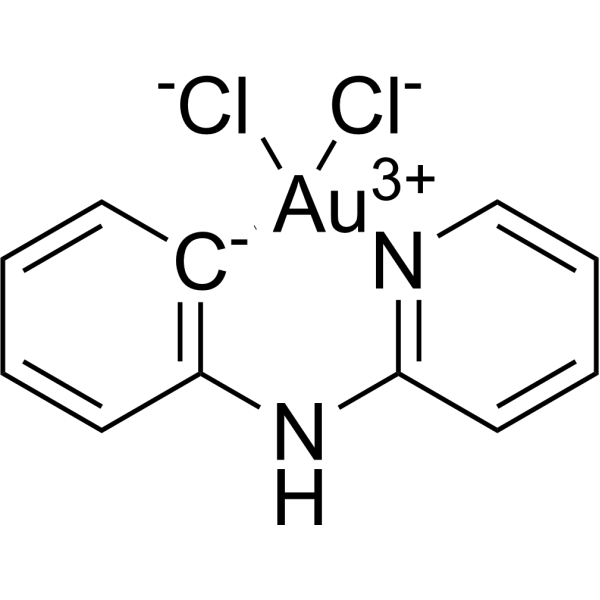 0 ImagesCat. No.: HY-157979CAS No.: 198711-19-2AQP3-IN-1 (compounds 3) is an AQP3 inhibitor with a IC50 value of 8.91 μM. AQP3-IN-1 inhibits cell proliferation of melanoma cells.

-
AQP4 (201-220)
 0 ImagesCat. No.: HY-P10936CAS No.: 2104700-59-4AQP4 (201-220) is an encephalitogenic epitope of AQP-4. AQP4 (201-220) can induce experimental autoimmune encephalomyelitis (EAE) (characterized by midline lesions in the brain, retinal pathology, and lesions at the grey matter/white matter border zone in the spinal cord). AQP-4 is a target antigen in neuromyelitis optica.
-
Aquaporumab
 0 ImagesCat. No.: HY-P991869Synonyms: AQmabAM; rAb-53Aquaporumab (AQmabAM) is an engineered human monoclonal IgG antibody. Aquaporumab is a selective inhibitor of aquaporin 4 (AQP4), binding tightly to AQP4 and competitively displacing AQP4-IgG from serum [1][2]. Aquaporumab significantly reduces neuromyelitis optica lesions in spinal cord slice cultures and in mice receiving intracerebral injection of AQP4-IgG and complement [1][2]. Aquaporumab can be used for research on neuromyelitis optica spectrum disorders [1][2]."}
-
Steviol (Standard)
 0 ImagesSteviol (Standard) is the analytical standard of Steviol (HY-N2057). This product is intended for research and analytical applications. Steviol is the main metabolite of steviol glycosides and an inhibitor of AQP2/CFTR. Steviol slows down the growth of renal cysts by inhibiting the activity of CFTR, reducing the expression of AQP2, and promoting the degradation of AQP2 and CFTR. Steviol can be used in the research of polycystic kidney disease.
-
TC AQP1 1 (Standard)
 0 ImagesCat. No.: HY-110200RCAS No.: 37710-81-9Synonyms: m-Phenylenediacrylic acid (Standard); m-Benzenediacrylic acid (Standard)
- 1
- 2




