



Biochemical Assay Reagents
Biochemical agents refers to the life science research related to biological material or organic compounds. Due to a wide range of life sciences, rapid development, and therefore a wide variety of such agents, complex in nature. There are electrophoresis reagents, chromatography reagents, centrifuged reagents, immunological reagent, labeled reagent, staining agents, penetration agents and carcinogens variable, insecticides, culture, buffering agents, electron microscopy reagents, protein and nucleic acid precipitating agent, condensing agent ultrafiltration membrane, clinical diagnostic reagents, dyes, antioxidants, preservatives, detergents and surfactants, standard biochemical reagents, biochemical reagents quality control materials, separation material, etc..
All Product Categories
-
Biochemical Assay Reagents Inhibitors
(10)
View all products
-
Biochemical Assay Reagents Modulator
(1)
View all products
-
Biochemical Assay Reagents Chemicals
(7)
View all products
-
Biochemical Assay Reagents Inducer
(1)
View all products
-
Biochemical Assay Reagents Controls
(59)
View all products
-
Biochemical Assay Reagents Substrates
(4)
View all products
-
Biochemical Assay Reagents Ligands
(2)
View all products
-
Biochemical Assay Reagents Related Products (16057)
Related Products (16057)

-
Antibodies (44)
-
N,N'-Di-o-tolyl-p-phenylenediamine
 0 ImagesN,N'-Di-o-tolyl-p-phenylenediamine is a diphenylamine antioxidant that could be found in wastewater. N,N'-Di-o-tolyl-p-phenylenediamine accumulates in aquatic organisms, exhibits bioaccumulating potential, may have long-term effects on aquatic ecosystems.
-
4-Aminohippuric acid (Standard)
 0 Images4-Aminohippuric acid (p-Aminohippuric acid) (Standard) is the analytical standard of 4-Aminohippuric acid (HY-B1306). This product is intended for research and analytical applications. 4-Aminohippuric acid (p-Aminohippuric acid) is a coordination ligand for metal ions (such as Cu2+, Fe3+, Hg2+) and a functionalization reagent for nanomaterials. 4-Aminohippuric acid can coordinate with metal ions or modify the surface of materials such as carbon nanotubes and gold nanoparticles through amino and carboxyl groups. 4-Aminohippuric acid can form stable complexes with metal ions or participate in the synthesis of nanomaterials as a reducing agent/stabilizer, enriching metal ions or giving nanoparticles peroxidase-mimicking activity. 4-Aminohippuric acid can be used to construct highly sensitive electrochemical sensors or colorimetric sensors to detect and quantitatively analyze heavy metal ions such as copper, iron, and mercury in environmental water samples and biological samples. 4-Aminohippuric acid may also be a biomarker for attention-deficit/hyperactivity disorder (ADHD).
-
Bisoctrizole
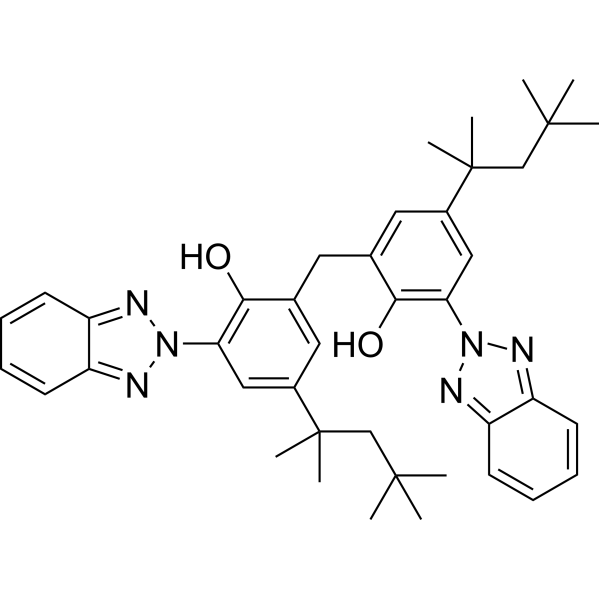 0 ImagesBisoctrizole is a broad-spectrum UVA/UVB absorber that belongs to the benzotriazole class of compounds. Bisoctrizole absorbs UV light through hydroxyphenyl groups, causing reversible electronic transitions, thereby converting light energy into heat energy, inhibiting UV-induced material or skin damage. Bisoctrizole is highly efficient in capturing UVA (320-400 nm) and some UVB (280-320 nm) radiation. Bisoctrizole delays the photodegradation of materials such as silicones, improving their UV aging resistance or enhancing the photoprotective ability of sunscreen products.
-
1,4-Benzenediacetic acid
 0 ImagesCat. No.: HY-W009946CAS No.: 7325-46-4Synonyms: p-Phenylenediacetic acid1,4-Benzenediacetic acid (Compound 13, p-Phenylenediacetic acid) is an eluent, which is produced by the direct carbonylation of difunctional alcohols 1,2- and 1, 4-benzenediethanol and 2-hydroxybenzenemethanol.
-
Rhodanine
 0 ImagesRhodanine is a selective Echovirus 12 proliferation inhibitor and intermediate. Rhodanine is used to determine tannase activity. Rhodanine can be used in the synthesis of anticancer and antibacterial agents.
-
Fmoc-Glu(Otbu)-Gly-OH
 0 ImagesCat. No.: HY-W871891CAS No.: 866044-63-5Fmoc-Glu(Otbu)-Gly-OH is a biochemical reagent that can be used as a biological material or organic compound for life science related research.
-
CMSA Protein
 0 ImagesCat. No.: HY-NP002OSynonyms: Cynomolgus Monkey serum albuminCMSA Protein (Cynomolgus Monkey Serum Albumin) is a plasma protein derived from cynomolgus monkeys. It is highly homologous to HSA (HY-P1956) and has an extremely high sequence similarity. CMSA Protein mainly regulates blood osmotic pressure and binds or transports hormones, metals, and active compounds.
-
MG1 peptide
 0 ImagesCat. No.: HY-P11315Purity: 99.23%MG1 peptide is an M1 microglia-targeting peptide with blood-brain barrier permeability. MG1 peptide can be used in studies related to ischemic stroke and cerebral ischemia-reperfusion injury.
-
1,5-Diazidopentane
 0 ImagesCat. No.: HY-W800671CAS No.: 17607-21-5Synonyms: 1,5-Pentane diazide
-
dPEG(R)8-SATA
 0 ImagesSynonyms: S-Acetyl-dPEG(R)8-NHS esterdPEG(R)8-SATA (S-Acetyl-dPEG(R)8-NHS ester) is a bioconjugation reagent with excellent biocompatibility and high selectivity. dPEG(R)8-SATA can be used to label and cross-link biomolecules and promote the interaction between biomolecules. dPEG(R)8-SATA plays an important role in bioimaging and compound delivery systems.
-
N3-PEG2-Tos
 0 ImagesCat. No.: HY-W190836CAS No.: 182347-24-6
-
2-Br-2,2-Dimethyl-acetamido-NHS ester
 0 ImagesCat. No.: HY-403874CAS No.: 1433633-71-62-Br-2,2-Dimethyl-acetamido-NHS ester (compound II) is a functionalized amide-containing initiator.
-
6-Azido-6-deoxy-D-glucose, 95%
 0 Images6-Azido-6-deoxy-D-glucose, 95% is used for visualizing protein-specific glycosylation in living cells.
-
N,N′-Bis(2,5-di-tert-butylphenyl)-3,4,9,10-perylenedicarboximide
 0 ImagesN,N′-Bis(2,5-di-tert-butylphenyl)-3,4,9,10-perylenedicarboximide is an organic semiconductor material with excellent electron transport activity. N,N′-Bis(2,5-di-tert-butylphenyl)-3,4,9,10-perylenedicarboximide is widely used in organic field effect transistors (OFETs) and organic photovoltaic (OPV) devices due to its high carrier mobility. The chemical structure design of N,N′-Bis(2,5-di-tert-butylphenyl)-3,4,9,10-perylenedicarboximide enables it to perform well in light absorption and photoelectric conversion, thereby improving the efficiency of organic photoelectric devices.
![1,2,3,4-Tetrahydrobenzo[h]quinolin-3-ol](https://file.medchemexpress.com/product_pic/hy-d0900.gif "Click to View 1,2,3,4-Tetrahydrobenzo[h]quinolin-3-ol Product Detail")
-
3-(Acetylthio)propionic acid N-succinimidyl ester
 0 Images3-(Acetylthio)propionic acid N-succinimidyl ester is a biochemical reagent that can be used as a biological material or organic compound for life science related research.
-
Highly purified Type II collagen, from bovine articular cartilage
 0 ImagesCat. No.: HY-NP102Purity: 99%Synonyms: Bovine Type II collagen, immunization gradeHighly purified Type II collagen, from bovine articular cartilage (Bovine Type II collagen, immunization grade), an immunization grade, is the major matrix protein in cartilage that can be used for the study of arthritis.
-
1-Methyl-3-amino-4-cyanopyrazole
 0 ImagesCat. No.: HY-107497CAS No.: 21230-50-2
-
THAM hydrochloride (≥99%, for cell culture)
 0 ImagesSynonyms: Tris HCl (≥99%, for cell culture); Tris hydrochloride (≥99%, for cell culture)THAM hydrochloride (≥99%, for cell culture) is a low-toxicity amino alcohol buffer, a specific CO2-consuming proton acceptor that buffers carbon dioxide and acid both in vitro and in vivo. THAM hydrochloride (≥99%, for cell culture) binds protons to form bicarbonate, reduces PaCO2, and induces intracellular alkalization, thereby ameliorating hypercapnia-induced elevation of pulmonary blood vessels and pulmonary arterial pressure. THAM hydrochloride (≥99%, for cell culture) may cause PaCO2 rebound, hypoglycemia, and respiratory depression. THAM hydrochloride (≥99%, for cell culture) removes amniotic epithelium and preserves the basement membrane, but depletes extracellular matrix and reduces the adhesion rate of limbal epithelial cells. THAM hydrochloride (≥99%, for cell culture) can act as a CO2 carrier to enhance the productivity and carbon utilization rate of Scenedesmus obliquus. THAM hydrochloride (≥99%, for cell culture) is a key component of buffer solutions used in various biological, cell culture, biochemical, and molecular biology applications.
-
Polyoxyl 40 stearate
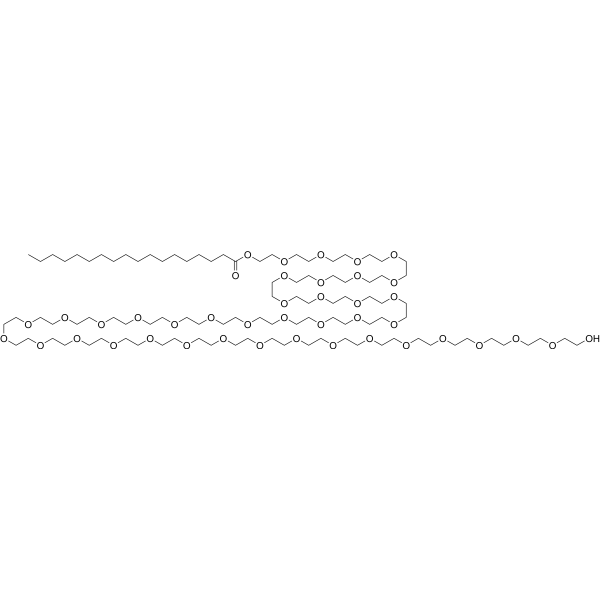 0 ImagesSynonyms: PEG 40 stearatePolyoxyl 40 stearate (PEG 40 stearate) is a nonionic surfactant formed by the esterification of stearic acid with polyethylene glycol (PEG) containing approximately 40 ethoxy units, it is used in pharmaceutical preparations, nanodrug carriers, emulsification systems and biomedical materials. Polyoxyl 40 stearate can serve as a matrix component of solid lipid nanoparticles to achieve controlled release of encapsulated antifungal drugs; it can also act as a base material for solid lipid nanoparticles for vaginal administration, and polymerizable groups can be introduced via modification with acryloyl chloride.




