



SOD
Superoxide Dismutase
SOD (Superoxide dismutase), an antioxidant enzyme, are a group of metalloenzymes that defenses against reactive oxygen species (ROS)-mediated injury. SOD can catalyze the dismutation of superoxide radicals (O2˙-) into hydrogen peroxide (H2O2) and oxygen (O2). The chemical moiety of SOD contains some metal ions such as Cu2+, Zn2+, Mn2+, and Fe2+ in the active site, which mediates the dismutation process. On the basis of these metallic cofactors, SOD can be classified into three distinct types, SOD1 (Cu/Zn-SOD), SOD2 (Mn-SOD), and SOD3 (Fe-SOD)[1][2].
References:
- [1]. Younus H. Therapeutic potentials of superoxide dismutase. Int J Health Sci (Qassim). 2018 May-Jun;12(3):88-93. [Content Brief]
- [2]. Saurav Suman, et al. Chapter 14 - Biotic stresses on plants: reactive oxygen species generation and antioxidant mechanism. Frontiers in Plant-Soil Interaction. Molecular Insights Into Plant Adaptation. 2021, 381-411.
All Product Categories
-
SOD Related Products (234)
Related Products (234)

-
Antibodies (4)
-
Deoxymikanolide
 0 ImagesCat. No.: HY-N13756CAS No.: 23753-57-3Deoxymikanolide is an orally active antibacterial agent that inhibits catalase (CAT), peroxidase (POD), and superoxide dismutase (SOD) activities. Deoxymikanolide increases glycan metabolism, phosphorus metabolism, electric conductivity, intrabacterial reactive oxygen species (ROS) levels, and malondialdehyde (MDA) levels, causes cell shrinkage, cytoplasmic damage, and cell disruption in Ralstonia solanacearum. Deoxymikanolide inhibits Acetic acid-induced writhing in mice. Deoxymikanolide can be used for the research of bacterial wilt.
-
Emodin-8-glucoside (Standard)
 0 ImagesCat. No.: HY-N0311RCAS No.: 23313-21-5Emodin-8-glucoside (Standard) is the analytical standard of Emodin-8-glucoside. This product is intended for research and analytical applications. Emodin-8-glucoside is an anthraquinone derivative that can be isolated from Aloe vera. Emodin-8-glucoside is the inhibitor for MAPK with an inhibition constant of 430.14 pM. Emodin-8-glucoside exhibits moderate inhibitory activity against rat lens aldose reductase (ALAR) and topoisomerases II with IC50s of 14.4 μM and 66 μM. Emodin-8-glucoside exhibits antioxidant, anti-inflammatory and anti-fibrotic activities. Emodin-8-glucoside can cross the blood brain barrier.
-
Xanthine oxidase-IN-18
 0 ImagesCat. No.: HY-178342Xanthine oxidase-IN-18 is a potent orally activeXanthine oxidase (XO) inhibitor (IC50 = 0.263 μM). Xanthine oxidase-IN-18 exerts inhibition by directly and stably binding to the xanthine oxidase Mo-co active site. Xanthine oxidase-IN-18 exhibits reactive oxygen species (ROS) scavenging activity. Xanthine oxidase-IN-18 shows anti-hyperuricemia effects in a Potassium oxonate (HY-17511)-induced hyperuricemic rat model. Xanthine oxidase-IN-18 can be used for hyperuricemia, breast and lung cancer research.
-
SOD1-IN-1
 0 ImagesCat. No.: HY-176827CAS No.: 2640565-68-8SOD1-IN-1 (comppund 9) is a potent SOD1 inhibitor. SOD1-IN-1 shows no cytotoxicity.
-
Allyl methyl sulfide (Standard)
 0 ImagesCat. No.: HY-128447RCAS No.: 10152-76-8Allyl methyl sulfide (Standard) is the analytical standard of Allyl methyl sulfide (HY-128447). This product is intended for research and analytical applications. Allyl methyl sulfide is an orally active organic sulfide. Allyl methyl sulfide is one of the main active ingredients in garlic volatile metabolites. Allyl methyl sulfide can be extracted from garlic. Allyl methyl sulfide enhances SOD activity, inhibits NF-κB signaling pathway, and upregulates pancreatic GLUT2 expression. Allyl methyl sulfide has significant antioxidant, anti-inflammatory and hypoglycemic activities. Allyl methyl sulfide can be used in the research of diabetes and its complications.
-
Dendrobine (Standard)
 0 ImagesDendrobine (Standard) is the analytical standard of Dendrobine. This product is intended for research and analytical applications. Dendrobine is an alkaloid isolated from Dendrobium nobile. Dendrobine possesses antiviral activity against influenza A viruses, with IC50s of 3.39 μM, 2.16 μM and 5.32 μM for A/FM-1/1/47 (H1N1), A/Puerto Rico/8/34 H274Y (H1N1) and A/Aichi/2/68 (H3N2), respectively. Dendrobine activates the JNK/p38/Nrf2 signaling pathway. Dendrobine exhibits antiviral, antitumor, anti-inflammatory, and neuroprotective properties.
-
Antioxidant peptide A
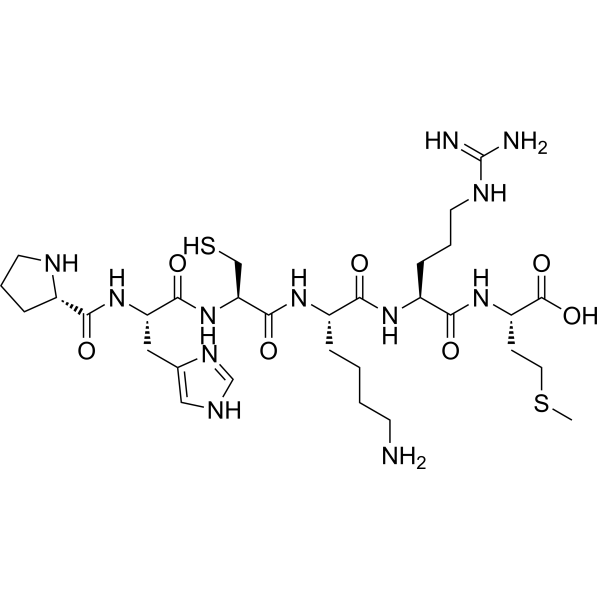 0 ImagesCat. No.: HY-P1512CAS No.: 159147-88-3
-
Monoamine Oxidase B inhibitor 6
 0 ImagesCat. No.: HY-170798CAS No.: 101091-29-6Monoamine Oxidase B inhibitor 6 (Compound BT5) is a BBB-penetrable, highly selective, reversible and competitive MAO-B inhibitor, with an IC50 of 0.11 μM. Monoamine Oxidase B inhibitor 6 has antioxidant and neuroprotective effects and can be used in the research of neurodegenerative diseases.
-
4-Acetylaminoantipyrine-d3
 0 ImagesCat. No.: HY-W268542S1CAS No.: 342821-66-34-Acetylaminoantipyrine-d3 is the deuterium labeled 4-Acetylaminoantipyrine (HY-W268542). 4-Acetylaminoantipyrine (4-AA) is a derivative of antipyrine (HY-B0171). 4-Acetylaminoantipyrine acts as a PGE2-dependent blocker and inhibitor of cyclooxygenase (COX). 4-Acetylaminoantipyrine can inhibit Cu/ZnSOD. 4-Acetylaminoantipyrine can spontaneously bind with bovine serum albumin (BSA) and alter its conformation.
-
CDK4/6-IN-26
 0 ImagesCat. No.: HY-179151CDK4/6-IN-26 is a carbamate derivative that targets CDK4/CDK6. CDK4/6-IN-26 reduces CDK4/CDK6 levels, resulting in cell cycle arrest in the G0/G1 phase and in the S phase. CDK4/6-IN-26 exhibits high potency against SW480 cells (IC50 = 6.3 μM). CDK4/6-IN-26 affects ROS levels by increasing the expression of SOD2/MnSOD. CDK4/6-IN-26 establishes several interactions with the amino acids of the CDK6 active site. CDK4/6-IN-26 can be used for the research of colorectal cancer.
-
Tofersen sodium scrambled negative control
 0 ImagesCat. No.: HY-132580DTofersen sodium scrambled negative control is the sequence scrambled negative control of Tofersen sodium.
-
β-Cyfluthrin (Standard)
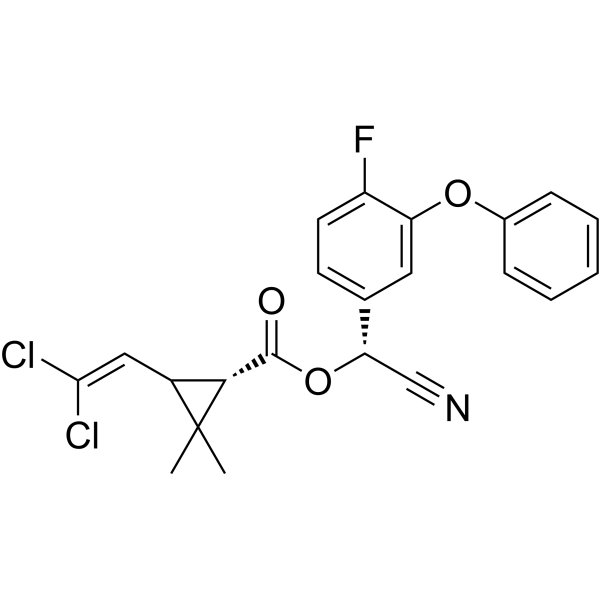 0 ImagesCat. No.: HY-B1837ARCAS No.: 1820573-27-0Synonyms: beta-Cyfluthrin (Standard)β-Cyfluthrin (Standard) is the analytical standard of β-Cyfluthrin. This product is intended for research and analytical applications. β-Cyfluthrin (beta-Cyfluthrin) is a type II synthetic pyrethroid and also an active ingredient of many insecticide products used for pestsin agriculture. β-Cyfluthrin is a neurotoxicant and affects calcium concentration in nervous tissue by inhibiting Ca2+ ATPase involved in calcium transport.
-
SRI-22818
 0 ImagesCat. No.: HY-182446CAS No.: 1429221-68-0SRI-22818 is a NF-κB activator with an EC50 of 0.5 μM. SRI-22818 upregulates the expression of NF-κB and promotes its activation. SRI-22818 increases the level of SOD2. SRI-22818 exhibits activity in the SOD1G93A model of amyotrophic lateral sclerosis (ALS). SRI-22818 can be used for research related to amyotrophic lateral sclerosis.
-
Diludine (Standard)
 0 ImagesSynonyms: Et-HE (Standard); 1,4-DHP (Standard)Diludine (Standard) is the analytical standard of Diludine (HY-W017960). This product is intended for research and analytical applications. Diludine (BNP-7787) is an orally effective feed additive. Diludine reduces the activity of G6PD and increases the level of superoxide dismutase (SOD). Diludine reduces the mutagenic effect of environmental pollutants, protects parental reproductive systems and improves offspring quality. Diludine is mainly applied during the transition period of dairy cows to increase milk yield and milk fat content, and improve health status during parturition. Diludine can be used in animal feeding research.
-
Aldose reductase-IN-10
 0 ImagesCat. No.: HY-184702Aldose reductase-IN-10 is an inhibitor of aldose reductase with an IC50 of 1.965 μM. Aldose reductase-IN-10 reduces malondialdehyde levels and enhances the activities of SOD, CAT and GPx. Aldose reductase-IN-10 decreases total cholesterol, triglyceride and LDL-C levels, while increasing HDL-C levels. Aldose reductase-IN-10 can be used for the research of diabetic complications.
-
EUK-118
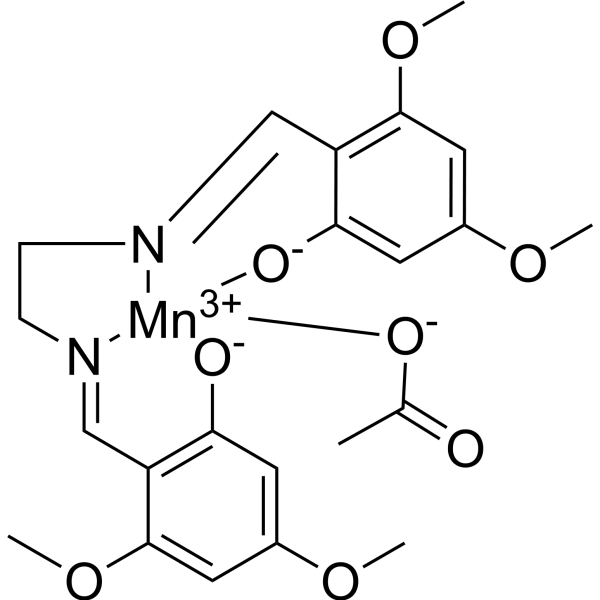 0 ImagesCat. No.: HY-130438CAS No.: 186299-34-3EUK-118 is an analog of EUK 8 and EUK 134 with reduced activity. EUK-118 exhibits superoxide dismutase (SOD) mimetic activity.
-
lathosterol-d7
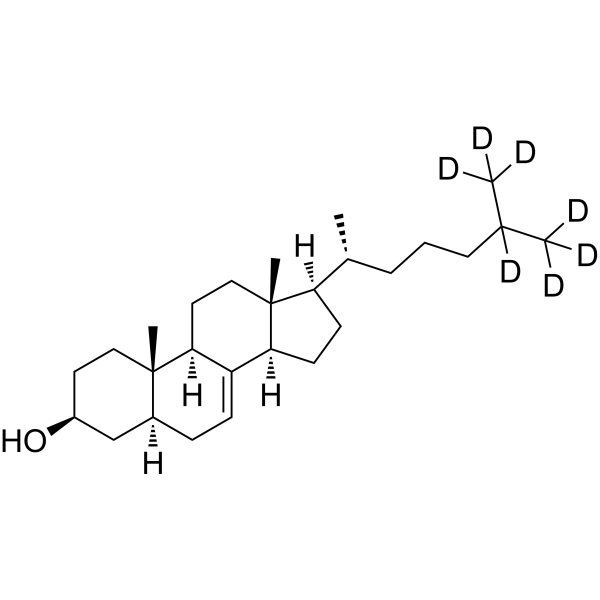 0 ImagesCat. No.: HY-113486S1CAS No.: 2260669-10-9lathosterol-d7 is deuterium labeled Lathosterol (HY-113486). Lathosterol is a plant sterol and cholesterol-like molecule. Lathosterol increases antioxidant enzymes (such as SOD, CAT, and GSH) and decreases LDH. Lathosterol has a hepatoprotective effect on mice with acetaminophen (HY-66005)-induced liver injury.
-
γ-Elemene
 0 ImagesCat. No.: HY-135876CAS No.: 29873-99-2Synonyms: (-)-γ-Elemeneγ-Elemene ((-)-γ-Elemene) is a lipid-lowering agent. γ-Elemene increases superoxide dismutase (SOD). γ-Elemene reduces the expression of adhesion molecules (VCAM-1, ICAM-1) in cells damaged by H2O2. γ-Elemene regulates lipid peroxidation. γ-Elemene protects cells from peroxidative damage induced by high fat and H2O2. γ-Elemene decreases lipid content. γ-Elemene can be used in the research of atherosclerosis.
-
Antioxidant agent-22
 0 ImagesCat. No.: HY-181174CAS No.: 2996086-75-8Antioxidant agent-22 is a paraben derivative tetracyclic spermine cyclotriphosphazene compound. Antioxidant agent-22 exhibits antioxidant, anti-Inflammatory, and apoptotic activities. Antioxidant agent-22 significantly upregulates CAT, SOD, caspase-3 and IL-6 expression, suppresses GSH, IL-1β, and reduces BCL-2 and BAX levels. Antioxidant agent-22 can be used for the research of cancer, such as lung cancer.
-
AF03
 0 ImagesCat. No.: HY-180141AF03 is a larvicide against Aedes aegypti Vector Larvae with a LC50 of 41.6 μg/mL. AF03 binds stably to the sterol carrier protein-2 (AeSCP-2) of Aedes aegypti, interfering with lipid metabolism in larvae. AF03 can increase acetylcholinesterase (AChE) activity in the zebrafish brain, slightly elevate catalase (CAT) activity in the liver and heart, and increased superoxide dismutase (SOD) activity in the brain. AF03 can be used for the research of arboviruses infection, such as Dengue.




