



Afimkibart (WT IgG1)
Based on 1 publication(s) in Google Scholar
Afimkibart (PF-06480605; RVT-3101) is a fully human monoclonal antibody that selectively inhibits trimeric tumor necrosis factor-like ligand 1A (TL1A). Afimkibart neutralizes active trimeric TL1A, blocks TL1A-induced signaling pathways. Afimkibart inhibits NF-κB activation and IFN-γ production. Afimkibart can be used for the research of inflammatory bowel disease.
For research use only. We do not sell to patients.
- Purity : 99.59%
- CAS No.: 2911580-96-4
- Molecular Weight:146.54 kDa
-
Storage:
Please store the product under the recommended conditions in the Certificate of Analysis.


To place orders, for customer services and technical support, please contact: MedChemExpress USA
Tel: 609-228-6898 E-mail: [email protected] [email protected]


-
 Biological Activity
-
Chemical Information
- Protocols
- Purity & Documentation
- References
-
 Help & FAQs


-

HY-P990007
TulisokibartAnti-TNFSf15/TL1A Antibody -

HY-P990006
DuvakitugAnti-TNFSf15/TL1A Antibody -

HY-P9908
AdalimumabTNF-α Inhibitor -

HY-P99001
Human IgG1 kappa, Isotype ControlIgG1κ Isotype Control -
HY-P99366A
Tezepelumab (anti-TSLP)Anti-TSLP Antibody -

HY-P9931
GuselkumabIL-23 Neutralizing Antibody -

HY-P99486
BriakinumabAnti-IL-12/23p40 Antibody -
HY-19569
UpadacitinibJAK1 Inhibitor -

HY-P9909
Ustekinumab -

HY-P99248
RisankizumabIL-23 IgG Monoclonal Antibody
Publications Citing Use of MedChemExpress (MCE) Afimkibart (WT IgG1)
More

Biological Activity
Description
Isotype
Human IgG1 kappa
Recommend Isotype Controls
Species Reactivity
Human
IC50 & Target
[1]|
TL1A |
In Vitro
Afimkibart selectively binds to functionally active trimeric recombinant human TL1A and does not bind to monomeric recombinant human TL1A[1].
Afimkibart potently inhibits trimeric recombinant human TL1A-induced NF-κB activation in human peripheral T lymphocytes and trimeric recombinant human TL1A/IL12/IL18-induced IFN-γ production in human PBMCs[1].
MedChemExpress (MCE) has not independently confirmed the accuracy of these methods. They are for reference only. Further protocols information, click here.
Gene ID
Accession
Conjugated
Unconjugated
Reconsititution
The product can be reconstituted/diluted with sterile PBS or saline.
Format
-
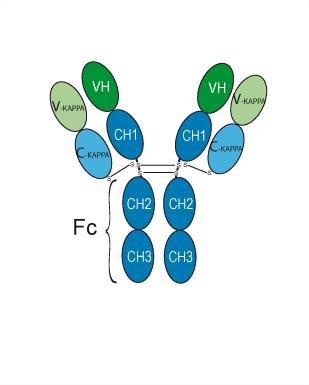
IgG1-kappa
Application
ELISA, FACS, Functional assay
Verified Bioactivity
-
 Immobilized TL1A/TNFSF15 Trimer Protein, Human can bind Afimkibart. The EC50 for this effect is 8.563 ng/mL.
 -
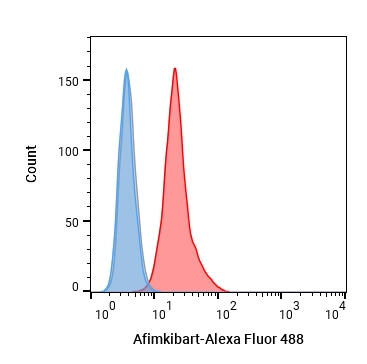 Flow cytometric analysis of 1.5X10⁶ HT-29 cells with Afimkibart (HY-P990876, red). Cells were fixed with 4% paraformaldehyde. Then stained with the primary antibody at 1/200 dilution for an hour at 4℃. Goat Anti-Human IgG H&L (AF488) (HY-P83776) was used as the secondary antibody at 1/1,000 dilution for 30 minutes at 4℃. Human IgG1 kappa, Isotype Control (HY-P99001, blue) was used as the isotype control, cells without incubation with primary antibody were used as the unlabeled control (black).


Chemical Information
-
CAS No. 2911580-96-4
-
Appearance Liquid
-
Molecular Weight 146.54 kDa
-
Color Colorless to light yellow
-
SMILES
[Afimkibart (WT IgG1)]
-
Synonyms
PF-06480605 (WT IgG1); RVT-3101 (WT IgG1)
-
Shipping
Shipping with dry ice.
-
Formulation
Please refer to the lot-specific COA for specific buffer information.
-
Storage
Please store the product under the recommended conditions in the Certificate of Analysis.


Publications (1)
-
Journal Impact Factor
-
Most Recent
-
Inflamm Bowel Dis
Preclinical development of SL-325, a novel high-affinity DR3-blocking antibody for durable inhibition of the DR3/TL1A axis in inflammatory bowel disease. [Abstract]2026 Jun 27:izag101. PMID: 42364076

Protocols
-
DSS-Induced Colitis
Dextran sulfate sodium (DSS)-induced colitis is generated by administering DSS in mouse drinking water, producing epithelial injury, barrier disruption, weight loss, diarrhea, fecal blood, colon shortening, histologic mucosal damage, and inflammatory mediator changes; the model is mainly used to study acute or chronic intestinal inflammation resembling selected features of ulcerative colitis. DSS injury is interpreted through clinical and tissue readouts rather than a single molecular endpoint: daily body weight, stool consistency, and bleeding are combined into a disease activity index, while colon length, histology, cytokines, myeloperoxidase activity, intestinal permeability, and tight-junction markers provide complementary measures of inflammation and barrier damage.
-
TNBS-Induced Colitis
TNBS-induced colitis is produced by intrarectal delivery of 2,4,6-trinitrobenzene sulfonic acid in ethanol, where ethanol disrupts the mucosal barrier and TNBS haptenates colonic proteins, generating immune-mediated colonic inflammation with weight loss, diarrhea, ulceration, transmural injury, inflammatory-cell infiltration, and cytokine responses. The model is used as an experimental intestinal inflammation model with Crohn’s disease–like features, especially when Th1-type responses, IL-12–dependent inflammation, chronic relapsing inflammation, or fibrosis-related endpoints are studied.
-
Research Protocol for Inflammation-related Diseases
The NLRP3 inflammasome is a cytosolic innate immune signaling platform that integrates priming signals and danger-signal activation to promote caspase-1 activation, maturation of IL-1β and IL-18, and gasdermin D-mediated pyroptotic cell death. The core experimental logic is to determine whether inflammatory disease phenotypes are driven by increased NLRP3 expression, ASC-containing inflammasome assembly, caspase-1 cleavage, GSDMD cleavage, and extracellular release of IL-1β/IL-18 rather than by nonspecific cell injury alone. The pathway is strongly linked to inflammation-related disease phenotypes because monosodium urate crystals activate NALP3/NLRP3 inflammasome signaling in gout-like crystal inflammation, cholesterol crystals activate NLRP3 inflammasomes in atherogenesis models, and DSS-induced intestinal inflammation has been reported to involve NLRP3 inflammasome activity. However, experimental colitis studies also show context-dependent protective effects of NLRP3 inflammasome co


Purity & Documentation
-
Data Sheet (272 KB)
-
SDS (252 KB)
- English - EN (252 KB)
- Français - FR (252 KB)
- Deutsch - DE (252 KB)
- Norwegian - NO (252 KB)
- Español - ES (252 KB)
- Swedish - SV (252 KB)
- Italian - IT (252 KB)
- Korean - KR (252 KB)
- Portuguese - PT (252 KB)
-
Inhibitory Antibodies User Guide (603 KB)
References

Calculators
Concentration (start) × Volume (start) = Concentration (final) × Volume (final)


Afimkibart (WT IgG1) Related Classifications
HY-P990876 Related Classifications
 Powered by Bioz
Keywords
- Afimkibart (WT IgG1)
- 2911580-96-4
- PF-06480605 (WT IgG1)
- RVT-3101 (WT IgG1)
- TNF Receptor
- NF-κB
- IFNAR
- peripheral T lymphocytes
- IFN-γ
- endogenous active TL1A
- TL1A
- Tumor necrosis factor-like ligand 1A
- inflammatory bowel disease
- human peripheral blood mononuclear cells
- interferon-gamma
- human PBMCs
- Inhibitor
- inhibitor
- inhibit