
Anti-inflammatory agent 50
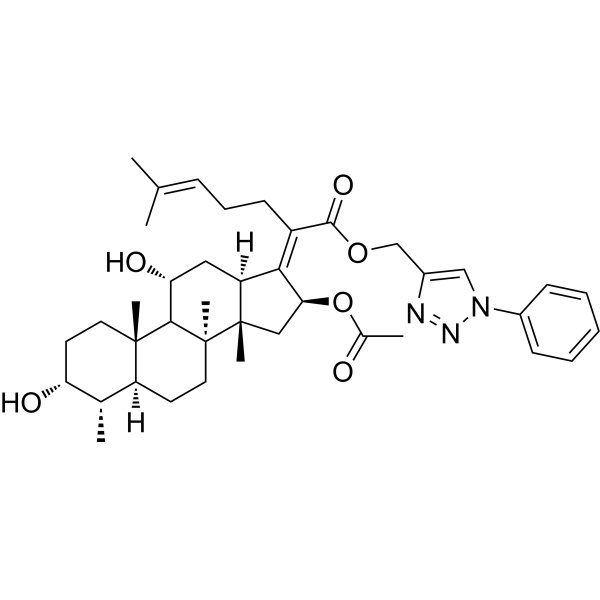
Anti-inflammatory agent 50 (compound a1) is a Fusidic acid derivative with anti-inflammatory effects. Anti-inflammatory agent 50 inhibits inflammatory factor NO, IL-6 and TNF-α. Anti-inflammatory agent 50 alleviates acute lung injury by regulating inflammatory mediators and suppressing the MAPK, NF-κB and NLRP3 inflammasome signaling pathways.
For research use only. We do not sell to patients.
- Formula: C40H55N3O6
- Molecular Weight:673.88
-
Storage:
Please store the product under the recommended conditions in the Certificate of Analysis.
Biological Activity
Description
In Vitro
In LPS-induced RAW264.7 cells, Anti-inflammatory agent 50 (compound a1) inhibits inflammatory factor NO (IC50 of 3.26 μM), IL-6 (IC50 of 1.85 μM) and TNF-α (IC50 of 3.88 μM). Anti-inflammatory agent 50 markedly inhibits the expression of certain immune-related cytotoxic factors, including COX-2 and inducible nitric-oxide synthase (iNOS)[1].
MedChemExpress (MCE) has not independently confirmed the accuracy of these methods. They are for reference only. Further protocols information, click here.
In Vivo
MedChemExpress (MCE) has not independently confirmed the accuracy of these methods. They are for reference only.
Chemical Information
-
Molecular Weight 673.88
-
Formula C40H55N3O6
-
SMILES
C/C(C)=C\CC/C(C(OCC1=CN(C2=CC=CC=C2)N=N1)=O)=C3[C@@H](OC(C)=O)C[C@]4(C)[C@@]5(C)CC[C@@]6([H])[C@H](C)[C@H](O)CC[C@]6(C)C5[C@H](O)C[C@@]/34[H]
-
Shipping
Room temperature in continental US; may vary elsewhere.
-
Storage
Please store the product under the recommended conditions in the Certificate of Analysis.
Protocols
-
Research Protocol for Inflammation-related Diseases
The NLRP3 inflammasome is a cytosolic innate immune signaling platform that integrates priming signals and danger-signal activation to promote caspase-1 activation, maturation of IL-1β and IL-18, and gasdermin D-mediated pyroptotic cell death. The core experimental logic is to determine whether inflammatory disease phenotypes are driven by increased NLRP3 expression, ASC-containing inflammasome assembly, caspase-1 cleavage, GSDMD cleavage, and extracellular release of IL-1β/IL-18 rather than by nonspecific cell injury alone. The pathway is strongly linked to inflammation-related disease phenotypes because monosodium urate crystals activate NALP3/NLRP3 inflammasome signaling in gout-like crystal inflammation, cholesterol crystals activate NLRP3 inflammasomes in atherogenesis models, and DSS-induced intestinal inflammation has been reported to involve NLRP3 inflammasome activity. However, experimental colitis studies also show context-dependent protective effects of NLRP3 inflammasome co
-
Inhalation Toxicity Study
Inhalation toxicity studies expose rodents to a controlled aerosol, vapor, gas, or smoke atmosphere and assess respiratory and systemic toxicity using exposure-atmosphere characterization, clinical observations, body and organ weights, bronchoalveolar lavage fluid, histopathology, blood chemistry, hematology, and, when included, molecular endpoints such as transcriptomics, proteomics, lipidomics, or tissue burden analysis. The primary biological readouts are airway irritation, pulmonary inflammation, cytotoxicity, altered surfactant or lipid homeostasis, impaired particle clearance, and tissue remodeling, reflected by BALF cell differentials, BALF protein, LDH, phosphatase activities, cytokines, lung weight, microscopic respiratory-tract lesions, and retained lung burden.
-
Pyroptosis Solutions
Pyroptosis is a lytic inflammatory cell-death pathway executed by gasdermin pores, most classically through inflammasome-mediated activation of caspase-1, cleavage of gasdermin D, membrane pore formation, LDH release, and secretion of IL-1β and IL-18. The canonical pathway is commonly modeled by priming cells with an inflammatory signal such as LPS to induce pro-IL-1β and inflammasome components, followed by an activation signal such as ATP or nigericin to activate NLRP3, ASC speck formation, caspase-1 cleavage, GSDMD cleavage, cytokine release, and pyroptotic membrane rupture. The non-canonical pathway is triggered when cytosolic LPS activates mouse caspase-11 or human caspase-4/5, leading to GSDMD cleavage and pyroptosis, and this can secondarily activate NLRP3-dependent IL-1β release. Pyroptosis is linked to inflammatory injury, infection, cancer, liver disease, ocular disease, placental inflammation, and other disease phenotypes, but unresolved questions include which gasdermin fam
Purity & Documentation
References
Calculators
Concentration (start) × Volume (start) = Concentration (final) × Volume (final)

