



Antimalarial agent 18
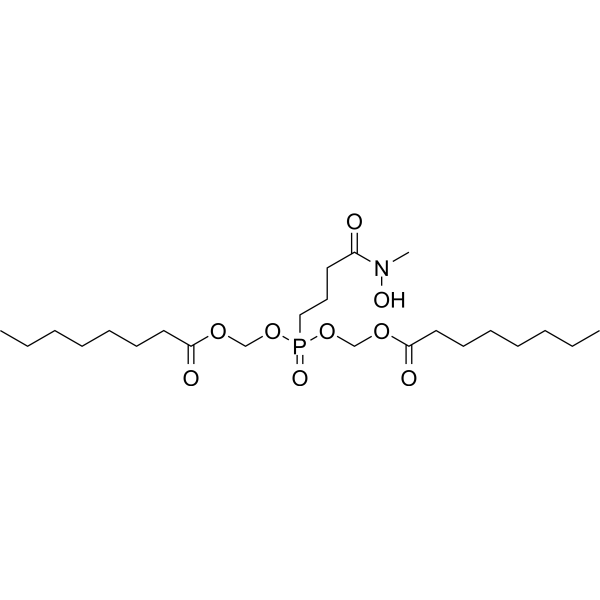
Antimalarial agent 18 is an potent antimalarial agent, based on electronic, highly lipophilic and siderophoric properties. Antimalarial agent 18 belongs to acyloxymethyl series, as a fosmidomycin surrogate, which is potent IspC inhibitor against the non-mevalonate isoprenoid biosynthesis pathway. Antimalarial agent 18 inhibits P. falciparum (IC50=50 nM) and A. baumanii (IC50=390 nM).
연구목적의 판매만을 진행합니다. 환자를 대상으로 한 판매는 하지 않습니다.
- CAS No.: 3037689-82-7
- 화학식: C23H44NO9P
- 분자량:509.57
-
보관:
Please store the product under the recommended conditions in the Certificate of Analysis.

To place orders, for customer services and technical support, please contact: MedChemExpress USA
Tel: 609-228-6898 E-mail: [email protected] [email protected]


-
 Biological Activity
-
Chemical Information
- 순도&문서
- References
-
 Help & FAQs


All Parasite Isoforms
More

Biological Activity
제품 설명
IC50 & Target
|
Plasmodium |
Cellular Effect
|
Cell Line

|
Type | Value | Description | References |
|---|---|---|---|---|
| MRC5 | CC50 |
40.3 μM
Compound: 13j
|
Cytotoxicity against human MRC5 cells assessed as reduction in cell viability
Cytotoxicity against human MRC5 cells assessed as reduction in cell viability
|
[PMID: 36399924] |
In Vitro
Antimalarial agent 18 (compound 13j) is the long chain octanoyl analog, shows cytotoxicity against MRC-5 fibroblasts with an IC50 value of 40.3 μM[1].
Antimalarial agent 18 poorly inhibits avirulent M. tuberculosis strain (H37Ra) with an IC50 value >64 μM[1].
Antimalarial agent 18 may serve as a lead for future analog development of MEP pathway inhibitors against Gram-negative pathogens in general, and A. baumannii in particular[1].
MedChemExpress (MCE) has not independently confirmed the accuracy of these methods. They are for reference only.


Chemical Information
-
CAS No. 3037689-82-7
-
분자량 509.57
-
화학식 C23H44NO9P
-
SMILES
CCCCCCCC(OCOP(CCCC(N(O)C)=O)(OCOC(CCCCCCC)=O)=O)=O
-
선적
Room temperature in continental US; may vary elsewhere.
-
보관
Please store the product under the recommended conditions in the Certificate of Analysis.


순도&문서
-
Data Sheet (263 KB)
-
SDS (252 KB)
- Français - FR (252 KB)
- Deutsch - DE (252 KB)
- Norwegian - NO (252 KB)
- Español - ES (252 KB)
- Swedish - SV (252 KB)
- Italian - IT (252 KB)
- Korean - KR (252 KB)
- Portuguese - PT (252 KB)
-
Handling Instructions (2659 KB)
References

Calculators
Concentration (start) × Volume (start) = Concentration (final) × Volume (final)


Antimalarial agent 18 Related Classifications
HY-151965 Related Classifications
 Powered by Bioz