



Avutometinib potassium
Based on 6 publication(s) in Google Scholar
Avutometinib (CH5126766) (potassium) is a RAF/MEK clamp that potently inhibits RAF/MEK kinase activity and induces dominant negative RAF-MEK complexes preventing phosphorylation of MEK by ARAF, BRAF and CRAF. Avutometinib (potassium) shows anti-proliferative potency across tumor cell lines carrying KRAS mutations including PDAC cell lines. Avutometinib (potassium) induces tumor inhibition and increases survival in a KRAS/p53 pancreatic cancer mouse model. Avutometinib (potassium) is promising for research of low-grade-serous-ovarian-carcinoma (LGSOC), ovarian cancer and pancreatic ductal adenocarcinoma (PDAC).
For research use only. We do not sell to patients.
- CAS No.: 946128-90-1
- Formula: C21H18FKN5O5S
- Molecular Weight:510.56
-
Storage:
Please store the product under the recommended conditions in the Certificate of Analysis.


To place orders, for customer services and technical support, please contact: MedChemExpress USA
Tel: 609-228-6898 E-mail: [email protected] [email protected]


-
 Biological Activity
-
Chemical Information
- Protocols
- Purity & Documentation
- References
-
 Help & FAQs


Publications Citing Use of MedChemExpress (MCE) Avutometinib potassium
More Customer Validation & Images

-
WB
-
Bio/Physico-chemical Assay
-
WB
-
Cell Proliferation/Viability Assay
All MEK Isoforms
More

Biological Activity
Description


Chemical Information
-
CAS No. 946128-90-1
-
Molecular Weight 510.56
-
Formula C21H18FKN5O5S
-
SMILES
O=S(NC)(NC1=NC=CC(CC2=C(C)C3=CC=C(OC4=NC=CC=N4)C=C3OC2=O)=C1F)=O.[K]
-
Synonyms
Ro 5126766 potassium; CH5126766 potassium
-
Shipping
Room temperature in continental US; may vary elsewhere.
-
Storage
Please store the product under the recommended conditions in the Certificate of Analysis.


Publications (6)
-
Journal Impact Factor
-
Most Recent
-
Nat Cancer
The MEK-RAF molecular glue IK-595 has potent antitumor activity across RAS/MAPK pathway-altered cancers. [Abstract]2026 Jan;7(1):116-130. PMID: 41482524
Avutometinib potassium purchased from MedChemExpress. Usage Cited in: Nat Cancer. 2026 Jan;7(1):116-130. [Abstract]
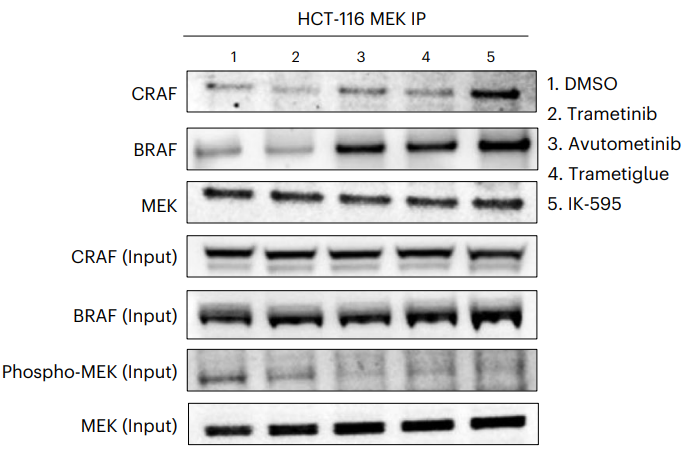
Western blot analysis of MEK immunoprecipitants depicting the modulation of MEK–BRAF and MEK–CRAF interactions in HCT-116 cells treated with DMSO, trametinib (10 nM), Avutometinib (30 nM), trametiglue (3 nM) or IK-595 (3 nM) for 4 h. A representative image of three independent experiments is shown.
Avutometinib potassium purchased from MedChemExpress. Usage Cited in: Nat Cancer. 2026 Jan;7(1):116-130. [Abstract]
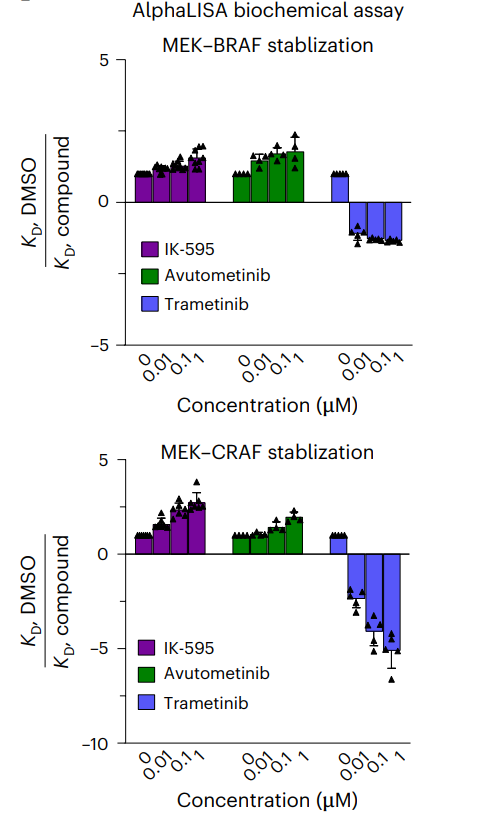
DMSO–inhibitor KD ratios obtained from an AlphaLISA biochemical assay measuring the interaction between MEK1 and BRAF (top) or CRAF (bottom) proteins following treatment with IK-595 (n = 1 sample per condition with nine biological replicates), trametinib (n = 1 sample per condition with five biological replicates) or Avutometinib (0.01-1 μM; 30 min) (n = 1 sample oer condition with four biological replicates). The results demonstrated that IK-595 and Avutometinib stabilized MEK1 with both BRAF and CRAF, whereas trametinib disrupted these interactions.
Avutometinib potassium purchased from MedChemExpress. Usage Cited in: Nat Cancer. 2026 Jan;7(1):116-130. [Abstract]
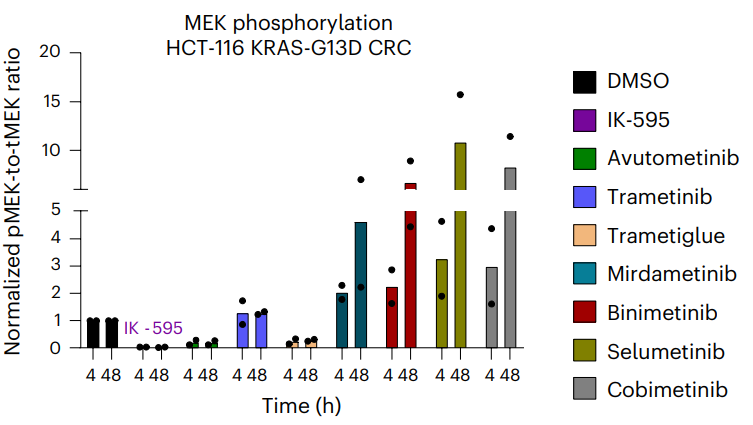
Western blot quantification of MEK phosphorylation normalized to total MEK protein levels in HCT-116 cells treated with DMSO, Avutometinib (30 nM), trametinib (10 nM), trametiglue (3 nM), mirdametinib (25 nM), binimetinib (50 nM), selumetinib (550 nM), cobimetinib (320 nM) or IK-595 (3 nM) for 4 or 48 h (n = 1 sample per condition in two biological replicates).
-
Nat Chem Biol
2026 May 12:10.1038/s41589-026-02212-2. PMID: 42120500 -
Clin Sci (Lond)
A pan-RAF inhibitor LY3009120 inhibits necroptosis by preventing phosphorylation of RIPK1 and alleviates dextran sulfate sodium-induced colitis. [Abstract]2019 Apr 16;133(8):919-932. PMID: 30944150 -
Sci Data
High-throughput drug screening identifies novel therapeutics for Low Grade Serous Ovarian Carcinoma. [Abstract]2024 Sep 19;11(1):1024. PMID: 39300112
Avutometinib potassium purchased from MedChemExpress. Usage Cited in: Sci Data. 2024 Sep 19;11(1):1024. [Abstract]
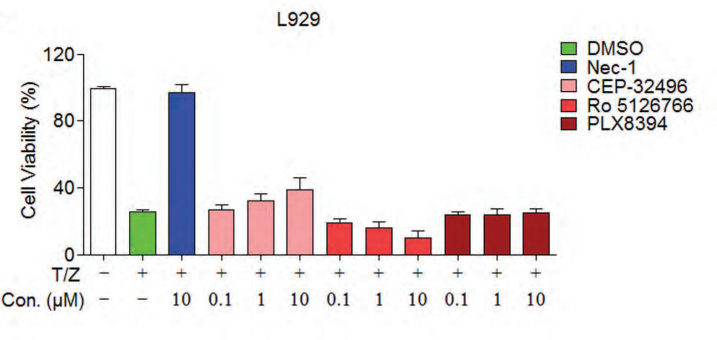
CEP-32496, Avutometinib (Ro 5126766) (0.1-10 μM; 1 h) and PLX8394 didn’t inhibit necroptosis in L929 cells. L929 or HT-29 cells were pretreated with DMSO or Nec-1 or indicated inhibitors for 1h, then stimulated with T/Z for 3 hours or T/S/Z for 8 hours, respectively. Then cell viability was determined by CCK8 assay.
-
-

Protocols
-
Kinase activity and phosphorylation assays
Kinase activity assays measure the ability of kinases to transfer phosphate groups from ATP to specific substrates, while phosphorylation assays detect the presence and levels of phosphorylated proteins. Common methods include radiolabeled ATP incorporation (e. g. ,), ADP release detection via bioluminescence (e. g. ,[3]), enzyme-linked immunosorbent assays (ELISA) for phospho-specific epitopes (e. g. ,[6]), and microtiter-based formats for high-throughput screening (e. g. ,[8]). The ADP-Glo assay quantifies kinase activity by measuring ADP produced during phosphorylation using a luciferase-based system. Radiometric assays involve autoradiography or scintillation counting after incorporation of 32P-labeled ATP into substrate proteins. ELISA-based approaches rely on phospho-specific antibodies to detect activated kinases in cell lysates or purified samples.
-
Western Blot
Western blotting (WB) is a commonly used experimental method in molecular biology, biochemistry, and immunogenetics for identifying and quantifying target proteins. It combines gel electrophoresis with immunoassay, enabling researchers to analyze protein expression, post-translational modifications, and molecular weight.
-
Protocol for Kinase activity and phosphorylation assays
Kinase activity assays measure transfer of phosphate from ATP to a protein or peptide substrate, generating phosphorylated substrate, ADP, or incorporated radiolabeled phosphate as the readout; phosphorylation assays measure site-specific phosphorylation in cells or tissues as a proxy for kinase-pathway activation, inhibition, or substrate regulation. Phosphorylation can be detected by phospho-specific Western blot, immunoprecipitation kinase assay, phospho-immunofluorescence, phospho-flow cytometry, luminescent ADP detection, radiolabeled ATP incorporation, or reporter-based pathway assays, and these readouts can be applied to cancer cells, primary neurons, mouse tumors, organoids, inflammatory macrophages, ferroptosis studies, and mitophagy studies when the kinase target is biologically relevant.
-
Cell Viability Determination by MTT Colorimetric Assay
The following protocol uses the MTT colorimetric assay as a classic literature-established method for assessing cell viability/metabolic activity in cultured mammalian cells. MTT[3-(4,5-dimethylthiazol-2-yl)-2,5-diphenyltetrazolium bromide] is reduced by metabolically active cells to a colored formazan product; the amount of formazan is quantified spectrophotometrically and provides an indirect measure of metabolically active viable cells. Importantly, MTT reduction reflects cellular oxidoreductase/metabolic activity rather than an absolute direct count of living cells, so changes in cellular metabolism can alter the signal independently of cell number.
-
How to Choose the Right Model Animal
Choosing the right model animal is a validity-driven decision in which the species, strain, sex, age, genetic background, disease-induction method, outcome measures, and welfare burden must match the scientific question rather than laboratory tradition or convenience. A model should be selected by judging face validity, construct validity, and predictive validity: whether it resembles the human phenotype, whether it reproduces relevant mechanisms, and whether results are likely to predict human biology or treatment response. Animal studies often fail to translate because of species differences, weak disease resemblance, poor experimental design, inadequate reporting, publication bias, and underuse of randomization, blinding, and sample-size justification. Unresolved questions include how to rank competing models objectively, how much human-disease complexity must be reproduced for a given objective, and when non-animal systems such as organoids, ex vivo tissue, or computational models


Purity & Documentation
References

Calculators
Concentration (start) × Volume (start) = Concentration (final) × Volume (final)


Avutometinib potassium Related Classifications
HY-18652A Related Classifications
 Powered by Bioz