



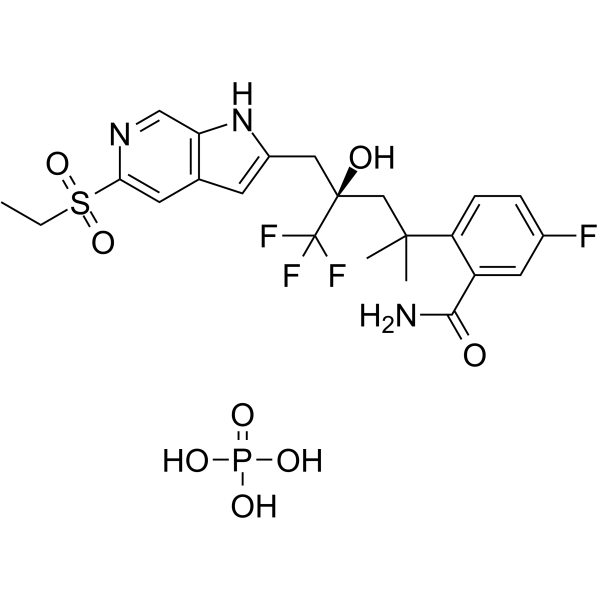
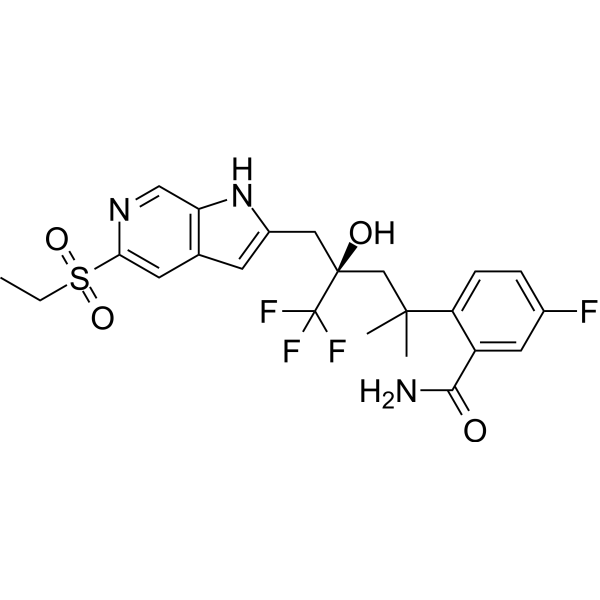
BI 653048 phosphate
BI 653048 phosphate is a selective and orally active nonsteroidal glucocorticoid (GC) agonist with an IC50 value of 55 nM. BI 653048 phosphate inhibits CP1A2, CYP2D6, CYP2C9, CYP2C19 and CYP3A4 isoforms’ activity and reduces affinity for the hERG ion channel (IC50>30 μM). BI 653048 phosphate is extracted from patent WO2005028501A1 (Compound 103), is also a HCV NS3 protease inhibitor that can reduce viral loads infected with the hepatitis C virus.
For research use only. We do not sell to patients.
- CAS No.: 1198784-97-2
- Formula: C23H28F4N3O8PS
- Molecular Weight:613.52
-
Storage:
Please store the product under the recommended conditions in the Certificate of Analysis.

To place orders, for customer services and technical support, please contact: MedChemExpress USA
Tel: 609-228-6898 E-mail: [email protected] [email protected]


-
 Biological Activity
-
Chemical Information
- Protocols
- Purity & Documentation
- References
-
 Help & FAQs




Biological Activity
Description
IC50 & Target
[2]|
CYP1A2 50 μM (IC50) |
CYP2D6 41 μM (IC50) |
CYP2C9 12 μM (IC50) |
CYP2C19 9 μM (IC50) |
CYP3A4 8 μM (IC50) |
In Vitro
BI 653048 phosphate exhibits an improved drug-like properties, inhibits CP1A2 ,CYP2D6 ,CYP2C9, CYP2C19 and CYP3A4 with IC50 values of 50 μM, 41 μM, 12 μM, 9 μM,and 8 μM, respectively[2]. BI 653048 phosphate reduces affinity for the hERG ion channel with an IC50>30 μM in recombinant HEK293 cells expressing the human ERG potassium channel[2]. BI 653048 phosphate inhibits TNF-stimulated IL-6 production in mouse RAW cells with an IC50 value of 100 nM[2].
MedChemExpress (MCE) has not independently confirmed the accuracy of these methods. They are for reference only. Further protocols information, click here.
In Vivo
MedChemExpress (MCE) has not independently confirmed the accuracy of these methods. They are for reference only.
-
Animal Model:Mice[2]
-
Dosage:3, 10, and 30 mg/kg
-
Administration:Oral administration
-
Result:Exhibited significant decreases for all measured histology parameters at high doses.
Clinical Trial
| NCT Number | Sponsor | Condition | Start Date |
Phase

|
|---|---|---|---|---|
| NCT01329991 | Plexxikon| | 2011-05 | PHASE1 |


Chemical Information
-
CAS No. 1198784-97-2
-
Molecular Weight 613.52
-
Formula C23H28F4N3O8PS
-
SMILES
O=C(N)C1=CC(F)=CC=C1C(C)(C)C[C@@](O)(CC(N2)=CC3=C2C=NC(S(=O)(CC)=O)=C3)C(F)(F)F.O=P(O)(O)O
-
Shipping
Room temperature in continental US; may vary elsewhere.
-
Storage
Please store the product under the recommended conditions in the Certificate of Analysis.

Protocols
-
Cell Cytotoxicity Assay
Cytotoxicity assays are usually based on the assessment of cell membrane damage, which can also be indirectly detected by measuring cell viability. Detection methods include MTT assay, CKK-8 assay, LDH assay and ATP assay, etc.
-
Research Protocol for Endocrine Diseases
Endocrine diseases often arise from disrupted hormone production, hormone signaling, or target-tissue responsiveness; for diabetes-focused endocrine disease models, insulin signaling regulates glucose uptake, hepatic glucose output, lipid metabolism, and β-cell compensation. Type 2 diabetes develops through interacting defects in insulin resistance, β-cell dysfunction, adipose inflammation, hepatic glucose overproduction, altered incretin signaling, and ectopic lipid metabolism. A major unresolved question is whether endocrine dysfunction is driven primarily by target-tissue insulin resistance, intrinsic β-cell failure, immune/inflammatory stress, or combined multi-organ failure that differs by disease stage.
-
Two-electrode voltage clamp in Xenopus oocytes
Two-electrode voltage clamp measures whole-oocyte membrane current from Xenopus oocytes expressing exogenous ion channels, receptors, or transporters; one intracellular microelectrode senses membrane voltage, and the second injects current so the amplifier can hold the membrane at command voltages while recording the compensating current as the functional readout. The method is suited to Xenopus oocytes because their large size supports microinjection and intracellular electrode impalement, but the large membrane area can limit voltage-clamp speed and accuracy, especially for large or fast currents.


Purity & Documentation
References
[1]. Reeves JT, et al. Development of a large scale asymmetric synthesis of the glucocorticoid agonist BI 653048 BS H3PO4.J Org Chem. 2013 Apr 19;78(8):3616-35. [Content Brief]
[2]. Harcken C, et al. Optimization of drug-like properties of nonsteroidal glucocorticoid mimetics and identification of a clinical candidate.ACS Med Chem Lett. 2014 Nov 20;5(12):1318-23. [Content Brief]
[3]. Montse Llinas-Brunet, et al. Latest bibliographic data on file with the International Bureau

Calculators
Concentration (start) × Volume (start) = Concentration (final) × Volume (final)


BI 653048 phosphate Related Classifications
HY-12946A Related Classifications
 Powered by Bioz