



Blasticidin A
Based on 1 publication(s) in Google Scholar
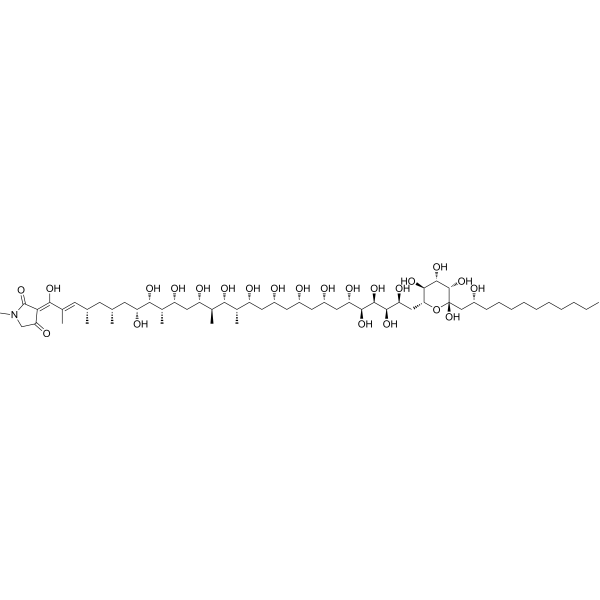
Blasticidin A ((+)-Blasticidin A) is a tetraamide acid derivative antibiotic produced by Streptomyces griseochromogenes, as well as a selective inhibitor of aflatoxin production. Blasticidin A exhibits antimicrobial activity against yeast. Blasticidin A can be used in research related to aflatoxin contamination (infection by Aspergillus sp.).
For research use only. We do not sell to patients.
- Purity : 95.00%
- CAS No.: 100513-53-9
- Formula: C58H107NO23
- Molecular Weight:1186.46
-
Storage:Powder -20°C, 3 years ; In solvent -80°C, 6 months , -20°C, 1 month

To place orders, for customer services and technical support, please contact: MedChemExpress USA
Tel: 609-228-6898 E-mail: [email protected] [email protected]


-
 Biological Activity
-
Chemical Information
- Protocols
- Purity & Documentation
- References
-
 Help & FAQs





Publications Citing Use of MedChemExpress (MCE) Blasticidin A
MoreAll Antibiotic Isoforms
More

Biological Activity
Description
In Vitro
Blasticidin A (0.25-0.5 μM) dose-dependently inhibits aflatoxin production by Aspergillus parasiticus NRRL2999 in liquid culture, achieving near-complete inhibition at 0.5 μM without significantly reducing mycelial growth[1].
Blasticidin A (0.03-0.5 μg/mL) dose-dependently inhibits aflatoxin production by Aspergillus parasiticus NRRL2999 on agar plates, achieving complete inhibition at 0.5 μg/mL, while also dose-dependently reducing fungal hyphal extension and altering colony morphology at higher concentrations[1].
Blasticidin A (1 μM; 30 min) alters the proteome of Saccharomyces cerevisiae strain W303, reducing ribosomal protein abundance, increasing Gpd1p abundance, and promoting shifts to phosphorylated forms of key translational and chaperone proteins[2].
Blasticidin A (1 μM; 30 min) does not alter transcription of ribosomal protein genes ASC1 and RPP0 but increases transcription of GPD1 in Saccharomyces cerevisiae strain W303[2].
Blasticidin A (0.1-1 μM; 60 min) inhibits galactose-induced 6×His-LacZ protein synthesis in a dose-dependent manner in plasmid-transformed Saccharomyces cerevisiae strain W303[2].
Blasticidin A potently and selectively inhibits aflatoxin production in Aspergillus parasiticus NRRL2999, with an IC50 of 0.25 μM for aflatoxin production and an IC50 of 1.6 μM for fungal growth, giving a selectivity ratio of 6.4[2].
Blasticidin A (0.3 mM; 24-36 h) alters the proteome of Aspergillus flavus IMF47798, reducing abundances of aflatoxin biosynthetic enzymes after 36 h and reducing abundances of multiple metabolic and hypothetical proteins while increasing glutathione S-transferase abundances after both 24 h and 36 h[2].
Blasticidin A selectively inhibits aflatoxin production in Aspergillus flavus IMF47798, with an IC50 of 0.25 μM for aflatoxin production and an IC50 of 1.6 μM for fungal growth[2].
MedChemExpress (MCE) has not independently confirmed the accuracy of these methods. They are for reference only.
-
Cell Line:Saccharomyces cerevisiae strain W303
-
Concentration:1 μM
-
Incubation Time:30 min
-
Result:Did not affect the mRNA levels of ribosomal protein genes ASC1 and RPP0.
Significantly increased the mRNA level of GPD1 relative to untreated control cells.


Chemical Information
-
CAS No. 100513-53-9
-
Appearance Solid
-
Molecular Weight 1186.46
-
Formula C58H107NO23
-
Color White to off-white
-
SMILES
OC(/C(C)=C/[C@@H](C)C[C@@H](C)C[C@@H](O)[C@H](O)[C@@H](C)[C@H](O)C[C@H](O)[C@H](C)[C@H](O)[C@@H](C)[C@H](O)C[C@H](O)C[C@H](O)C[C@H](O)C[C@H](O)[C@H](O)[C@@H](O)[C@H](O)[C@@H](O)C[C@H]1O[C@](O)([C@H]([C@H]([C@@H]1O)O)O)C[C@H](O)CCCCCCCCCC)=C2C(CN(C/2=O)C)=O
-
Synonyms
(+)-Blasticidin A
-
Shipping
Room temperature in continental US; may vary elsewhere.
-
Storage
Powder -20°C 3 years In solvent -80°C 6 months -20°C 1 month


Publications (1)
-
Journal Impact Factor
-
Most Recent
-
J Exp Clin Cancer Res
PHGDH activation fuels glioblastoma progression and radioresistance via serine synthesis pathway. [Abstract]2025 Mar 19;44(1):99. PMID: 40102981


Purity & Documentation
-
Data Sheet (269 KB)
-
SDS (394 KB)
- English - EN (394 KB)
- Français - FR (394 KB)
- Deutsch - DE (394 KB)
- Norwegian - NO (394 KB)
- Español - ES (394 KB)
- Swedish - SV (394 KB)
- Italian - IT (394 KB)
- Korean - KR (394 KB)
- Portuguese - PT (394 KB)
-
Handling Instructions (2659 KB)
References
[1]. Sakuda S, et al. Blasticidin A as an inhibitor of aflatoxin production by Aspergillus parasiticus. J Antibiot (Tokyo). 2000;53(11):1265-1271. [Content Brief]
[2]. Yoshinari T, et al. Inhibitory activity of blasticidin A, a strong aflatoxin production inhibitor, on protein synthesis of yeast: selective inhibition of aflatoxin production by protein synthesis inhibitors. J Antibiot (Tokyo). 2010;63(6):309-314. [Content Brief]

Calculators
Concentration (start) × Volume (start) = Concentration (final) × Volume (final)


Blasticidin A Related Classifications
HY-113542 Related Classifications
 Powered by Bioz