



Duroquinone

Based on 1 Customer Validation
Duroquinone (Tetramethylquinone) is a redox-active ubiquinone analog. Duroquinone exhibits highly efficient electron transfer activity in biological systems and can mediate a variety of transmembrane and enzymatic redox reactions. As an artificial electron donor or acceptor, Duroquinone directly inserts into and interferes with the mitochondrial respiratory chain and the chloroplast photosynthetic electron transport chain, thereby regulating or redirecting specific electron flows and the intracellular generation and metabolism of reactive oxygen species (ROS). Duroquinone also possesses antiparasitic activity. Duroquinone can be used in research on root-knot nematode infection, hypoxia/ischemia, non-small cell lung cancer, and liver cancer.
For research use only. We do not sell to patients.
- Purity : 99.85%
- CAS No.: 527-17-3
- Formula: C10H12O2
- Molecular Weight:164.20
-
Storage:
Store at room temperature 3 years.
In solvent -80°C, 2 years , -20°C, 1 year


To place orders, for customer services and technical support, please contact: MedChemExpress USA
Tel: 609-228-6898 E-mail: [email protected] [email protected]


-
 Biological Activity
-
Chemical Information
-
Solvent & Solubility
- Protocols
- Purity & Documentation
- References
-
 Help & FAQs



All Parasite Isoforms
More

Biological Activity
Description
Cellular Effect
|
Cell Line

|
Type | Value | Description | References |
|---|---|---|---|---|
| K562 | IC50 |
>50 μM
Compound: 6
|
In vitro cytotoxicity against Human Chronic Leukemia K562 cells
In vitro cytotoxicity against Human Chronic Leukemia K562 cells
|
[PMID: 8558523] |
| K562 | IC50 |
50 μM
Compound: 6
|
In vitro cytotoxicity against Human Chronic Leukemia K562 cells
In vitro cytotoxicity against Human Chronic Leukemia K562 cells
|
[PMID: 8558523] |
In Vitro
Duroquinone (24 h) is cytotoxic to MH22a murine hepatoma cells with a 24-h cL50 of 59.0 µM, and the RH1-resistant MH22a-R subline has a cL50 of 25.5 µM, indicating no cross-resistance[8].
Duroquinone (0.8 mM; 24 h) toxicity in A549 cells is protected against by NAC (3 mM), supporting ROS involvement in cell death[7].
Duroquinone (50 µM; 24 h) cytotoxicity in MH22a cells is partly oxidative-stress-dependent and is not sensitive to dicumarol[8].
Duroquinone (50-300 μM; 20 min prior illumination) in photoinactivated bovine heart mitochondria increased Complex I→III electron transfer while not affecting Complex II→III electron transfer[4].
Duroquinone (0-1.18 µM; 30 min) causes little or no additional oxidative DNA damage in wild-type V79 cells, even after glutathione depletion[1].
Duroquinone (0-38 µM; 30 min) reduces proliferation by approximately 50% at 1.2 µM in glutathione-depleted V79-hOR cells, whereas V79 cells show no effect even at 38 µM[1].
Duroquinone (10-100 μM; 3 h) selectively damages CA1 pyramidal neurons in OHSC, with 100 μM producing 64.16% CA1 damage versus 6.89% CA3 damage at 24 h after a 3-h exposure[6].
MedChemExpress (MCE) has not independently confirmed the accuracy of these methods. They are for reference only.
-
Cell Line:human nonsmall cell lung cancer A549 cells
-
Concentration:0.8 mM
-
Incubation Time:24 h
-
Result:Dicumarol reduced A549 cell survival after exposure.
Dicumarol dramatically enhanced cytotoxicity.
Survival without the inhibitor was normalized to 1.0.
-
Cell Line:human nonsmall cell lung cancer A549 cells
-
Concentration:0.8 mM
-
Incubation Time:24 h
-
Result:NAC protected A549 cells against toxicity.
Survival without antioxidant was normalized to 1.0.


Chemical Information
-
CAS No. 527-17-3
-
Appearance Solid
-
Molecular Weight 164.20
-
Formula C10H12O2
-
Color Light yellow to yellow
-
SMILES
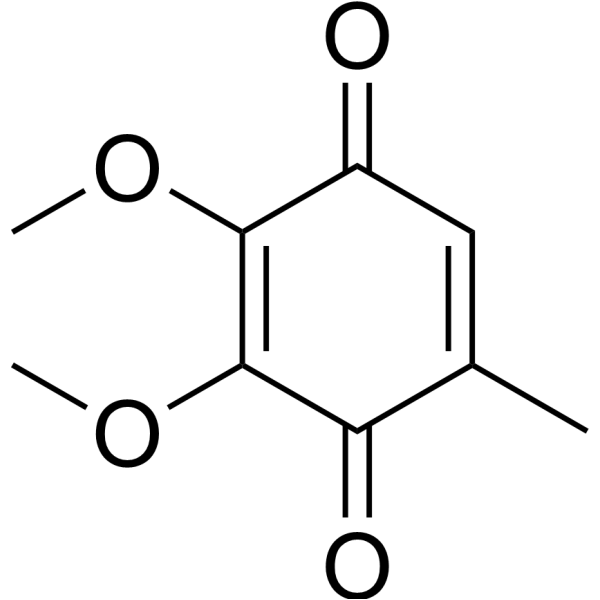
O=C1C(C)=C(C)C(C(C)=C1C)=O
-
Synonyms
Tetramethylquinone
-
Shipping
Room temperature in continental US; may vary elsewhere.
-
Storage
Store at room temperature 3 years
In solvent -80°C 2 years -20°C 1 year


Solvent & Solubility
In Vitro:
DMSO : 20 mg/mL (121.80 mM; Need ultrasonic; Hygroscopic DMSO has a significant impact on the solubility of product, please use newly opened DMSO)
Please refer to the solubility information to select the appropriate solvent. Once prepared, please aliquot and store the solution to prevent product inactivation from repeated freeze-thaw cycles.
Storage method and period of stock solution: -80°C, 2 years; -20°C, 1 year. When stored at -80°C, please use it within 2 years. When stored at -20°C, please use it within 1 year.
Concentration (start) × Volume (start) = Concentration (final) × Volume (final)


Purity & Documentation
-
Data Sheet (282 KB)
-
SDS (394 KB)
- English - EN (394 KB)
- Français - FR (394 KB)
- Deutsch - DE (394 KB)
- Norwegian - NO (394 KB)
- Español - ES (394 KB)
- Swedish - SV (394 KB)
- Italian - IT (394 KB)
- Korean - KR (394 KB)
- Portuguese - PT (394 KB)
-
Handling Instructions (2659 KB)
References


Complete Stock Solution Preparation Table
Please refer to the solubility information to select the appropriate solvent. Once prepared, please aliquot and store the solution to prevent product inactivation from repeated freeze-thaw cycles.
Storage method and period of stock solution: -80°C, 2 years; -20°C, 1 year. When stored at -80°C, please use it within 2 years. When stored at -20°C, please use it within 1 year.
| Optional Solvent | Concentration Solvent Mass | 1 mg | 5 mg | 10 mg | 25 mg |
|---|---|---|---|---|---|
| DMSO | 1 mM | 6.0901 mL | 30.4507 mL | 60.9013 mL | 152.2534 mL |
| 5 mM | 1.2180 mL | 6.0901 mL | 12.1803 mL | 30.4507 mL | |
| 10 mM | 0.6090 mL | 3.0451 mL | 6.0901 mL | 15.2253 mL | |
| 15 mM | 0.4060 mL | 2.0300 mL | 4.0601 mL | 10.1502 mL | |
| 20 mM | 0.3045 mL | 1.5225 mL | 3.0451 mL | 7.6127 mL | |
| 25 mM | 0.2436 mL | 1.2180 mL | 2.4361 mL | 6.0901 mL | |
| 30 mM | 0.2030 mL | 1.0150 mL | 2.0300 mL | 5.0751 mL | |
| 40 mM | 0.1523 mL | 0.7613 mL | 1.5225 mL | 3.8063 mL | |
| 50 mM | 0.1218 mL | 0.6090 mL | 1.2180 mL | 3.0451 mL | |
| 60 mM | 0.1015 mL | 0.5075 mL | 1.0150 mL | 2.5376 mL | |
| 80 mM | 0.0761 mL | 0.3806 mL | 0.7613 mL | 1.9032 mL | |
| 100 mM | 0.0609 mL | 0.3045 mL | 0.6090 mL | 1.5225 mL |


Duroquinone Related Classifications
HY-W100959 Related Classifications
 Powered by Bioz