



Protopine (Standard)
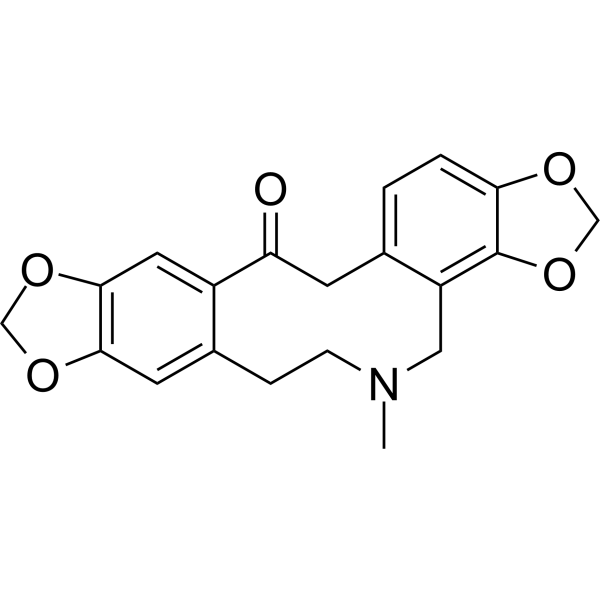
Protopine (Standard) is the analytical standard of Protopine. This product is intended for research and analytical applications. Protopine (Corydinine), an isoquinoline alkaloid, is a specific reversible and competitive inhibitor of acetylcholinesterase. Protopine exhibits anti-inflammation, anti-microbial, anti-angiogenic and anti-tumour activity.
Nos produits utilisent uniquement pour la recherche. Nous ne vendons pas aux patients.
- Pureté: 98%
- CAS No.: 130-86-9
- Formule: C₂₀H₁₉NO₅
- Masse moléculaire:353.37
-
Stockage:
Please store the product under the recommended conditions in the Certificate of Analysis.


To place orders, for customer services and technical support, please contact: MedChemExpress USA
Tel: 609-228-6898 E-mail: [email protected] [email protected]


-
 Product Information
-
Chemical Information
- Pureté et documentation
-
 Help & FAQs




Product Information
The compound is the grade of analytical standard, which is the reference standard supplied assay. It is commonly used in qualitative, quantitative and methodological research experiments in HPLC, GC and MS.


Chemical Information
-
CAS No. 130-86-9
-
Masse moléculaire 353.37
-
Formule C₂₀H₁₉NO₅
-
SMILES
O=C1CC2=CC=C3C(OCO3)=C2CN(C)CCC4=CC5=C(OCO5)C=C41
-
Synonyms
Corydinine (Standard)
-
Structure Classification
-
Initial Source
-
Livraison
Room temperature in continental US; may vary elsewhere.
-
Stockage
Please store the product under the recommended conditions in the Certificate of Analysis.


Pureté et documentation
Références
[1]. Kim SR, et, al. Protopine from Corydalis ternata has anticholinesterase and antiamnesic activities. Planta Med. 1999 Apr;65(3):218-21. [Content Brief]
[2]. Nie C, et, al. Protopine triggers apoptosis via the intrinsic pathway and regulation of ROS/PI3K/Akt signalling pathway in liver carcinoma. Cancer Cell Int. 2021 Jul 27;21(1):396. [Content Brief]
[3]. Xu LF, et al. Protopine inhibits serotonin transporter and noradrenaline transporter and has the antidepressant-like effect in mice models. Neuropharmacology. 2006 Jun;50(8):934-40. [Content Brief]
[4]. Xiao X, et al. Protective effect of protopine on the focal cerebral ischaemic injury in rats. Basic Clin Pharmacol Toxicol. 2007 Aug;101(2):85-9. [Content Brief]

Calculators
Concentration (start) × Volume (start) = Concentration (final) × Volume (final)


Protopine (Standard) Related Classifications
HY-N0793R Related Classifications
 Powered by Bioz