



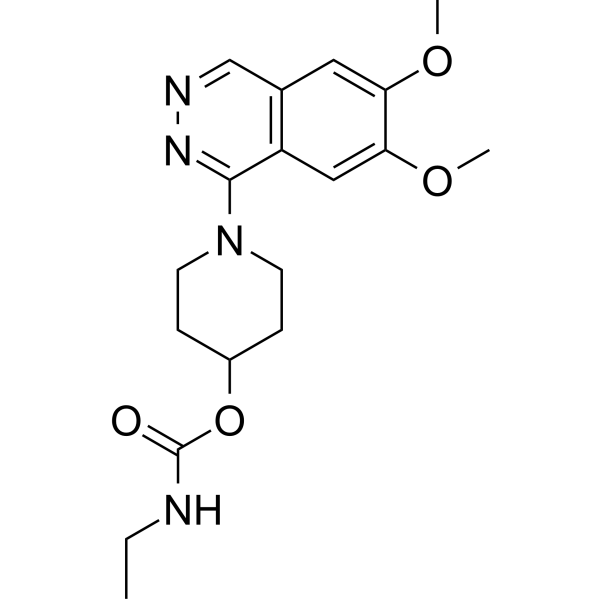
Carbazeran

Based on 1 Customer Validation
Carbazeran is a phosphodiesterase inhibitor. Carbazeran is oxidized by aldehyde oxidase/AOX1 to 4-oxo-carbazeran/hydroxycarbazeran, serving as an AOX1 probe and competitively inhibiting xanthine oxidase. Carbazeran can be used in research on congestive heart failure and chronic heart failure.
For research use only. We do not sell to patients.
- Purity : 99.94%
- CAS No.: 70724-25-3
- Formula: C18H24N4O4
- Molecular Weight:360.41
-
Storage:Powder -20°C, 3 years , 4°C, 2 years ; In solvent -80°C, 6 months , -20°C, 1 month

To place orders, for customer services and technical support, please contact: MedChemExpress USA
Tel: 609-228-6898 E-mail: [email protected] [email protected]


-
 Biological Activity
-
Chemical Information
-
Solvent & Solubility
- Protocols
- Purity & Documentation
- References
-
 Help & FAQs





Biological Activity
Description
In Vitro
Carbazeran selectively inhibits rat kidney cytosol cyclic AMP-specific KPDE-MQ-V and KPDE-MQ-IV with Ki values of 6-8.0 μM[1].
Carbazeran weakly inhibits bovine retinal cyclic GMP-specific phosphodiesterase with a Ki of 168 μM[1].
Carbazeran is a high-affinity substrate for guinea-pig and baboon liver aldehyde oxidase (Km 0.053 and 0.009 mM, respectively) and a competitive inhibitor of bovine milk xanthine oxidase (Ki 0.015 mM), with no interaction with rabbit liver aldehyde oxidase[2].
Carbazeran inhibits isolated cyclic AMP phosphodiesterase with an IC50 of 17.5 μM[7].
Carbazeran does not demonstrably inhibit cardiac Na+,K+-ATPase activity[7].
Carbazeran increases cyclic AMP levels in rabbit right ventricular papillary muscles[7].
Carbazeran (4-20 mM extracellular K+) restores contractility in potassium-depolarized rabbit papillary muscles[7].
MedChemExpress (MCE) has not independently confirmed the accuracy of these methods. They are for reference only. Further protocols information, click here.
Parmacokinetics


Chemical Information
-
CAS No. 70724-25-3
-
Appearance Solid
-
Molecular Weight 360.41
-
Formula C18H24N4O4
-
SMILES
COC1=CC2=C(C=C1OC)C=NN=C2N3CCC(OC(NCC)=O)CC3
-
Shipping
Room temperature in continental US; may vary elsewhere.
-
Storage
Powder -20°C 3 years 4°C 2 years In solvent -80°C 6 months -20°C 1 month


Solvent & Solubility
In Vitro:
DMSO : ≥ 100 mg/mL (277.46 mM; Hygroscopic DMSO has a significant impact on the solubility of product, please use newly opened DMSO)
* "≥" means soluble, but saturation unknown.
Please refer to the solubility information to select the appropriate solvent. Once prepared, please aliquot and store the solution to prevent product inactivation from repeated freeze-thaw cycles.
Storage method and period of stock solution: -80°C, 6 months; -20°C, 1 month. When stored at -80°C, please use it within 6 months. When stored at -20°C, please use it within 1 month.
Please refer to the solubility information to select the appropriate solvent. Once prepared, please aliquot and store the solution to prevent product inactivation from repeated freeze-thaw cycles.
Storage method and period of stock solution: -80°C, 6 months; -20°C, 1 month. When stored at -80°C, please use it within 6 months. When stored at -20°C, please use it within 1 month.
Concentration (start) × Volume (start) = Concentration (final) × Volume (final)
In Vivo:
Select the appropriate dissolution method based on your experimental animal and administration route.
- For the following dissolution methods, please ensure to first prepare a clear stock solution using an In Vitro approach and then sequentially add co-solvents:
- To ensure reliable experimental results, the clarified stock solution can be appropriately stored based on storage conditions. As for the working solution for In Vivo experiments, it is recommended to prepare freshly and use it on the same day.
- The percentages shown for the solvents indicate their volumetric ratio in the final prepared solution. If precipitation or phase separation occurs during preparation, heat and/or sonication can be used to aid dissolution.
Add each solvent one by one: 10% DMSO 40% PEG300 5% Tween-80 45% Saline
Solubility: ≥ 5 mg/mL (13.87 mM); Clear solution
This protocol yields a clear solution of ≥ 5 mg/mL (saturation unknown).
Taking 1 mL working solution as an example, add 100 μL DMSO stock solution (50.0 mg/mL) to 400 μL PEG300, and mix evenly; then add 50 μL Tween-80 and mix evenly; then add 450 μL Saline to adjust the volume to 1 mL.
Preparation of Saline: Dissolve 0.9 g sodium chloride in ddH₂O and dilute to 100 mL to obtain a clear Saline solution.
Add each solvent one by one: 10% DMSO 90% (20% SBE-β-CD in Saline)
Solubility: ≥ 5 mg/mL (13.87 mM); Clear solution
This protocol yields a clear solution of ≥ 5 mg/mL (saturation unknown).
Taking 1 mL working solution as an example, add 100 μL DMSO stock solution (50.0 mg/mL) to 900 μL 20% SBE-β-CD in Saline, and mix evenly.
Preparation of 20% SBE-β-CD in Saline (4°C, storage for one week): 2 g SBE-β-CD powder is dissolved in 10 mL Saline, completely dissolve until clear.
In Vivo Dissolution Calculator
Please enter the basic information of animal experiments:
-
-
-
-
Recommended: Prepare an additional quantity of animals to account for potential losses during experiments.
Please enter your animal formula composition:
-
%DMSO +
Recommended: Keep the proportion of DMSO in working solution below 2% if your animal is weak.
-
%+
-
+%Tween-80 + +
-
%Saline +
The co-solvents required include: DMSO, . All of co-solvents are available by MedChemExpress (MCE). , Tween 80. All of co-solvents are available by MedChemExpress (MCE).
Working solution concentration: 0.22 mg/mL
Method for preparing stock solution: mg drug dissolved in μL DMSO. Stock solution concentration: mg/mL.
1. Take μL DMSO stock solution;
2. Add μL .
μL , mix evenly;
3. Then add μL Tween 80, mix evenly;
4. Then add μL
Please ensure that the stock solution in the first step is dissolved to a clear state, and add co-solvents in sequence. You can use ultrasonic heating (ultrasonic cleaner, recommended frequency 20-40 kHz), vortexing, etc. to assist dissolution.

Protocols
-
Research Protocol for Cardiovascular Diseases
Cardiovascular disease can be modeled as maladaptive cardiac remodeling, where ischemic injury or pressure overload activates inflammatory signaling, fibroblast activation, extracellular-matrix deposition, cardiomyocyte hypertrophy, vascular remodeling, and progressive ventricular dysfunction. The TGF-β/SMAD axis is a central profibrotic pathway after myocardial injury and pressure overload, while innate immune and cytokine pathways regulate leukocyte recruitment, scar formation, and adverse remodeling. Key unresolved questions include which inflammatory signals are reparative versus harmful, when fibrosis is protective versus maladaptive, and whether pathway inhibition improves function without weakening necessary infarct healing or compensatory remodeling.


Purity & Documentation
-
Data Sheet (284 KB)
-
SDS (480 KB)
- English - EN (480 KB)
- Français - FR (480 KB)
- Deutsch - DE (480 KB)
- Norwegian - NO (480 KB)
- Español - ES (480 KB)
- Swedish - SV (480 KB)
- Italian - IT (480 KB)
- Korean - KR (480 KB)
- Portuguese - PT (480 KB)
-
Handling Instructions (2659 KB)
References
[1]. Hoey M, et al. Identification and selective inhibition of four distinct soluble forms of cyclic nucleotide phosphodiesterase activity from kidney. Biochemical pharmacology. 1990 Jul 15;40(2):193-202. [Content Brief]
[3]. Fu C, et al. Aldehyde oxidase 1 (AOX1) in human liver cytosols: quantitative characterization of AOX1 expression level and activity relationship. Drug metabolism and disposition: the biological fate of chemicals. 2013 Oct;41(10):1797-804. [Content Brief]
[9]. Uehara S, et al. Human Aldehyde Oxidase 1-Mediated Carbazeran Oxidation in Chimeric TK-NOG Mice Transplanted with Human Hepatocytes. Drug metabolism and disposition: the biological fate of chemicals. 2020 Jul;48(7):580-586. [Content Brief]


Complete Stock Solution Preparation Table
Please refer to the solubility information to select the appropriate solvent. Once prepared, please aliquot and store the solution to prevent product inactivation from repeated freeze-thaw cycles.
Storage method and period of stock solution: -80°C, 6 months; -20°C, 1 month. When stored at -80°C, please use it within 6 months. When stored at -20°C, please use it within 1 month.
| Optional Solvent | Concentration Solvent Mass | 1 mg | 5 mg | 10 mg | 25 mg |
|---|---|---|---|---|---|
| DMSO | 1 mM | 2.7746 mL | 13.8731 mL | 27.7462 mL | 69.3654 mL |
| 5 mM | 0.5549 mL | 2.7746 mL | 5.5492 mL | 13.8731 mL | |
| 10 mM | 0.2775 mL | 1.3873 mL | 2.7746 mL | 6.9365 mL | |
| 15 mM | 0.1850 mL | 0.9249 mL | 1.8497 mL | 4.6244 mL | |
| 20 mM | 0.1387 mL | 0.6937 mL | 1.3873 mL | 3.4683 mL | |
| 25 mM | 0.1110 mL | 0.5549 mL | 1.1098 mL | 2.7746 mL | |
| 30 mM | 0.0925 mL | 0.4624 mL | 0.9249 mL | 2.3122 mL | |
| 40 mM | 0.0694 mL | 0.3468 mL | 0.6937 mL | 1.7341 mL | |
| 50 mM | 0.0555 mL | 0.2775 mL | 0.5549 mL | 1.3873 mL | |
| 60 mM | 0.0462 mL | 0.2312 mL | 0.4624 mL | 1.1561 mL | |
| 80 mM | 0.0347 mL | 0.1734 mL | 0.3468 mL | 0.8671 mL | |
| 100 mM | 0.0277 mL | 0.1387 mL | 0.2775 mL | 0.6937 mL |


Carbazeran Related Classifications
HY-B0051 Related Classifications
 Powered by Bioz