



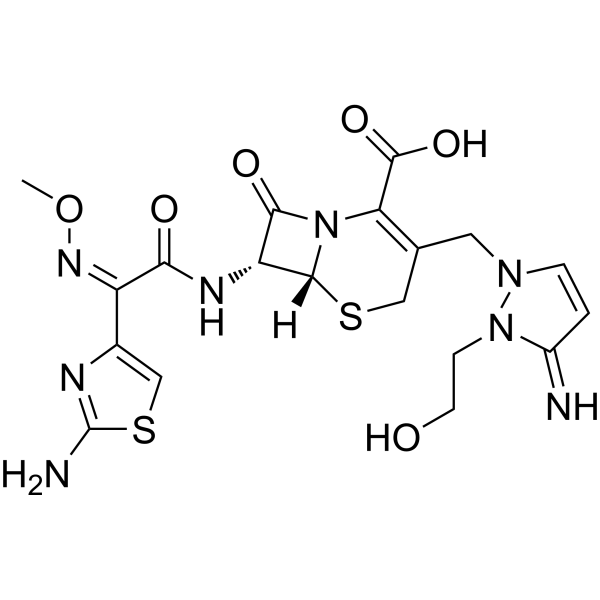
Cefoselis
Cefoselis, the fourth gen-eration of cephalosporin, is a β-lactam antibiotic. Cefoselis exhibits good activity against a wide range of Gram-positive and Gram-negative organisms. Cefoselis penetrates the blood-brain barrier.
Para uso exclusivo en investigación. No vendemos a pacientes.
- No. CAS: 122841-10-5
- Fòrmula: C19H22N8O6S2
- Peso molecular:522.56
-
Almacenamiento:
Please store the product under the recommended conditions in the Certificate of Analysis.

To place orders, for customer services and technical support, please contact: MedChemExpress USA
Tel: 609-228-6898 E-mail: [email protected] [email protected]


-
 Actividad biológica
-
Chemical Information
- Protocolo
- Pureza y Documentación
- Referencias
-
 Help & FAQs


Ver todos los productos específicos de isoformas Antibiotic
More

Actividad biológica
Descripciòn
IC50 & Target
|
β-lactam |
In Vitro
Cefoselis, a new parenteral cephalosporin, was active against clinical isolates of both gram-positive and gram-negative aerobic bacteria. The activity of Cefoselis was similar to that of cefpirome and cefepime and generally superior to that of ceftazidime. Cefoselis showed potent antibacterial activity against Hemophilus influenzae and Moraxella catarrhalis.Cefoselis was highly active against MSSA and MSCNS. Cefoselis was poor in the activity against MRSA,MRCNS,PRSP and Enterococcus faecalis,and no activity for Enterococcus faecium.
MedChemExpress (MCE) has not independently confirmed the accuracy of these methods. They are for reference only.


Chemical Information
-
No. CAS 122841-10-5
-
Peso molecular 522.56
-
Fòrmula C19H22N8O6S2
-
SMILES
O=C(C(N12)=C(CN3N(CCO)C(C=C3)=N)CS[C@]2([H])[C@H](NC(/C(C4=CSC(N)=N4)=N\OC)=O)C1=O)O
-
Envío
Room temperature in continental US; may vary elsewhere.
-
Almacenamiento
Please store the product under the recommended conditions in the Certificate of Analysis.


Pureza y Documentación
Referencias
[1]. K Ohtaki, et al. Cefoselis, a beta-lactam antibiotic, easily penetrates the blood-brain barrier and causes seizure independently by glutamate release. J Neural Transm (Vienna). 2004 Dec;111(12):1523-35. [Content Brief]
[3]. King, A., L. Bethune, and I. Phillips, The Comparative In Vitro Activity of FK-037 (Cefoselis), a New Broad-Spectrum Cephalosporin. Clin Microbiol Infect, 1995. 1(1): p. 13-17. [Content Brief]

Calculators
Concentration (start) × Volume (start) = Concentration (final) × Volume (final)


Cefoselis Related Classifications
HY-B0186 Related Classifications
 Powered by Bioz