



Necitumumab

Based on 1 Customer Validation
Necitumumab (11F8; IMC-11F8; LY3012211) is a human IgG monoclonal antibody directed against EGFR. Necitumumab binds to the EGF binding site of EGFR, blocks ligand binding, neutralizes ligand-induced EGFR phosphorylation and downstream signaling, induces EGFR internalization and degradation, and mediates antibody-dependent cellular cytotoxicity (ADCC) in EGFR-expressing cells. Necitumumab enhances antitumour activity in combination with Gemcitabine (HY-17026) and Cisplatin (HY-17394) in murine non-small-cell lung cancer xenograft models. Necitumumab can be used in research on cancers such as non-small cell lung cancer and colorectal cancer.
Nur für Forschungszwecke. Wir verkaufen nicht an Patienten.
- Reinheit : 99.82%
- CAS. Nr.: 906805-06-9
- Molecular Weight:144.78 kDa
-
Speicherung:Shipping with dry ice
Please store the product under the recommended conditions in the Certificate of Analysis.

To place orders, for customer services and technical support, please contact: MedChemExpress USA
Tel: 609-228-6898 E-mail: [email protected] [email protected]


-
 Biologische Aktivität
-
Chemical Information
- Protokoll
- Reinheit & Dokumentation
- Verweise
-
 Help & FAQs


-

HY-P99041
PanitumumabAnti-EGFR Monoclonal Antibody -

HY-P9905
CetuximabEGFR Inhibitor -

HY-P99155
ZalutumumabEGFR Antibody -

HY-P99849
DepatuxizumabMonoclonal Antibody -

HY-P9969
MatuzumabEGFR Inhibitor -

HY-P9S0008
Cetuximab (PBS)EGFR Antibody Inhibitor -

HY-P9977
AmivantamabEGFR-MET Dual Antibody -
HY-P9968
NimotuzumabEGFR Antibody -

HY-P99275
PatritumabNeutralizing Antibody -
HY-P9956
SiltuximabAnti-IL-6 mAb -
HY-P99201
ZilovertamabROR1 Inhibitor -

HY-P9925
BrodalumabAnti-IL-17R mAb


Biologische Aktivität
Beschreibung
IC50 & Target
ERBB1/EGFR/HER1
In Vitro
Necitumumab specifically binds to the EGF binding site of human EGFR with high affinity (dissociation constant 0.32 nM) and blocks ligand binding with an IC50 of 1-2 nM[1].
Necitumumab neutralizes ligand-induced EGFR phosphorylation with an IC50 of 1.5-3 nM[1].
Necitumumab inhibits the proliferation of EGFR-dependent colorectal tumour cells with an IC50 of 0.8-1.0 nM[1].
Necitumumab induces EGFR internalization and degradation, and triggers antibody-dependent cellular cytotoxicity in EGFR-expressing human cells[1].
MedChemExpress (MCE) has not independently confirmed the accuracy of these methods. They are for reference only.
In Vivo
MedChemExpress (MCE) has not independently confirmed the accuracy of these methods. They are for reference only.
-
Animal Model:Athymic mice with A549 and NCI-H1650 xenograft (5-6 week; female)[2]
-
Dosage:60 mg/kg
-
Administration:I.p.; twice a week for 2 weeks
-
Result:Reduced tumor volume.
Increased Ki-67-positive.
- Kinase activity and phosphorylation assays
- Western Blot
- Cell Cytotoxicity Assay
- Mammalian live/dead viability and cytotoxicity staining
- Patient-Derived Xenograft (PDX)
- Splenic/Portal-Vein Liver Metastasis Xenograft
- Protocol for Kinase activity and phosphorylation assays
- Subcutaneous Cell-Line-Derived Xenograft
- Orthotopic Cell-Line Xenograft
- Cell Viability Determination by MTT Colorimetric Assay
- Intraperitoneal/Peritoneal Dissemination Xenograft
Clinical Trial
| NCT Number | Sponsor | Condition | Start Date |
Phase

|
|---|---|---|---|---|
| NCT01329991 | 2011-05 | PHASE1 |
Anwendung
ELISA, FACS, Functional assay
Verified Bioactivity
-
 Immobilized Human ERBB1/EGFR/HER1, His Tag can bind Necitumumab. The EC50 for this effect is 11.47 ng/mL.
-
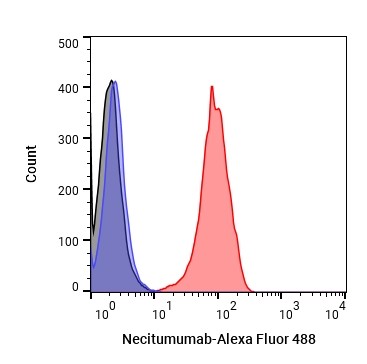 Flow Cytometry analysis of A431 cells labelling ERBB1/EGFR/HER1 (red) with Necitumumab (anti-ERBB1/EGFR/HER1) (HY-P9964). Goat Anti-Human IgG (Alexa Fluor 488) (HY-P83776) at a dilution of 1/1000 was used as the secondary antibody. Blue-Human IgG1 kappa (HY-P99001). Black-Unlabelled control, cells without incubation with primary antibody.


Product Details
-
CAS. Nr. 906805-06-9
-
Accession P00533
-
Synonyms 11F8; IMC-11F8; LY3012211
-
Molecular Weight 144.78 kDa
-
Species Reactivity
Human
-
Conjugated
Unconjugated
-
Isotype
Human IgG1 kappa
-
Recommend Isotype Controls
-
Format
-
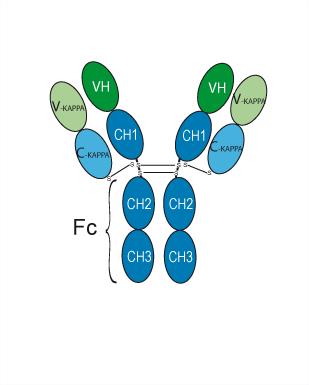
Human IgG1 kappa
-
Product Properties
-
Appearance
Liquid
-
Formulation
Please refer to the lot-specific COA for specific buffer information.
-
Reinheit
99.82%
-
Reconstitution
The product can be reconstituted/diluted with sterile PBS or saline.
-
Storage & Stability
Please store the product under the recommended conditions in the Certificate of Analysis.
-
Versand
Shipping with dry ice.
Reinheit & Dokumentation


Verweise
[1]. Garnock-Jones KP, et al. Necitumumab: First Global Approval. Drugs. 2016;76(2):283-289. [Content Brief]
[2]. Samakoglu S, et al. Preclinical rationale for combining an EGFR antibody with cisplatin/gemcitabine for the treatment of NSCLC. Cancer Genomics Proteomics. 2012 Mar-Apr;9(2):77-92. [Content Brief]

Calculators
Konzentration (Stammlösung) × Volumen (Stammlösung) = Konzentration (Ziellösung) × Volumen (Ziellösung)


Necitumumab Related Classifications
HY-P9964 Related Classifications
 Powered by Bioz