



TAT peptide
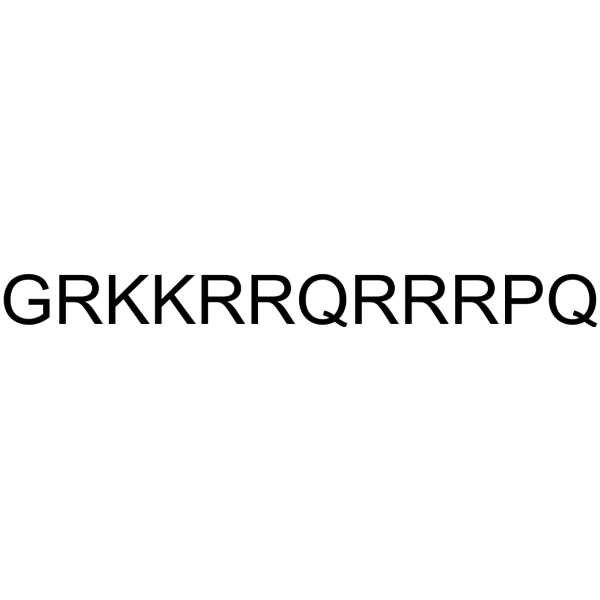
TAT peptide is a cell penetrating peptide (GRKKRRQRRRPQ) derived from the trans-activating transcriptional activator (Tat) from HIV-1.
The free form of the compound is prone to instability, it is advisable to consider the stable salt form (TAT peptide TFA) that retains the same biological activity.
Nos produits utilisent uniquement pour la recherche. Nous ne vendons pas aux patients.
- Formule: C65H124N34O15
- Masse moléculaire:1621.91
-
Stockage:
Sealed storage, away from moisture.
Powder -80°C, 2 years , -20°C, 1 year* In solvent : -80°C, 6 months; -20°C, 1 month (sealed storage, away from moisture)

To place orders, for customer services and technical support, please contact: MedChemExpress USA
Tel: 609-228-6898 E-mail: [email protected] [email protected]
Other In-stock Forms of TAT peptide


-
 Activité biologique
-
Chemical Information
-
Solvant et solubilité
- Pureté et documentation
- Références
-
 Help & FAQs




Activité biologique
Description
In Vitro
TAT peptide is a cell penetrating peptide (GRKKRRQRRRPQ) derived from the trans-activating transcriptional activator (Tat) from HIV-1[1]. TAT peptide (GRKKRRQRRRPQ) functionalized hybrid nanoparticles are also studied due to their combined magnetic enrichment and optical detection for cell separation and rapid cell labelling. A cell viability assay reveals good biocompatibility of these hybrid nanoparticles[2].
MedChemExpress (MCE) has not independently confirmed the accuracy of these methods. They are for reference only.


Chemical Information
-
Appearance Solid
-
Masse moléculaire 1621.91
-
Formule C65H124N34O15
-
Color White to off-white
-
Sequence
Gly-Arg-Lys-Lys-Arg-Arg-Gln-Arg-Arg-Arg-Pro-Gln
-
Sequence Shortening
GRKKRRQRRRPQ
-
Livraison
Room temperature in continental US; may vary elsewhere.
-
Stockage
Sealed storage, away from moisture
Powder -80°C 2 years -20°C 1 year * In solvent : -80°C, 6 months; -20°C, 1 month (sealed storage, away from moisture)


Solvant et solubilité
In Vitro
H2O
Peptide Solubility and Storage Guidelines:
1. Calculate the length of the peptide.
2. Calculate the overall charge of the entire peptide according to the following table:
| Contents | Assign value | |
|---|---|---|
| Acidic amino acid | Asp (D), Glu (E), and the C-terminal -COOH. | -1 |
| Basic amino acid | Arg (R), Lys (K), His (H), and the N-terminal -NH2 | +1 |
| Neutral amino acid | Gly (G), Ala (A), Leu (L), Ile (I), Val (V), Cys (C), Met (M), Thr (T), Ser (S), Phe (F), Tyr (Y), Trp (W), Pro (P), Asn (N), Gln (Q) | 0 |
3. Recommended solution:
| Overall charge of peptide | Details |
|---|---|
| Negative (<0) |
1. Try to dissolve the peptide in water first. 2. If water fails, add NH4OH (<50 μL). 3. If the peptide still does not dissolve, add DMSO (50-100 μL) to solubilize the peptide. |
| Positive (>0) |
1. Try to dissolve the peptide in water first. 2. If water fails, try dissolving the peptide in a 10%-30% acetic acid solution. 3. If the peptide still does not dissolve, try dissolving the peptide in a small amount of DMSO. |
| Zero (=0) |
1. Try to dissolve the peptide in organic solvent (acetonitrile, methanol, etc.) first. 2. For very hydrophobic peptides, try dissolving the peptide in a small amount of DMSO, and then dilute the solution with water to the desired concentration. |


Pureté et documentation


Références
[1]. Orzáez M, et al. Intrinsic caspase-8 activation mediates sensitization of erlotinib-resistant tumor cells toerlotinib/cell-cycle inhibitors combination treatment. Cell Death Dis. 2012 Oct 25;3:e415. [Content Brief]
[2]. Lou L, et al. Functionalized magnetic-fluorescent hybrid nanoparticles for cell labelling. Nanoscale. 2011 May;3(5):2315-23. [Content Brief]

Calculators
Concentration (start) × Volume (start) = Concentration (final) × Volume (final)


TAT peptide Related Classifications
HY-P0282 Related Classifications
 Powered by Bioz