



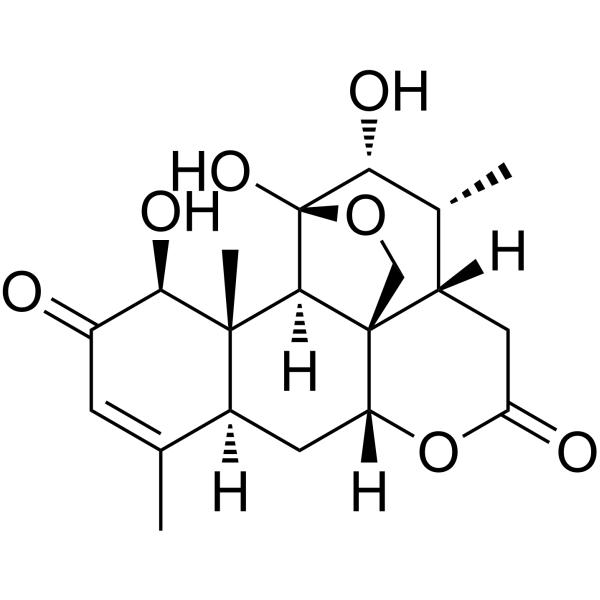
Chaparrinone
Chaparrinone is a quassinoid that can be isolated from the root of Eurycoma harmandiana. Chaparrinone has antimalarial and cytotoxic activities against Plasmodium falciparum and P-388 cells (IC50: 0.037 and 0.34 μg/mL respectively).
For research use only. We do not sell to patients.
- CAS No.: 22611-34-3
- Formula: C20H26O7
- Molecular Weight:378.42
-
Storage:
Please store the product under the recommended conditions in the Certificate of Analysis.

To place orders, for customer services and technical support, please contact: MedChemExpress USA
Tel: 609-228-6898 E-mail: [email protected] [email protected]


-
 Biological Activity
-
Chemical Information
- Protocols
- Purity & Documentation
- References
-
 Help & FAQs


All Parasite Isoforms
More

Biological Activity
Description
Cellular Effect
|
Cell Line

|
Type | Value | Description | References |
|---|---|---|---|---|
| BT-549 | IC50 |
0.8 μg/mL
Compound: chaparrinone
|
Cytotoxicity against human BT549 cells after 2 to 7 days by neutral red assay
Cytotoxicity against human BT549 cells after 2 to 7 days by neutral red assay
|
[PMID: 8984156] |
| Hep 3B2 | IC50 |
2.17 μM
Compound: 4
|
Cytotoxicity against human Hep3B cells measured after 48 hrs by MTT assay
Cytotoxicity against human Hep3B cells measured after 48 hrs by MTT assay
|
[PMID: 23290052] |
| HepG2 | IC50 |
>50 μM
Compound: 4
|
Cytotoxicity against human adriamycin-resistant HepG2 cells measured after 48 hrs by MTT assay
Cytotoxicity against human adriamycin-resistant HepG2 cells measured after 48 hrs by MTT assay
|
[PMID: 23290052] |
| HepG2 | IC50 |
1.2 μM
Compound: 4
|
Cytotoxicity against human HepG2 cells measured after 48 hrs by MTT assay
Cytotoxicity against human HepG2 cells measured after 48 hrs by MTT assay
|
[PMID: 23290052] |
| HL-60 | EC50 |
2.4 μM
Compound: 26
|
Induction of cell differentiation in human HL60 cells assessed as superoxide anion production after 4 days by NBT reduction assay
Induction of cell differentiation in human HL60 cells assessed as superoxide anion production after 4 days by NBT reduction assay
|
[PMID: 11754601] |
| HL-60 | IC50 |
1.2 μM
Compound: 26
|
Antiproliferative activity against human HL60 cells assessed as inhibition of [3H]thymidine incorporation after 4 days by liquid scintillation counter
Antiproliferative activity against human HL60 cells assessed as inhibition of [3H]thymidine incorporation after 4 days by liquid scintillation counter
|
[PMID: 11754601] |
| HL-60 | IC50 |
5 μM
Compound: 26
|
Cytotoxicity against human HL60 cells assessed as loss of membrane integrity after 4 days by trypan blue exclusion assay
Cytotoxicity against human HL60 cells assessed as loss of membrane integrity after 4 days by trypan blue exclusion assay
|
[PMID: 11754601] |
| K562 | IC50 |
1.8 μg/mL
Compound: chaparrinone
|
Cytotoxicity against human K562 cells after 2 to 7 days by neutral red assay
Cytotoxicity against human K562 cells after 2 to 7 days by neutral red assay
|
[PMID: 8984156] |
| KB | ED50 |
0.025 μg/mL
Compound: 2, NSC-288754
|
Cytotoxicity against human KB cells by NCI method
Cytotoxicity against human KB cells by NCI method
|
[PMID: 6875576] |
| KB | IC50 |
1.2 μg/mL
Compound: chaparrinone
|
Cytotoxicity against human KB cells after 2 to 7 days by neutral red assay
Cytotoxicity against human KB cells after 2 to 7 days by neutral red assay
|
[PMID: 8984156] |
| P388 | IC50 |
0.92 μg/mL
Compound: 6
|
Cytotoxicity against mouse P388 cells after 3 days by MTT assay
Cytotoxicity against mouse P388 cells after 3 days by MTT assay
|
[PMID: 9644063] |
| SK-OV-3 | IC50 |
0.5 μg/mL
Compound: chaparrinone
|
Cytotoxicity against human SKOV3 cells after 2 to 7 days by neutral red assay
Cytotoxicity against human SKOV3 cells after 2 to 7 days by neutral red assay
|
[PMID: 8984156] |
| Vero | IC50 |
1.5 μg/mL
Compound: chaparrinone
|
Cytotoxicity against african green monkey Vero cells after 2 to 7 days by neutral red assay
Cytotoxicity against african green monkey Vero cells after 2 to 7 days by neutral red assay
|
[PMID: 8984156] |


Chemical Information
-
CAS No. 22611-34-3
-
Molecular Weight 378.42
-
Formula C20H26O7
-
SMILES
C[C@@]12[C@]3([H])[C@@]45[C@@](OC(C[C@@]4([H])[C@H]([C@H]([C@@]3(OC5)O)O)C)=O)([H])C[C@@]1([H])C(C)=CC([C@H]2O)=O
-
Structure Classification
-
Initial Source
-
Shipping
Room temperature in continental US; may vary elsewhere.
-
Storage
Please store the product under the recommended conditions in the Certificate of Analysis.

Protocols
-
Cell Cytotoxicity Assay
Cytotoxicity assays are usually based on the assessment of cell membrane damage, which can also be indirectly detected by measuring cell viability. Detection methods include MTT assay, CKK-8 assay, LDH assay and ATP assay, etc.
-
Cell Viability Determination by MTT Colorimetric Assay
The following protocol uses the MTT colorimetric assay as a classic literature-established method for assessing cell viability/metabolic activity in cultured mammalian cells. MTT[3-(4,5-dimethylthiazol-2-yl)-2,5-diphenyltetrazolium bromide] is reduced by metabolically active cells to a colored formazan product; the amount of formazan is quantified spectrophotometrically and provides an indirect measure of metabolically active viable cells. Importantly, MTT reduction reflects cellular oxidoreductase/metabolic activity rather than an absolute direct count of living cells, so changes in cellular metabolism can alter the signal independently of cell number.


Purity & Documentation
References
[1]. Kanchanapoom T, et al. Quassinoids from Eurycoma harmandiana. Phytochemistry. 2001 Aug;57(8):1205-8. [Content Brief]
[2]. François G, et al. Antimalarial and cytotoxic potential of four quassinoids from Hannoa chlorantha and Hannoa klaineana, and their structure-activity relationships. Int J Parasitol. 1998 Apr;28(4):635-40. [Content Brief]

Calculators
Concentration (start) × Volume (start) = Concentration (final) × Volume (final)


Chaparrinone Related Classifications
HY-N12151 Related Classifications
 Powered by Bioz