



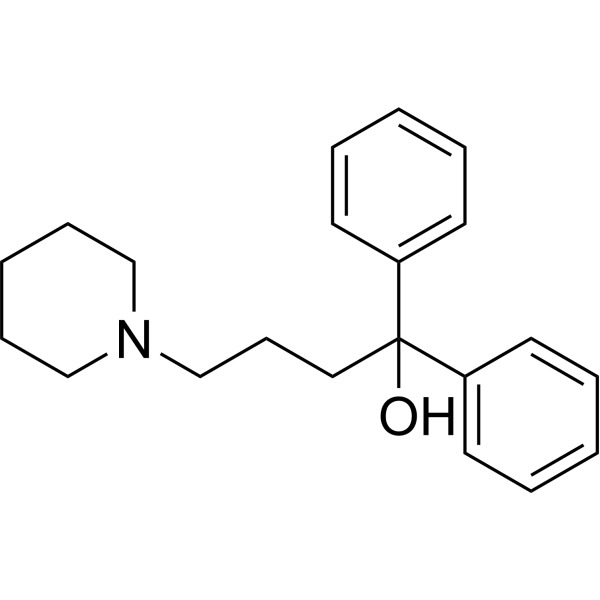
Diphenidol
Based on 1 publication(s) in Google Scholar
Diphenidol is a non-selective muscarinic M1-M4 receptor antagonist, has anti-arrhythmic activity. Diphenidol is also a potent non-specific blocker of voltage-gated ion channels (Na+, K+, and Ca2+) in neuronal cells. Diphenidol can be used in the study of antivertigo and antinausea.
For research use only. We do not sell to patients.
- CAS No.: 972-02-1
- Formula: C21H27NO
- Molecular Weight:309.45
-
Storage:
Please store the product under the recommended conditions in the Certificate of Analysis.

To place orders, for customer services and technical support, please contact: MedChemExpress USA
Tel: 609-228-6898 E-mail: [email protected] [email protected]


-
 Biological Activity
-
Chemical Information
- Protocols
- Purity & Documentation
- References
-
 Help & FAQs


Publications Citing Use of MedChemExpress (MCE) Diphenidol
More

Biological Activity
Description
IC50 & Target
|
mAChR1 |
mAChR2 |
mAChR3 |
mAChR4 |
In Vitro
Diphenidol inhibits sodium currents and produces spinal anesthesia, and at -70 and -100 mV holding potentials, N2A cells IC50 were 0.77 and 62.6 μM, respectively [3].
MedChemExpress (MCE) has not independently confirmed the accuracy of these methods. They are for reference only. Further protocols information, click here.
In Vivo
Diphenidol (30 mg/kg, injected intravenously) has an inhibitory effect on exercise and morphine-induced vomiting in pica rats[5].
MedChemExpress (MCE) has not independently confirmed the accuracy of these methods. They are for reference only.
-
Animal Model:Chronic constriction injury (CCI) rat model[4]
-
Dosage:2, 10 μmoL/kg
-
Administration:i.p., berore surgery, and on postoperative days 3, 6, 7, 11, 13 and 14.
-
Result:Increased mechanical withdrawal threshold in a dose-dependent manner and decreased the TNF-α level.
Clinical Trial
| NCT Number | Sponsor | Condition | Start Date |
Phase

|
|---|---|---|---|---|
| NCT01329991 | Plexxikon| | 2011-05 | PHASE1 |


Chemical Information
-
CAS No. 972-02-1
-
Molecular Weight 309.45
-
Formula C21H27NO
-
SMILES
OC(C1=CC=CC=C1)(C2=CC=CC=C2)CCCN3CCCCC3
-
Shipping
Room temperature in continental US; may vary elsewhere.
-
Storage
Please store the product under the recommended conditions in the Certificate of Analysis.


Publications (1)
-
Journal Impact Factor
-
Most Recent
-
Int J Mol Sci
Bile Canalicular Bitter Taste Receptors Inhibit β-Adrenergic Receptor-Induced Lipolysis in Steatotic Hepatocytes. [Abstract]2026 Apr 2;27(7):3226. PMID: 41977407

Protocols
-
Ca2+ Staining Technique
Ca2+ staining is an experimental technique that utilizes specific fluorescent probes (such as Fluo-4 AM, Fura-2, etc.) to qualitatively or quantitatively detect dynamic changes in intracellular Ca2+ concentrations; this is achieved by monitoring the changes in fluorescent signals generated when these probes bind to free intracellular calcium ions. The underlying principle relies primarily on the presence of chelating groups within the probe's molecular structure that possess high affinity for calcium ions.


Purity & Documentation
References
[1]. Leung YM, et al. Inhibition of voltage-gated K+ channels and Ca2+ channels by diphenidol. Pharmacol Rep. 2012;64(3):739-44. [Content Brief]
[2]. Leung YM, et al. Diphenidol inhibited sodium currents and produced spinal anesthesia. Neuropharmacology. 2010 Jun;58(7):1147-52. [Content Brief]
[3]. Leung YM, et al. Diphenidol inhibited sodium currents and produced spinal anesthesia. Neuropharmacology. 2010 Jun;58(7):1147-52. [Content Brief]
[4]. Chen YW, et al. Systemic diphenidol reduces neuropathic allodynia and TNF-alpha overexpression in rats after chronic constriction injury. Neurosci Lett. 2013 Sep 27;552:62-5. [Content Brief]
[5]. Takeda N, et al. Neuropharmacological mechanisms of emesis. I. Effects of antiemetic drugs on motion- and apomorphine-induced pica in rats. Methods Find Exp Clin Pharmacol. 1995 Nov;17(9):589-90. [Content Brief]

Calculators
Concentration (start) × Volume (start) = Concentration (final) × Volume (final)


Diphenidol Related Classifications
HY-A0270 Related Classifications
 Powered by Bioz