



Emfizatamab

Based on 1 Customer Validation
Emfizatamab (GNC-038) is a monoclonal antibody against CD19/CD3E/TNFRSF9/PD-L1. Emfizatamab exhibits antitumor activity, being capable of activating CD3 and 4-1BB signals on T cells, as well as targeting the high expression of CD19 or PD-L1 on tumor cells. Emfizatamab functions as a CD19-specific T cell engager by mediating direct antitumor activity. Emfizatamab can also overcome the inhibition of T cells by PD-L1. Emfizatamab can be used in the research of tumors such as R/R non-Hodgkin lymphoma or acute lymphoblastic leukemia.
Nur für Forschungszwecke. Wir verkaufen nicht an Patienten.
- Reinheit : 95.495%
- CAS. Nr.: 2559704-23-1
- Molecular Weight:303.229 kDa
-
Speicherung:
Please store the product under the recommended conditions in the Certificate of Analysis.


To place orders, for customer services and technical support, please contact: MedChemExpress USA
Tel: 609-228-6898 E-mail: [email protected] [email protected]


-
 Biologische Aktivität
-
Chemical Information
- Protokoll
- Reinheit & Dokumentation
- Verweise
-
 Help & FAQs


Alle TNF Receptor Isoform-spezifische Produkte anzeigen
More

Biologische Aktivität
Beschreibung
Isotype
(scFv-kappa-heavy)-G1_L-kappa-(scFv-heavy-kappa)-(scFv-heavy-kappa)
Recommend Isotype Controls
Species Reactivity
Human
IC50 & Target
CD19 & CD3E & TNFRSF9 & PD-L1
In Vitro
Emfizatamab can effectively mediate the killing of CD19+ tumor cells by T cells, and the T cell degranulation and IFN-γ production induced by it are similar to those of Blinatumomab (HY-P9963)[2].
Emfizatamab (48 h) produces more IFN-γ, IL-2 and TNF-α in peripheral blood mononuclear cells (PBMC) compared to Blinatumomab, but there is no significant difference in IL-6 production[2].
MedChemExpress (MCE) has not independently confirmed the accuracy of these methods. They are for reference only.
Clinical Trial
| NCT Number | Sponsor | Condition | Start Date |
Phase

|
|---|---|---|---|---|
| NCT01329991 | Plexxikon| | 2011-05 | PHASE1 |
Gene ID
Accession
Conjugated
Unconjugated
Reconsititution
The product can be reconstituted/diluted with sterile PBS or saline.
Format
-
(scFv-kappa-heavy)-G1_L-kappa-(scFv-heavy-kappa)-(scFv-heavy-kappa)

Anwendung
ELISA, FACS, Functional assay
Verified Bioactivity
-
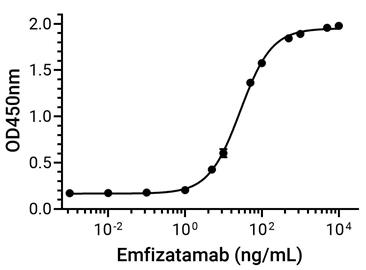 Immobilized CD3 epsilon Protein, Human (HEK293, His, HY-P70506) can bind Emfizatamab. The EC50 for this effect is 27.4 ng/mL.
 -
 Immobilized CD19 Protein, Human (HEK293, His, HY-P74330) can bind Emfizatamab. The EC50 for this effect is 57.29 ng/mL.
 -
 Immobilized 4-1BB/TNFRSF9 Protein, Human, HY-P7125) can bind Emfizatamab. The EC50 for this effect is 1.358 ng/mL.
 -
 Immobilized PD-L1 Protein, Human (HEK293, HY-P73361) can bind Emfizatamab. The EC50 for this effect is 64.84 ng/mL.


Chemical Information
-
CAS. Nr. 2559704-23-1
-
Appearance Liquid
-
Molecular Weight 303.229 kDa
-
Color Colorless to off-white
-
SMILES
[Emfizatamab]
-
Synonyms
GNC-038
-
Versand
Shipping with dry ice.
-
Formulation
Please refer to the lot-specific COA for specific buffer information.
-
Speicherung
Please store the product under the recommended conditions in the Certificate of Analysis.


Reinheit & Dokumentation
-
Data Sheet (258 KB)
-
SDS (251 KB)
- English - EN (251 KB)
- Français - FR (251 KB)
- Deutsch - DE (251 KB)
- Norwegian - NO (251 KB)
- Español - ES (251 KB)
- Swedish - SV (251 KB)
- Italian - IT (251 KB)
- Korean - KR (251 KB)
- Portuguese - PT (251 KB)
-
Inhibitory Antibodies User Guide (603 KB)
Verweise

Calculators
Konzentration (Stammlösung) × Volumen (Stammlösung) = Konzentration (Ziellösung) × Volumen (Ziellösung)


Emfizatamab Related Classifications
HY-P99914 Related Classifications
 Powered by Bioz