



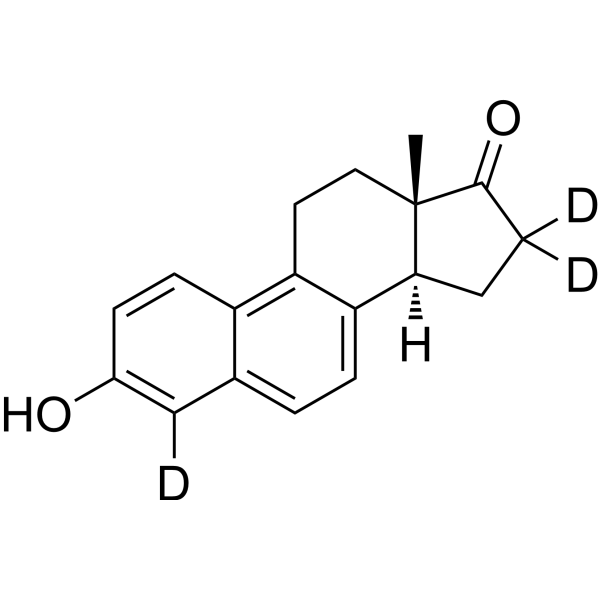
Equilenin-4,16,16-d3
Equilenin-4,16,16-d3 is the d3-labeled Equilenin (HY-116865). Equilenin is a B-ring unsaturated estrogen discovered in pregnant mare urine and is one of the major components of Premarin, a drug commonly used for estrogen replacement therapy. Equilenin binds to estrogen receptors in the body and exerts effects similar to endogenous estrogens. Equilenin weakly binds to and activates the aryl hydrocarbon receptor (AhR) to induce CYP1A1 expression. Equilenin exhibits high affinity for sex hormone-binding globulin (SHBG/SBP) and is metabolized by CYP1A1/1B1 to 4-hydroxy and 17β-dihydro derivatives. Equilenin is used in breast cancer-related research.
For research use only. We do not sell to patients.
- CAS No.: 56588-54-6
- Formula: C18H15D3O2
- Molecular Weight:269.35
-
Storage:
Please store the product under the recommended conditions in the Certificate of Analysis.

To place orders, for customer services and technical support, please contact: MedChemExpress USA
Tel: 609-228-6898 E-mail: [email protected] [email protected]


-
 Biological Activity
-
Chemical Information
- Protocols
- Purity & Documentation
- References
-
 Help & FAQs


All Endogenous Metabolite Isoforms
More

Biological Activity
Description
Application
1. This compound can be used as a tracer
2. This compound can be used as an internal standard for quantitative analysis by NMR, GC-MS, or LC-MS.


Chemical Information
-
CAS No. 56588-54-6
-
Unlabeled CAS 517-09-9
-
Molecular Weight 269.35
-
Formula C18H15D3O2
-
SMILES
C[C@]1([C@](CC2([2H])[2H])([H])C3=CC=C4C([2H])=C(O)C=CC4=C3CC1)C2=O
-
Shipping
Room temperature in continental US; may vary elsewhere.
-
Storage
Please store the product under the recommended conditions in the Certificate of Analysis.

Protocols
-
RNA extraction experimental
By lysing cells, releasing RNA, and removing impurities such as proteins and DNA, high-purity RNA products are finally obtained. The commonly used traditional method is the guanidine isothiocyanate/phenol/chloroform method (Trizol), which is suitable for a variety of animal materials including animal tissues, microorganisms, cultured cells, etc., and most plant materials.
-
Research Protocol for Endocrine Diseases
Endocrine diseases often arise from disrupted hormone production, hormone signaling, or target-tissue responsiveness; for diabetes-focused endocrine disease models, insulin signaling regulates glucose uptake, hepatic glucose output, lipid metabolism, and β-cell compensation. Type 2 diabetes develops through interacting defects in insulin resistance, β-cell dysfunction, adipose inflammation, hepatic glucose overproduction, altered incretin signaling, and ectopic lipid metabolism. A major unresolved question is whether endocrine dysfunction is driven primarily by target-tissue insulin resistance, intrinsic β-cell failure, immune/inflammatory stress, or combined multi-organ failure that differs by disease stage.
-
Breast Cancer Modeling
Breast cancer is a heterogeneous cancer, and it has been distinguished into four subtypes: luminal A, luminal B, HER2-positive and basal-like. Molecular mutations, epigenetic alterations, hormone exposure and immune microenvironment are related to the progression of breast cancer.


Purity & Documentation
References

Calculators
Concentration (start) × Volume (start) = Concentration (final) × Volume (final)


Equilenin-4,16,16-d3 Related Classifications
HY-116865S Related Classifications
 Powered by Bioz
Keywords
- Equilenin-4,16,16-d3
- 56588-54-6
- Isotope-Labeled Compounds
- Endogenous Metabolite
- Aryl Hydrocarbon Receptor
- Cytochrome P450
- medaka embryos
- dihydrotestosterone
- 17β-dihydroequilenin
- aryl hydrocarbon receptor
- ethoxyresorufin O-deethylase
- CYP1A1
- cytochrome P450 1B1
- sex steroid-binding protein
- catechol O-methyltransferase
- cytochrome P450 1A1
- Inhibitor
- inhibitor
- inhibit