



ERRα antagonist-2

Based on 1 Customer Validation
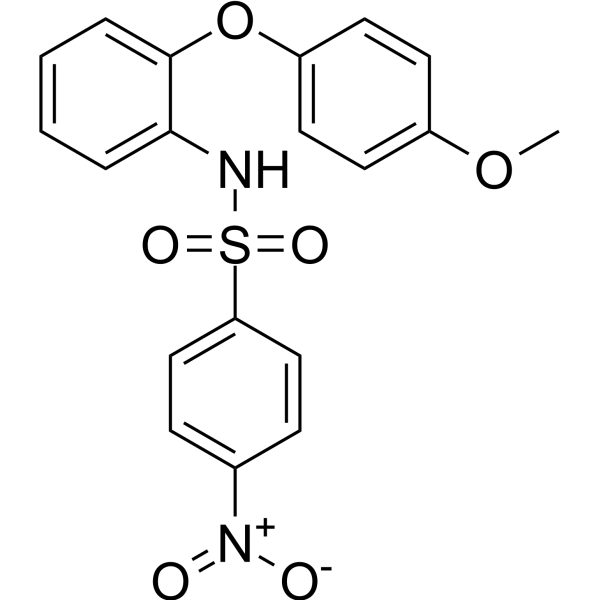
ERRα antagonist-2 (Compound 11) is a potential ERRα (estrogen related receptor α) inverse agonist with an IC50 of 0.80 μM. ERRα antagonist-2 suppresses the migration and invasion of the ER-negative MDA-MB-231 cell line. ERRα antagonist-2 inhibits breast cancer growth in vivo.
For research use only. We do not sell to patients.
- Purity : 99.07%
- CAS No.: 3032965-02-6
- Formula: C19H16N2O6S
- Molecular Weight:400.41
-
Storage:Powder -20°C, 3 years , 4°C, 2 years ; In solvent -80°C, 6 months , -20°C, 1 month

To place orders, for customer services and technical support, please contact: MedChemExpress USA
Tel: 609-228-6898 E-mail: [email protected] [email protected]


-
 Biological Activity
-
Chemical Information
-
Solvent & Solubility
- Protocols
- Purity & Documentation
- References
-
 Help & FAQs




Biological Activity
Description
IC50 & Target
|
ERRα 0.80 μM (IC50) |


Chemical Information
-
CAS No. 3032965-02-6
-
Appearance Solid
-
Molecular Weight 400.41
-
Formula C19H16N2O6S
-
Color Light yellow to yellow
-
SMILES
COC1=CC=C(C=C1)OC2=CC=CC=C2NS(=O)(C3=CC=C([N+]([O-])=O)C=C3)=O
-
Shipping
Room temperature in continental US; may vary elsewhere.
-
Storage
Powder -20°C 3 years 4°C 2 years In solvent -80°C 6 months -20°C 1 month


Solvent & Solubility
In Vitro:
DMSO : 250 mg/mL (624.36 mM; Need ultrasonic; Hygroscopic DMSO has a significant impact on the solubility of product, please use newly opened DMSO)
Please refer to the solubility information to select the appropriate solvent. Once prepared, please aliquot and store the solution to prevent product inactivation from repeated freeze-thaw cycles.
Storage method and period of stock solution: -80°C, 6 months; -20°C, 1 month. When stored at -80°C, please use it within 6 months. When stored at -20°C, please use it within 1 month.
Please refer to the solubility information to select the appropriate solvent. Once prepared, please aliquot and store the solution to prevent product inactivation from repeated freeze-thaw cycles.
Storage method and period of stock solution: -80°C, 6 months; -20°C, 1 month. When stored at -80°C, please use it within 6 months. When stored at -20°C, please use it within 1 month.
Concentration (start) × Volume (start) = Concentration (final) × Volume (final)

Protocols
-
Cell Cytotoxicity Assay
Cytotoxicity assays are usually based on the assessment of cell membrane damage, which can also be indirectly detected by measuring cell viability. Detection methods include MTT assay, CKK-8 assay, LDH assay and ATP assay, etc.
-
Cell migration
Cell migration is a method that plays an important role in wound healing, cell differentiation, embryonic development, etc.
-
Research Protocol for Endocrine Diseases
Endocrine diseases often arise from disrupted hormone production, hormone signaling, or target-tissue responsiveness; for diabetes-focused endocrine disease models, insulin signaling regulates glucose uptake, hepatic glucose output, lipid metabolism, and β-cell compensation. Type 2 diabetes develops through interacting defects in insulin resistance, β-cell dysfunction, adipose inflammation, hepatic glucose overproduction, altered incretin signaling, and ectopic lipid metabolism. A major unresolved question is whether endocrine dysfunction is driven primarily by target-tissue insulin resistance, intrinsic β-cell failure, immune/inflammatory stress, or combined multi-organ failure that differs by disease stage.
-
Cell invasion
Cell invasion is the ability of cells to migrate from one area to another via the extracellular matrix. Cell invasion is the response of normal and cancer cells to chemical and mechanical stimuli. Before migrating to a new region, the extracellular matrix is degraded by proteases within the cell. Cell invasion often occurs during wound repair, vascularization and inflammation, abnormal tissue invasion, and tumor cell metastasis.
-
Breast Cancer Modeling
Breast cancer is a heterogeneous cancer, and it has been distinguished into four subtypes: luminal A, luminal B, HER2-positive and basal-like. Molecular mutations, epigenetic alterations, hormone exposure and immune microenvironment are related to the progression of breast cancer.


Purity & Documentation
-
Data Sheet (276 KB)
-
SDS (252 KB)
- English - EN (252 KB)
- Français - FR (252 KB)
- Deutsch - DE (252 KB)
- Norwegian - NO (252 KB)
- Español - ES (252 KB)
- Swedish - SV (252 KB)
- Italian - IT (252 KB)
- Korean - KR (252 KB)
- Portuguese - PT (252 KB)
-
Handling Instructions (2659 KB)
References


Complete Stock Solution Preparation Table
Please refer to the solubility information to select the appropriate solvent. Once prepared, please aliquot and store the solution to prevent product inactivation from repeated freeze-thaw cycles.
Storage method and period of stock solution: -80°C, 6 months; -20°C, 1 month. When stored at -80°C, please use it within 6 months. When stored at -20°C, please use it within 1 month.
| Optional Solvent | Concentration Solvent Mass | 1 mg | 5 mg | 10 mg | 25 mg |
|---|---|---|---|---|---|
| DMSO | 1 mM | 2.4974 mL | 12.4872 mL | 24.9744 mL | 62.4360 mL |
| 5 mM | 0.4995 mL | 2.4974 mL | 4.9949 mL | 12.4872 mL | |
| 10 mM | 0.2497 mL | 1.2487 mL | 2.4974 mL | 6.2436 mL | |
| 15 mM | 0.1665 mL | 0.8325 mL | 1.6650 mL | 4.1624 mL | |
| 20 mM | 0.1249 mL | 0.6244 mL | 1.2487 mL | 3.1218 mL | |
| 25 mM | 0.0999 mL | 0.4995 mL | 0.9990 mL | 2.4974 mL | |
| 30 mM | 0.0832 mL | 0.4162 mL | 0.8325 mL | 2.0812 mL | |
| 40 mM | 0.0624 mL | 0.3122 mL | 0.6244 mL | 1.5609 mL | |
| 50 mM | 0.0499 mL | 0.2497 mL | 0.4995 mL | 1.2487 mL | |
| 60 mM | 0.0416 mL | 0.2081 mL | 0.4162 mL | 1.0406 mL | |
| 80 mM | 0.0312 mL | 0.1561 mL | 0.3122 mL | 0.7805 mL | |
| 100 mM | 0.0250 mL | 0.1249 mL | 0.2497 mL | 0.6244 mL |


ERRα antagonist-2 Related Classifications
HY-144699 Related Classifications
 Powered by Bioz