



CCT196969

Based on 1 Customer Validation
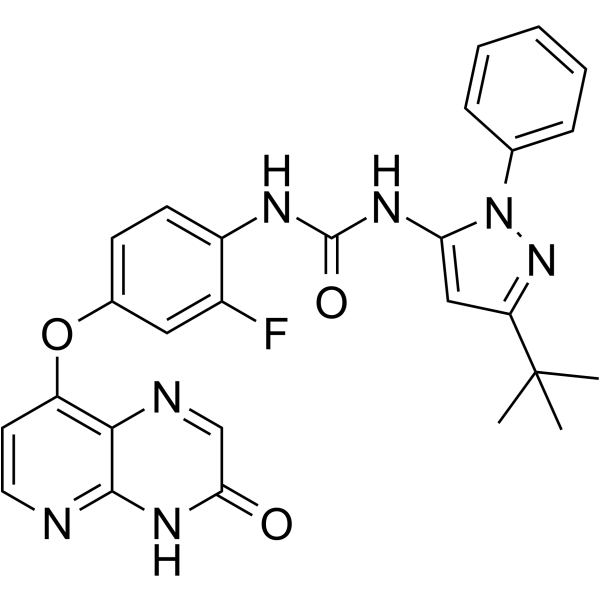
CCT196969 is a pan-Raf inhibitor, which inhibits B-Raf, BRafV600E and CRAF with IC50s of 0.1, 0.04, and 0.01 μM, respectively.
For research use only. We do not sell to patients.
- Purity: 99.67%
- CAS No.: 1163719-56-9
- Formula: C27H24FN7O3
- Molecular Weight:513.52
-
Storage:Powder -20°C, 3 years , 4°C, 2 years ; In solvent -80°C, 2 years , -20°C, 1 year

To place orders, for customer services and technical support, please contact: MedChemExpress USA
Tel: 609-228-6898 E-mail: [email protected] [email protected]


-
 Biological Activity
-
Chemical Information
-
Solvent & Solubility
- Protocol
- Purity & Documentation
- References
-
 Help & FAQs
-

Immunology/Inflammation Compound Library
HY-L007
-
Kinase Inhibitor Library
HY-L009
-
MAPK Compound Library
HY-L010
-
Anti-Cancer Compound Library
HY-L025
-
Oxygen Sensing Compound Library
HY-L045
-
Ferroptosis Compound Library
HY-L051
-
Glutamine Metabolism Compound Library
HY-L064
-
Anti-Pancreatic Cancer Compound Library
HY-L077
-
Anti-Obesity Compound Library
HY-L087
-
Anti-Liver Cancer Compound Library
HY-L101
-
Anti-Colorectal Cancer Compound Library
HY-L103
-
Membrane Receptor-targeted Compound Library
HY-L150
-
Serine/Threonine Kinase Inhibitor Library
HY-L164
-
Multi-Target Compound Library
HY-L176
-
Bioactive Compound Library Max
HY-L181
-
MCE Bioactive Compound Library
HY-L001V
-
Bioactive Compound Library
HY-L001
-
Anti-Brain Cancer Compound Library
HY-L188
-
Protein Kinase Compound Library
HY-L196
-
Cell Proliferation Compound Library
HY-L201
-
High-Throughput Bioactive Compound Library
HY-L205
-
Posttranslational Modification Library
HY-L226




Biological Activity
|
BRafV600E 0.04 μM (IC50) |
Braf 0.1 μM (IC50) |
CRAF 0.01 μM (IC50) |
LCK 0.02 μM (IC50) |
SRC 0.03 μM (IC50) |
|
Cell Line

|
Type | Value | Description | References |
|---|---|---|---|---|
| A-375 | IC50 |
12 μM
Compound: 128
|
Antiproliferative activity against human A-375 cells assessed as inhibition of cell viability
Antiproliferative activity against human A-375 cells assessed as inhibition of cell viability
|
[PMID: 32798788] |
| WM 266-4 | IC50 |
15 nM
Compound: 14; CCT196969
|
Cytotoxicity in human WM266.4 cells after 72 hrs by CellTiter-Glo assay
Cytotoxicity in human WM266.4 cells after 72 hrs by CellTiter-Glo assay
|
[PMID: 29461827] |
CCT196969 is a pan-Raf inhibitor with anti-SRC activity. CCT196969 is an orally available, well-tolerated B-Raf inhibitor that directly inhibits B-RafV600E in cells. CCT196969 inhibits B-Raf at 100 nM and B-RafV600E at 40 nM. It inhibits CRaf at 12 nM, SRC at 26 nM, and LCK at 14 nM. CCT196969 is active against melanoma and colorectal cancer cell lines that are mutant for B-Raf. CCT196969 induces caspase 3 and PARP cleavage, demonstrating that it induces apoptosis[1].
MedChemExpress (MCE) has not independently confirmed the accuracy of these methods. They are for reference only.
MedChemExpress (MCE) has not independently confirmed the accuracy of these methods. They are for reference only.


Chemical Information
-
CAS No. 1163719-56-9
-
Appearance Solid
-
Molecular Weight 513.52
-
Formula C27H24FN7O3
-
Color White to off-white
-
SMILES
O=C1NC2=NC=CC(OC3=CC=C(NC(NC4=CC(C(C)(C)C)=NN4C5=CC=CC=C5)=O)C(F)=C3)=C2N=C1
-
Shipping
Room temperature in continental US; may vary elsewhere.
-
Storage
Powder -20°C 3 years 4°C 2 years In solvent -80°C 2 years -20°C 1 year


Solvent & Solubility
DMSO : ≥ 32 mg/mL (62.32 mM; Hygroscopic DMSO has a significant impact on the solubility of product, please use newly opened DMSO)
* "≥" means soluble, but saturation unknown.
Please refer to the solubility information to select the appropriate solvent. Once prepared, please aliquot and store the solution to prevent product inactivation from repeated freeze-thaw cycles.
Storage method and period of stock solution: -80°C, 2 years; -20°C, 1 year. When stored at -80°C, please use it within 2 years. When stored at -20°C, please use it within 1 year.
Please refer to the solubility information to select the appropriate solvent. Once prepared, please aliquot and store the solution to prevent product inactivation from repeated freeze-thaw cycles.
Storage method and period of stock solution: -80°C, 2 years; -20°C, 1 year. When stored at -80°C, please use it within 2 years. When stored at -20°C, please use it within 1 year.
Concentration (start) × Volume (start) = Concentration (final) × Volume (final)
Select the appropriate dissolution method based on your experimental animal and administration route.
- For the following dissolution methods, please ensure to first prepare a clear stock solution using an In Vitro approach and then sequentially add co-solvents:
- To ensure reliable experimental results, the clarified stock solution can be appropriately stored based on storage conditions. As for the working solution for In Vivo experiments, it is recommended to prepare freshly and use it on the same day.
- The percentages shown for the solvents indicate their volumetric ratio in the final prepared solution. If precipitation or phase separation occurs during preparation, heat and/or sonication can be used to aid dissolution.
Add each solvent one by one: 10% DMSO 40% PEG300 5% Tween-80 45% Saline
Solubility: ≥ 2.08 mg/mL (4.05 mM); Clear solution
This protocol yields a clear solution of ≥ 2.08 mg/mL (saturation unknown).
Taking 1 mL working solution as an example, add 100 μL DMSO stock solution (20.8 mg/mL) to 400 μL PEG300, and mix evenly; then add 50 μL Tween-80 and mix evenly; then add 450 μL Saline to adjust the volume to 1 mL.
Preparation of Saline: Dissolve 0.9 g sodium chloride in ddH₂O and dilute to 100 mL to obtain a clear Saline solution.
Add each solvent one by one: 10% DMSO 90% (20% SBE-β-CD in Saline)
Solubility: ≥ 2.08 mg/mL (4.05 mM); Clear solution
This protocol yields a clear solution of ≥ 2.08 mg/mL (saturation unknown).
Taking 1 mL working solution as an example, add 100 μL DMSO stock solution (20.8 mg/mL) to 900 μL 20% SBE-β-CD in Saline, and mix evenly.
Preparation of 20% SBE-β-CD in Saline (4°C, storage for one week): 2 g SBE-β-CD powder is dissolved in 10 mL Saline, completely dissolve until clear.
Please enter the basic information of animal experiments:
-
-
-
-
Recommended: Prepare an additional quantity of animals to account for potential losses during experiments.
Please enter your animal formula composition:
-
%DMSO +
Recommended: Keep the proportion of DMSO in working solution below 2% if your animal is weak.
-
%+
-
+%Tween-80 + +
-
%Saline +
The co-solvents required include: DMSO, . All of co-solvents are available by MedChemExpress (MCE). , Tween 80. All of co-solvents are available by MedChemExpress (MCE).
Working solution concentration: 0.22 mg/mL
Method for preparing stock solution: mg drug dissolved in μL DMSO. Stock solution concentration: mg/mL.
1. Take μL DMSO stock solution;
2. Add μL .
μL , mix evenly;
3. Then add μL Tween 80, mix evenly;
4. Then add μL
Please ensure that the stock solution in the first step is dissolved to a clear state, and add co-solvents in sequence. You can use ultrasonic heating (ultrasonic cleaner, recommended frequency 20-40 kHz), vortexing, etc. to assist dissolution.

Protocol
Cultured cells are seeded into 96-well plates (2,000 cells per well). At 24 hr later, serial dilutions of the B-Raf inhibitors PLX4720 and SB590885, the MEK inhibitor PD184352, or compounds CCT241161 and CCT196969 are added. Cells are incubated for a further 72 hr, and viability is measured by CellTiter-Glo assays. Relative survival in the presence of drugs is normalized to the untreated controls after background subtraction[1].
MedChemExpress (MCE) has not independently confirmed the accuracy of these methods. They are for reference only.
Mice: Tumors are established in female nude mice. Treatment is by oral gavage daily with vehicle (5% DMSO, 95% water), 90 mg/kg PLX4720, 20 mg/kg CCT196969, or 20 mg/kg CCT241161. All the inhibitors are administered 7 days/week, with no weekend break. Tumor size is determined by caliper measurements of tumor length, width, and depth; volume is calculated as volume = 0.5236×length×width×depth (in millimeters)[1].
MedChemExpress (MCE) has not independently confirmed the accuracy of these methods. They are for reference only.


Purity & Documentation
-
Data Sheet (281 KB)
-
SDS (393 KB)
- English - EN (393 KB)
- Français - FR (393 KB)
- Deutsch - DE (393 KB)
- Norwegian - NO (393 KB)
- Español - ES (393 KB)
- Swedish - SV (393 KB)
- Italian - IT (393 KB)
- Korean - KR (393 KB)
- Portuguese - PT (393 KB)
-
Handling Instructions (2659 KB)
References


Complete Stock Solution Preparation Table
Please refer to the solubility information to select the appropriate solvent. Once prepared, please aliquot and store the solution to prevent product inactivation from repeated freeze-thaw cycles.
Storage method and period of stock solution: -80°C, 2 years; -20°C, 1 year. When stored at -80°C, please use it within 2 years. When stored at -20°C, please use it within 1 year.
| Optional Solvent | Concentration Solvent Mass | 1 mg | 5 mg | 10 mg | 25 mg |
|---|---|---|---|---|---|
| DMSO | 1 mM | 1.9473 mL | 9.7367 mL | 19.4734 mL | 48.6836 mL |
| 5 mM | 0.3895 mL | 1.9473 mL | 3.8947 mL | 9.7367 mL | |
| 10 mM | 0.1947 mL | 0.9737 mL | 1.9473 mL | 4.8684 mL | |
| 15 mM | 0.1298 mL | 0.6491 mL | 1.2982 mL | 3.2456 mL | |
| 20 mM | 0.0974 mL | 0.4868 mL | 0.9737 mL | 2.4342 mL | |
| 25 mM | 0.0779 mL | 0.3895 mL | 0.7789 mL | 1.9473 mL | |
| 30 mM | 0.0649 mL | 0.3246 mL | 0.6491 mL | 1.6228 mL | |
| 40 mM | 0.0487 mL | 0.2434 mL | 0.4868 mL | 1.2171 mL | |
| 50 mM | 0.0389 mL | 0.1947 mL | 0.3895 mL | 0.9737 mL | |
| 60 mM | 0.0325 mL | 0.1623 mL | 0.3246 mL | 0.8114 mL |


CCT196969 Related Classifications
HY-12846 Related Classifications
 Powered by Bioz