



FPL 62064

Based on 1 Customer Validation
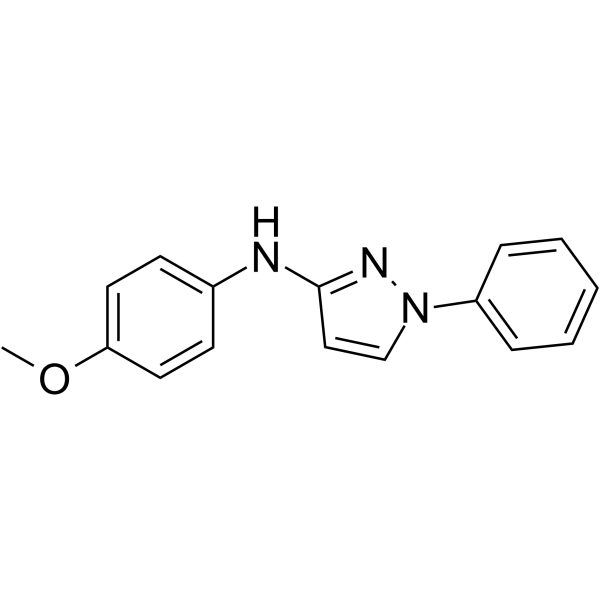
FPL 62064 is a potent 5-lipoxygenase (5-LOX) and COX dual inhibitor, with IC50 values of 3.5 μM and 3.1 μM for RBL-1 cytosolic 5-lipoxygenase and prostaglandin synthetase (cyclooxygenase), respectively. FPL 62064 has potent anti-inflammatory activity.
For research use only. We do not sell to patients.
- Purity : 99.25%
- CAS No.: 103141-09-9
- Formula: C16H15N3O
- Molecular Weight:265.31
-
Storage:Powder -20°C, 3 years , 4°C, 2 years ; In solvent -80°C, 6 months , -20°C, 1 month

To place orders, for customer services and technical support, please contact: MedChemExpress USA
Tel: 609-228-6898 E-mail: [email protected] [email protected]


-
 Biological Activity
-
Chemical Information
-
Solvent & Solubility
- Protocols
- Purity & Documentation
- References
-
 Help & FAQs




Biological Activity
Description
IC50 & Target
IC50: 3.5 μM (RBL-1 cytosolic 5-1ipoxygenase), and 3.1 μM (prostaglandin synthetase)[1]
In Vitro
FPL 62064 inhibits both 5-1ipoxygenase (IC50 of 3.5 μM for RBL-1 cytosolic 5-1ipoxygenase) and prostaglandin synthetase (IC50 of 3.1 μM for seminal vesicle prostaglandin synthetase ) with equal facility in the isolated enzyme screens. However in the intact RBL-I cell prostaglandin synthetase (IC50 of 3.6 μM) is more readily inhibited by FPL 62064 than is 5-1ipoxygenase (IC50 of 31 μM). This difference in sensitivity is not reflected in the mouse macrophage where the IC50s for leukotriene (IC50 of 0.72 μM) and prostaglandin (IC50 of 0.43 μM) production are similar[1].
MedChemExpress (MCE) has not independently confirmed the accuracy of these methods. They are for reference only.
In Vivo
MedChemExpress (MCE) has not independently confirmed the accuracy of these methods. They are for reference only.
-
Animal Model:Female LACA mice (20-30 g) injected with immune complex[1].
-
Dosage:5 mg/kg, 10 mg/kg, 20 mg/kg
-
Administration:Intraperitoneal injection
-
Result:Produced a dose-related inhibition of dye extravasation, leukotriene C4 (LTC4) and prostaglandin E2 (PGE2) formation.


Chemical Information
-
CAS No. 103141-09-9
-
Appearance Solid
-
Molecular Weight 265.31
-
Formula C16H15N3O
-
Color Light yellow to brown
-
SMILES
COC1=CC=C(NC2=NN(C3=CC=CC=C3)C=C2)C=C1
-
Shipping
Room temperature in continental US; may vary elsewhere.
-
Storage
Powder -20°C 3 years 4°C 2 years In solvent -80°C 6 months -20°C 1 month


Solvent & Solubility
In Vitro:
DMSO : 250 mg/mL (942.29 mM; Need ultrasonic; Hygroscopic DMSO has a significant impact on the solubility of product, please use newly opened DMSO)
Please refer to the solubility information to select the appropriate solvent. Once prepared, please aliquot and store the solution to prevent product inactivation from repeated freeze-thaw cycles.
Storage method and period of stock solution: -80°C, 6 months; -20°C, 1 month. When stored at -80°C, please use it within 6 months. When stored at -20°C, please use it within 1 month.
Please refer to the solubility information to select the appropriate solvent. Once prepared, please aliquot and store the solution to prevent product inactivation from repeated freeze-thaw cycles.
Storage method and period of stock solution: -80°C, 6 months; -20°C, 1 month. When stored at -80°C, please use it within 6 months. When stored at -20°C, please use it within 1 month.
Concentration (start) × Volume (start) = Concentration (final) × Volume (final)


Purity & Documentation
-
Data Sheet (273 KB)
-
SDS (393 KB)
- English - EN (393 KB)
- Français - FR (393 KB)
- Deutsch - DE (393 KB)
- Norwegian - NO (393 KB)
- Español - ES (393 KB)
- Swedish - SV (393 KB)
- Italian - IT (393 KB)
- Korean - KR (393 KB)
- Portuguese - PT (393 KB)
-
Handling Instructions (2659 KB)
References
[1]. Blackham A, et al. FPL 62064, a topically active 5-lipoxygenase/cyclooxygenase inhibitor. Agents Actions. 1990 Jun;30(3-4):432-42. [Content Brief]
[2]. Shabaan MA, et al. Synthesis and biological evaluation of pyrazolone analogues as potential anti-inflammatory agents targeting cyclooxygenases and 5-lipoxygenase. Arch Pharm (Weinheim). 2020 Feb 7:e1900308. [Content Brief]


Complete Stock Solution Preparation Table
Please refer to the solubility information to select the appropriate solvent. Once prepared, please aliquot and store the solution to prevent product inactivation from repeated freeze-thaw cycles.
Storage method and period of stock solution: -80°C, 6 months; -20°C, 1 month. When stored at -80°C, please use it within 6 months. When stored at -20°C, please use it within 1 month.
| Optional Solvent | Concentration Solvent Mass | 1 mg | 5 mg | 10 mg | 25 mg |
|---|---|---|---|---|---|
| DMSO | 1 mM | 3.7692 mL | 18.8459 mL | 37.6918 mL | 94.2294 mL |
| 5 mM | 0.7538 mL | 3.7692 mL | 7.5384 mL | 18.8459 mL | |
| 10 mM | 0.3769 mL | 1.8846 mL | 3.7692 mL | 9.4229 mL | |
| 15 mM | 0.2513 mL | 1.2564 mL | 2.5128 mL | 6.2820 mL | |
| 20 mM | 0.1885 mL | 0.9423 mL | 1.8846 mL | 4.7115 mL | |
| 25 mM | 0.1508 mL | 0.7538 mL | 1.5077 mL | 3.7692 mL | |
| 30 mM | 0.1256 mL | 0.6282 mL | 1.2564 mL | 3.1410 mL | |
| 40 mM | 0.0942 mL | 0.4711 mL | 0.9423 mL | 2.3557 mL | |
| 50 mM | 0.0754 mL | 0.3769 mL | 0.7538 mL | 1.8846 mL | |
| 60 mM | 0.0628 mL | 0.3141 mL | 0.6282 mL | 1.5705 mL | |
| 80 mM | 0.0471 mL | 0.2356 mL | 0.4711 mL | 1.1779 mL | |
| 100 mM | 0.0377 mL | 0.1885 mL | 0.3769 mL | 0.9423 mL |


FPL 62064 Related Classifications
HY-105024 Related Classifications
 Powered by Bioz