



ddTTP trisodium solution (100 mM)

Based on 1 Customer Validation
ddTTP trisodium solution (100 mM) is a DNA polymerase γ inhibitor, with Ki values of 0.05 μM and 0.4 μM against bovine testicular DNA polymerase γ. ddTTP trisodium solution (100 mM) can be incorporated into DNA to cause termination of the extended DNA strand. ddTTP trisodium solution (100 mM) can be used in the research of HIV infection.
Para uso exclusivo en investigación. No vendemos a pacientes.
- Pureza : 99.91%
- Fòrmula: C10H14N2Na3O13P3
- Peso molecular:532.11
-
Almacenamiento:
Solution, -20°C, 2 years

To place orders, for customer services and technical support, please contact: MedChemExpress USA
Tel: 609-228-6898 E-mail: [email protected] [email protected]


-
 Actividad biológica
-
Chemical Information
- Protocolo
- Pureza y Documentación
- Referencias
-
 Help & FAQs


Ver todos los productos específicos de isoformas DNA/RNA Synthesis
More

Actividad biológica
Descripciòn
In Vitro
ddTTP trisodium solution (100 mM) (0-100 μM; 30 min) potently inhibits bovine testicular DNA polymerase γ in a competitive manner relative to dTTP, with a Ki value of 0.05 μM when poly (rA)-oligo (dT) serves as the template-primer[1].
trisodium solution (100 mM) ddTTP (0-100 μM; 30 min) potently inhibits bovine testicular DNA polymerase γ in a competitive manner relative to dTTP, with a Ki value of 0.4 μM when activated calf thymus DNA is used as the template-primer[1].
trisodium solution (100 mM) ddTTP (2.5-10 μM; 60 min) can be incorporated into DNA by bovine testicular DNA polymerase γ and induce chain termination, and this effect is independent of 3'-exonuclease proofreading activity (verified by treatment with 1 mM 5'-GMP)[1].
MedChemExpress (MCE) has not independently confirmed the accuracy of these methods. They are for reference only.


Chemical Information
-
Appearance Liquid
-
Peso molecular 532.11
-
Fòrmula C10H14N2Na3O13P3
-
Color Colorless to light yellow
-
SMILES
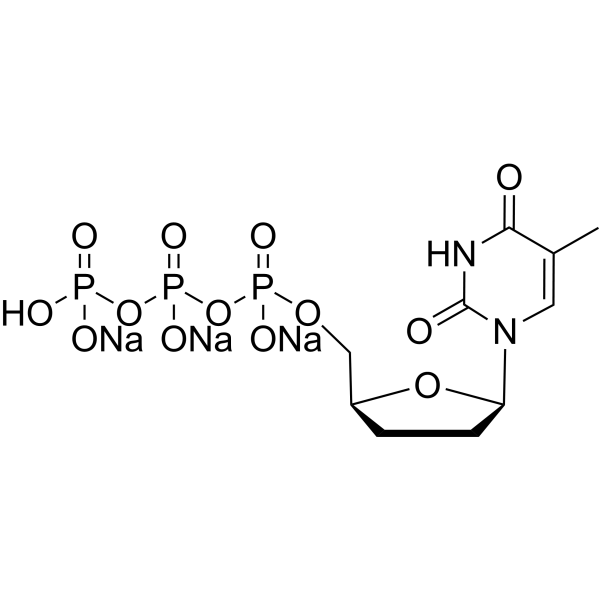
O=[P](O[P](O[P](O)(O[Na])=O)(O[Na])=O)(O[Na])OC[C@@H](O1)CC[C@@H]1N(C(NC2=O)=O)C=C2C
-
Envío
Room temperature in continental US; may vary elsewhere.
-
Almacenamiento
Solution, -20°C, 2 years


Pureza y Documentación
-
Ficha de datos (271 KB)
-
SDS (251 KB)
- English - EN (251 KB)
- Français - FR (251 KB)
- Deutsch - DE (251 KB)
- Norwegian - NO (251 KB)
- Español - ES (251 KB)
- Swedish - SV (251 KB)
- Italian - IT (251 KB)
- Korean - KR (251 KB)
- Portuguese - PT (251 KB)
-
Instrucciones de manejo (2659 KB)
Referencias

Calculators
Concentration (start) × Volume (start) = Concentration (final) × Volume (final)


ddTTP trisodium solution (100 mM) Related Classifications
HY-137694B Related Classifications
 Powered by Bioz