



IND 1316
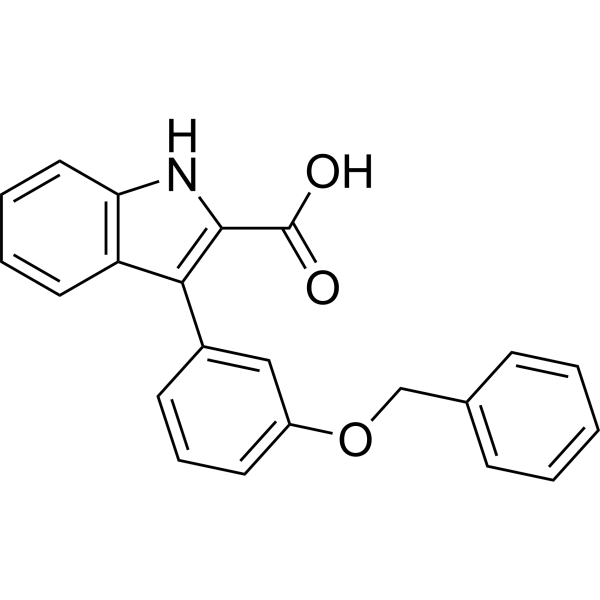
IND 1316 is an orally active, blood-brain barrier permeable AMPK activator with neuroprotective effects in animal models of Huntington's disease. IND 1316 can be used for research on neurodegenerative diseases, such as Alzheimer's disease and Parkinson's disease.
Para uso exclusivo en investigación. No vendemos a pacientes.
- No. CAS: 1888473-12-8
- Fòrmula: C22H17NO3
- Peso molecular:343.38
-
Almacenamiento:
Please store the product under the recommended conditions in the Certificate of Analysis.

To place orders, for customer services and technical support, please contact: MedChemExpress USA
Tel: 609-228-6898 E-mail: [email protected] [email protected]


-
 Actividad biológica
-
Chemical Information
- Protocolo
- Pureza y Documentación
- Referencias
-
 Help & FAQs


Ver todos los productos específicos de isoformas AMPK
More

Actividad biológica
Descripciòn


Chemical Information
-
No. CAS 1888473-12-8
-
Peso molecular 343.38
-
Fòrmula C22H17NO3
-
SMILES
O=C(C1=C(C2=CC(OCC3=CC=CC=C3)=CC=C2)C4=C(C=CC=C4)N1)O
-
Envío
Room temperature in continental US; may vary elsewhere.
-
Almacenamiento
Please store the product under the recommended conditions in the Certificate of Analysis.

Protocolo
-
Human pluripotent stem cell midbrain dopaminergic neuron differentiation
Human pluripotent stem cells are directed toward midbrain dopaminergic neurons by first inducing a neural floor-plate-like progenitor state, then patterning cells with ventralizing SHH signaling and midbrain/WNT-FGF cues, and finally maturing progenitors into neurons expressing dopaminergic markers such as TH, NURR1/NR4A2, PITX3, DAT/SLC6A3, VMAT2/SLC18A2, GIRK2/KCNJ6, FOXA2, LMX1A, and EN1. The main readouts are loss of pluripotency, acquisition of FOXA2+/LMX1A+ midbrain floor-plate progenitors, emergence of βIII-tubulin+/MAP2+ neurons, and production of TH+ dopaminergic neurons with molecular, dopamine-release, and electrophysiological features of midbrain dopaminergic identity.
-
Alzheimer’s Disease Modeling
Alzheimer’s Disease (AD) is a neurodegenerative disorder characterized by a progressive decline in cognitive functions and loss of specific types of neurons and synapses. Alzheimer's symptoms can be simulated in mice by injecting drugs (such as Aβ) or genetically modified.


Pureza y Documentación
Referencias

Calculators
Concentration (start) × Volume (start) = Concentration (final) × Volume (final)


IND 1316 Related Classifications
HY-161163 Related Classifications
 Powered by Bioz