



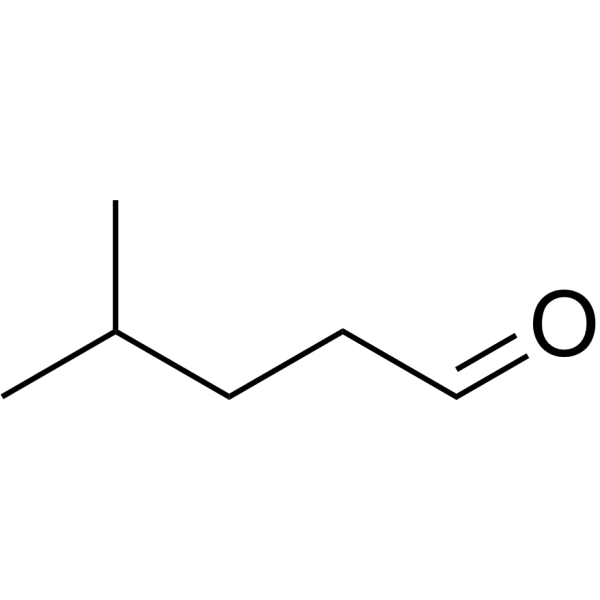
Isocaproaldehyde

Based on 1 Customer Validation
Isocaproaldehyde (4-Methylpentanal; 4-Methylvaleraldehyde) is a product of cholesterol side-chain cleavage catalyzed by CYP11A1, can be reduced by Akr1b7, MVDP, and mAR/aldose reductase, and can be converted to Isohexanol (HY-W007511) and Isocaproic acid (HY-W015882). Isocaproaldehyde is a component of rat alarm pheromone, acts on the vomeronasal system (VNS), and when sniffed together with Hexanal can activate the BNST and induce anxiety in rats. Isocaproaldehyde can be used in research related to anxiety and metabolic diseases.
Para uso exclusivo en investigación. No vendemos a pacientes.
- Pureza : 97.0%
- No. CAS: 1119-16-0
- Fòrmula: C6H12O
- Peso molecular:100.16
-
Almacenamiento:Pure form -20°C, 3 years , 4°C, 2 years ; In solvent -80°C, 6 months , -20°C, 1 month

To place orders, for customer services and technical support, please contact: MedChemExpress USA
Tel: 609-228-6898 E-mail: [email protected] [email protected]


-
 Actividad biológica
-
Chemical Information
- Pureza y Documentación
- Referencias
-
 Help & FAQs




Actividad biológica
Descripciòn
In Vitro
Isocaproaldehyde is reduced by recombinant rabbit AKR1B19 with a Km of 9.0 µM and a kcat/Km of 0.41 min−1 µM−1[4].
Isocaproaldehyde is a cholesterol side-chain cleavage product that is rapidly converted in adrenal tissue to Isohexanol (HY-W007511) and Isocaproic acid (HY-W015882)[5].
Isocaproaldehyde is reduced by recombinant MVDP in a cell-free assay with a strong preference for NADH (Km = 320 μM, kcat = 0.38 s-1)[6].
Isocaproaldehyde can be reduced by the NADH-dependent reductase (ICR/MVDP), and this reductase activity can be upregulated by Forskolin (HY-15371) and is not inhibited by Sorbinil (HY-50289); MVDP deficiency reduces its LD50[6].
MedChemExpress (MCE) has not independently confirmed the accuracy of these methods. They are for reference only.
In Vivo
Isocaproaldehyde activates the rostral accessory olfactory bulb via the vomeronasal system V1R and FPR receptors; stimulation alone cannot activate the BNST, and activation of the BNST requires its co-presence with Hexanal[1].
MedChemExpress (MCE) has not independently confirmed the accuracy of these methods. They are for reference only.
-
Animal Model:Wistar (male, 7 wk old at purchase and 9 wk old at testing)[1]
-
Dosage:1.3 × 10⁻⁶ M, 0.75 mL aqueous solution
-
Administration:nasal/inhalational exposure; single presentation after baseline trial
-
Result:Did not enhance the acoustic startle reflex.


Product Details
-
Structure Classification
-
Initial Source
red hartebeest, Alcelaphus buselaphus caama


Chemical Information
-
No. CAS 1119-16-0
-
Appearance Liquid (Density: 0.799 g/cm3)
-
Peso molecular 100.16
-
Fòrmula C6H12O
-
Color Colorless to light yellow
-
SMILES
O=CCCC(C)C
-
Synonyms
4-Methylpentanal; 4-Methylvaleraldehyde
-
Envío
Room temperature in continental US; may vary elsewhere.
-
Almacenamiento
Pure form -20°C 3 years 4°C 2 years In solvent -80°C 6 months -20°C 1 month
Pureza y Documentación


Referencias
[6]. Lefrançois-Martinez AM, et al. Product of side-chain cleavage of cholesterol, isocaproaldehyde, is an endogenous specific substrate of mouse vas deferens protein, an aldose reductase-like protein in adrenocortical cells. The Journal of biological chemistry. 1999 Nov 12;274(46):32875-80. [Content Brief]

Calculators
Concentration (start) × Volume (start) = Concentration (final) × Volume (final)


Isocaproaldehyde Related Classifications
HY-148614 Related Classifications
 Powered by Bioz
Keywords
- Isocaproaldehyde
- 1119-16-0
- 4-Methylpentanal
- 4-Methylvaleraldehyde
- Endogenous Metabolite
- Aldose Reductase
- Drug Intermediate
- AKR1B1
- Aldo-keto reductase family 1 member B
- Drug Iintermediate
- AKR1B19
- Akr1b7
- BNST circuits
- CYP11A1
- alarm pheromone
- aldose reductase
- aliphatic aldehyde
- anxiety
- social odor
- vomeronasal V1R agonist
- Inhibitor
- inhibitor
- inhibit