



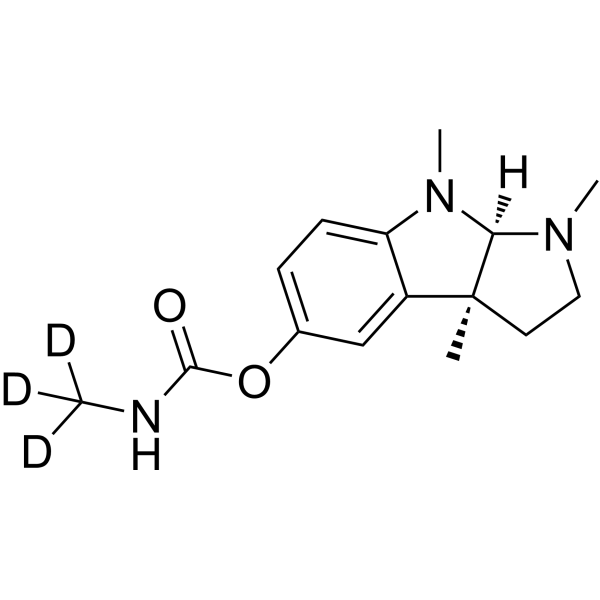
Physostigmine-d3

Based on 1 Customer Validation
Physostigmine-d3 is the deuterium labeled Physostigmine. Physostigmine (Eserine) is a reversible acetylcholinesterase (AChE) inhibitor. Physostigmine can crosses the blood-brain barrier and stimulates central cholinergic neurotransmission. Physostigmine can reverse memory deficits in transgenic mice with Alzheimer's disease. Physostigmine is also an antidote for anticholinergic poisoning.
Para uso exclusivo en investigación. No vendemos a pacientes.
- No. CAS: 1217704-11-4
- Fòrmula: C15H18D3N3O2
- Peso molecular:278.36
-
Almacenamiento:Powder -20°C, 3 years ; In solvent -80°C, 6 months , -20°C, 1 month

To place orders, for customer services and technical support, please contact: MedChemExpress USA
Tel: 609-228-6898 E-mail: [email protected] [email protected]


-
 Actividad biológica
-
Chemical Information
- Protocolo
- Pureza y Documentación
- Referencias
-
 Help & FAQs




Actividad biológica
Descripciòn
In Vitro
Stable heavy isotopes of hydrogen, carbon, and other elements have been incorporated into drug molecules, largely as tracers for quantitation during the drug development process. Deuteration has gained attention because of its potential to affect the pharmacokinetic and metabolic profiles of drugs[1].
MedChemExpress (MCE) has not independently confirmed the accuracy of these methods. They are for reference only.
Aplicación
1. This compound can be used as a tracer
2. This compound can be used as an internal standard for quantitative analysis by NMR, GC-MS, or LC-MS.


Chemical Information
-
No. CAS 1217704-11-4
-
Unlabeled CAS 57-47-6
-
Appearance Solid
-
Peso molecular 278.36
-
Fòrmula C15H18D3N3O2
-
Color White to off-white
-
SMILES
C[C@]12C3=CC(OC(NC([2H])([2H])[2H])=O)=CC=C3N([C@@]1([H])N(CC2)C)C
-
Synonyms
Eserine-d3
-
Envío
Room temperature in continental US; may vary elsewhere.
-
Almacenamiento
Powder -20°C 3 years In solvent -80°C 6 months -20°C 1 month


Pureza y Documentación
-
Ficha de datos (270 KB)
-
SDS (252 KB)
- English - EN (252 KB)
- Français - FR (252 KB)
- Deutsch - DE (252 KB)
- Norwegian - NO (252 KB)
- Español - ES (252 KB)
- Swedish - SV (252 KB)
- Italian - IT (252 KB)
- Korean - KR (252 KB)
- Portuguese - PT (252 KB)
-
Instrucciones de manejo (2659 KB)
Referencias
[1]. Russak EM, et al. Impact of Deuterium Substitution on the Pharmacokinetics of Pharmaceuticals. Ann Pharmacother. 2019;53(2):211-216. [Content Brief]
[2]. Haase U, et al. Pharmakotherapie--physostigmin post OP [Pharmacotherapy--physostigmine administered post-operatively]. Anasthesiol Intensivmed Notfallmed Schmerzther. 2007;42(3):188‐189. [Content Brief]
[3]. Dong H, et al, Bertchume A, Vallera D, Csernansky JG. Acetylcholinesterase inhibitors ameliorate behavioral deficits in the Tg2576 mouse model of Alzheimer's disease. Psychopharmacology (Berl). 2005;181(1):145‐152. [Content Brief]
[4]. Frascogna N. Physostigmine: is there a role for this antidote in pediatric poisonings? Curr Opin Pediatr. 2007;19(2):201‐205. [Content Brief]
[5]. Jonathan D Kenny, et al. Physostigmine and Methylphenidate Induce Distinct Arousal States During Isoflurane General Anesthesia in Rats. Anesth Analg. 2016 Nov;123(5):1210-1219. [Content Brief]

Calculators
Concentration (start) × Volume (start) = Concentration (final) × Volume (final)


Physostigmine-d3 Related Classifications
HY-N6608S Related Classifications
 Powered by Bioz