



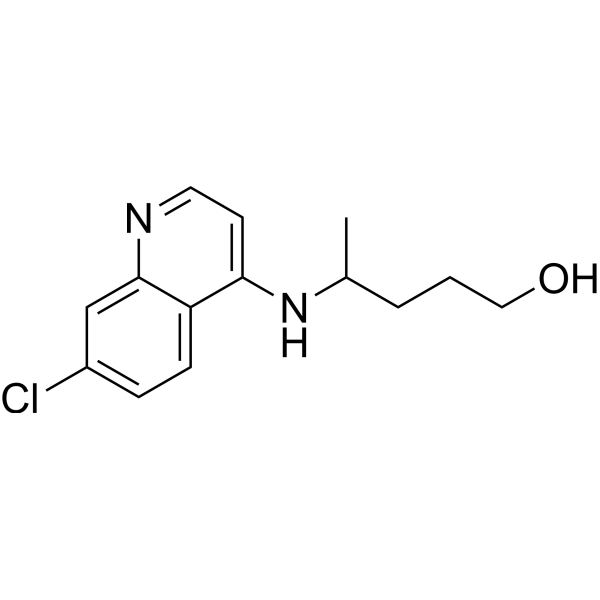
Hydroxychloroquine Impurity E
Hydroxychloroquine Impurity E is the impurity of Hydroxychloroquine. Hydroxychloroquine is a synthetic antimalarial agent which can also inhibit Toll-like receptor 7/9 (TLR7/9) signaling. Hydroxychloroquine is efficiently inhibits SARS-CoV-2 infection in vitro.
For research use only. We do not sell to patients.
- Purity : 99.83%
- CAS No.: 10500-64-8
- Formula: C14H17ClN2O
- Molecular Weight:264.75
-
Storage:
4°C, protect from light
* In solvent : -80°C, 6 months; -20°C, 1 month (protect from light)

To place orders, for customer services and technical support, please contact: MedChemExpress USA
Tel: 609-228-6898 E-mail: [email protected] [email protected]


-
 Biological Activity
-
Chemical Information
- Protocols
- Purity & Documentation
- References
-
 Help & FAQs




Biological Activity
Description
Cellular Effect
|
Cell Line

|
Type | Value | Description | References |
|---|---|---|---|---|
| Huh-7 | CC50 |
>10 μM
Compound: GNF-Pf-1978
|
NOVARTIS: Cytotoxicity against human hepatocellular carcinoma cell line (Huh7)
NOVARTIS: Cytotoxicity against human hepatocellular carcinoma cell line (Huh7)
|
[PMID: 18579783] |


Chemical Information
-
CAS No. 10500-64-8
-
Appearance Solid
-
Molecular Weight 264.75
-
Formula C14H17ClN2O
-
Color White to light yellow
-
SMILES
CC(NC1=CC=NC2=CC(Cl)=CC=C12)CCCO
-
Synonyms
4-[(7-Chloro-4-quinolinyl)amino]-1-pentanol
-
Shipping
Room temperature in continental US; may vary elsewhere.
-
Storage
4°C, protect from light
* In solvent : -80°C, 6 months; -20°C, 1 month (protect from light)


Purity & Documentation
-
Data Sheet (265 KB)
-
SDS (393 KB)
- English - EN (393 KB)
- Français - FR (393 KB)
- Deutsch - DE (393 KB)
- Norwegian - NO (393 KB)
- Español - ES (393 KB)
- Swedish - SV (393 KB)
- Italian - IT (393 KB)
- Korean - KR (393 KB)
- Portuguese - PT (393 KB)
-
Handling Instructions (2659 KB)
References
[1]. Manzo C, et al. Psychomotor Agitation Following Treatment with Hydroxychloroquine. Drug Saf Case Rep. 2017 Dec;4(1):6. [Content Brief]
[2]. Lamphier M, et al. Novel small molecule inhibitors of TLR7 and TLR9: mechanism of action and efficacy in vivo. Mol Pharmacol. 2014 Mar;85(3):429-40. [Content Brief]
[3]. Yao X, et al. In Vitro Antiviral Activity and Projection of Optimized Dosing Design of Hydroxychloroquine for the Treatment of Severe Acute Respiratory Syndrome Coronavirus 2 (SARS-CoV-2). Clin Infect Dis. 2020 Mar 9. pii: ciaa237. [Content Brief]

Calculators
Concentration (start) × Volume (start) = Concentration (final) × Volume (final)


Hydroxychloroquine Impurity E Related Classifications
HY-131262 Related Classifications
 Powered by Bioz