



IMC-D11

Based on 1 Customer Validation
IMC-D11 (LY-3076226 antibody) is an anti-FGFR3 IgG1 monoclonal antibody with an EC50 of approximately 0.1 nM against hFGFR3b and hFGFR3c. IMC-D11 inhibits the growth of FGFR3-dependent lung adenocarcinoma in mouse models and shows no effect on tumors that do not express FGFR3. IMC-D11 can serve as an ADC Antibody for ADC synthesis, such as LY3076226. IMC-D11 is applicable to research related to urothelial carcinoma, multiple myeloma, lung adenocarcinoma, as well as advanced or metastatic cancers.
Nos produits utilisent uniquement pour la recherche. Nous ne vendons pas aux patients.
- Pureté : 98.51%
- Masse moléculaire:145.82 kDa
-
Stockage:
Please store the product under the recommended conditions in the Certificate of Analysis.


To place orders, for customer services and technical support, please contact: MedChemExpress USA
Tel: 609-228-6898 E-mail: [email protected] [email protected]


-
 Activité biologique
-
Chemical Information
- Pureté et documentation
- Références
-
 Help & FAQs




Activité biologique
Description
Isotype
Human IgG1 kappa
Recommend Isotype Controls
Species Reactivity
Human
IC50 & Target
[1]|
FGFR3 ~0.1 nM (EC50) |
In Vitro
IMC-D11 binds to hFGFR3b and hFGFR3c with an EC50 of approximately 0.1 nM, and exhibits extremely low binding affinity for other FGFR family members[2].
IMC-D11 binds to FGFR3b and FGFR3c expressed on the surface of BaF3 cells, but does not bind to parental BaF3 cells[2].
IMC-D11 (preincubated for 1 h, total duration 72 h) inhibits FGF1- and FGF9-dependent viability in BaF3 cells expressing FGFR3b and FGFR3c, with IC50 values ranging from 1.6 to 41.3 nM[2].
IMC-D11 (0.09-200 nM; 72 h) induces a dose-dependent decrease in FGFR3 protein in UMUC-14 bladder cancer cells after 72 h of incubation[2].
IMC-D11 (up to 200 nM; 72 h) inhibits the proliferation of UMUC-14 bladder cancer cells carrying the FGFR3S249C mutation in a dose-dependent manner[2].
IMC-D11 potently blocks ligand-dependent signaling pathways of FGFR3 in tumor cells, promotes receptor internalization, and delivers targeted cytotoxins to FGFR3-activated cancer cells[3].
MedChemExpress (MCE) has not independently confirmed the accuracy of these methods. They are for reference only.
-
Cell Line:BaF3 cells stably expressing human FGFR3b, BaF3 cells stably expressing human FGFR3c
-
Concentration:Serial dilutions; 3.7 nM FGF1; 3.7 nM FGF9; 15 µg/mL heparin
-
Incubation Time:1 h (pre-incubation); 72 h (total)
-
Result:Inhibited the mitogenic response of FGFR3-expressing BaF3 cells to FGF1 or FGF9 with an IC50 ranging from 1.6 to 41.3 nM.
Had no detectable agonist activity.
-
Cell Line:UMUC-14 bladder carcinoma cells (harboring constitutively active FGFR3^S249C)
-
Concentration:Serial dilutions up to 200 nM
-
Incubation Time:72 h
-
Result:Significantly inhibited UMUC-14 cell growth in a dose-dependent manner compared to human IgG control.
-
Cell Line:UMUC-14 bladder carcinoma cells
-
Concentration:0.09-200 nM
-
Incubation Time:72 h
-
Result:Caused dose-dependent loss of FGFR3 protein, likely through internalization and degradation.
Reduced FGFR3/α-tubulin band intensity observed at all tested concentrations relative to human IgG control.
Parmacokinetics
| Species | Dose | Route | Plasma Concentration |
|---|---|---|---|
| Mice[2] | 40 mg/kg | i.p. | 1124 μg/mL |
In Vivo
IMC-D11 (40 mg/kg; i.p.; two doses 15 hours apart) significantly reduces FGFR3-dependent proliferation of Sftpc+/CC10+ bronchioalveolar duct junction cells in FVB mice[2].
MedChemExpress (MCE) has not independently confirmed the accuracy of these methods. They are for reference only.
-
Animal Model:FVB (6-12 weeks old; doxycycline-induced FGFR3-dependent tumorigenesis)[2]
-
Dosage:40 mg/kg
-
Administration:i.p.; every 2 days; 16 days
-
Result:Prevented tumor-associated weight loss, with treated mice gaining an average of 0.5 g over the experimental period.
Achieved mean plasma levels of 1124 µg/mL 24 hours after the last injection.
Reduced average lung pathology score to 1.8, a significant reduction from the control score of 3.8 (P<0.0001).
-
Animal Model:FVB (6-12 weeks old; doxycycline-induced FGFR3-dependent epithelial proliferation)[2]
-
Dosage:40 mg/kg
-
Administration:i.p.; two doses 15 hours apart
-
Result:Did not affect the number of Sftpc+/CC10+ cells in the bronchioalveolar duct junction region.
Caused a significant (P<0.002) decrease in the ratio of PCNA-positive (proliferating) cells to Sftpc+/CC10+ cells compared to untreated controls.
Gene ID
Accession
Conjugated
Unconjugated
Reconsititution
The product can be reconstituted/diluted with sterile PBS or saline.
Application
ELISA, FACS, Functional assay
Verified Bioactivity
-
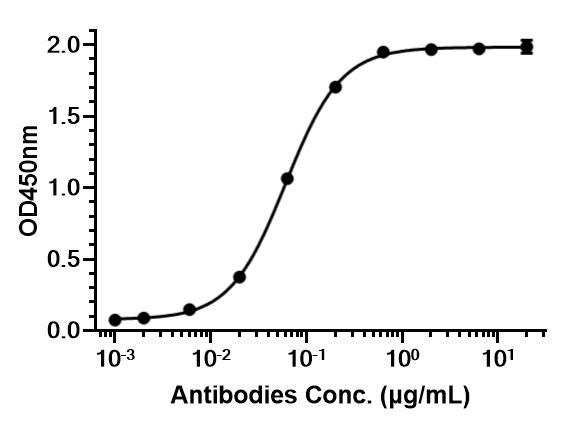 Immobilized Human FGFR3 Protein (ECD, alpha IIIb, His Tag) can bind IMC-D11. The EC50 for this effect is 60.8 ng/mL.


Chemical Information
-
Appearance Liquid
-
Masse moléculaire 145.82 kDa
-
Color Colorless to light yellow
-
SMILES
N/A
-
Synonyms
LY-3076226 antibody
-
Livraison
Shipping with dry ice.
-
Formulation
Please refer to the lot-specific COA for specific buffer information.
-
Stockage
Please store the product under the recommended conditions in the Certificate of Analysis.


Pureté et documentation
-
Fiche technique (266 KB)
-
SDS (251 KB)
- English - EN (251 KB)
- Français - FR (251 KB)
- Deutsch - DE (251 KB)
- Norwegian - NO (251 KB)
- Español - ES (251 KB)
- Swedish - SV (251 KB)
- Italian - IT (251 KB)
- Korean - KR (251 KB)
- Portuguese - PT (251 KB)
-
Inhibitory Antibodies User Guide (603 KB)
Références
[2]. Yin Y, et al. Inhibition of fibroblast growth factor receptor 3-dependent lung adenocarcinoma with a human monoclonal antibody. Disease models & mechanisms. 2016 May 01;9(5):563-71. [Content Brief]
[3]. Kollmannsberger C, et al. A phase 1 study of LY3076226, a fibroblast growth factor receptor 3 (FGFR3) antibody-drug conjugate, in patients with advanced or metastatic cancer. Invest New Drugs. 2021 Dec;39(6):1613-1623. [Content Brief]

Calculators
Concentration (start) × Volume (start) = Concentration (final) × Volume (final)


IMC-D11 Related Classifications
HY-P991106 Related Classifications
 Powered by Bioz