



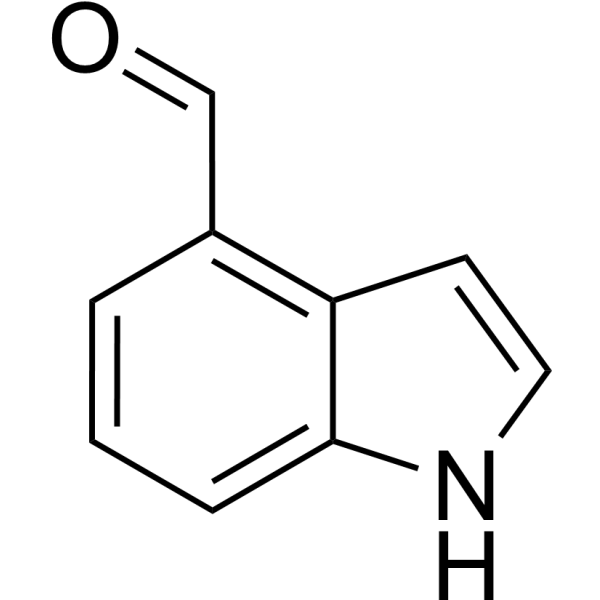
Indole-4-carboxaldehyde

Based on 1 Customer Validation
Indole-4-carboxaldehyde is an ergot alkaloid precursor that regulates glycosylation and inflammation. Indole-4-carboxaldehyde upregulates Glo-1, inhibits MGO-induced NF-κB activation, and suppresses MGO-induced expression of TNF-α and IFN-γ. Indole-4-carboxaldehyde inhibits MGO-induced formation of advanced glycation end products (AGE) and expression of their receptor (RAGE). Indole-4-carboxaldehyde is a core metabolite produced in the pedicels of Summer Black grapes after exogenous gibberellin treatment, and it directly promotes fruit enlargement and fruit set of Summer Black grapes. Indole-4-carboxaldehyde can be used in studies related to hepatic steatosis and plant growth regulation.
For research use only. We do not sell to patients.
- Purity : 99.32%
- CAS No.: 1074-86-8
- Formula: C9H7NO
- Molecular Weight:145.16
-
Storage:
4°C, stored under nitrogen
* In solvent : -80°C, 6 months; -20°C, 1 month (stored under nitrogen)

To place orders, for customer services and technical support, please contact: MedChemExpress USA
Tel: 609-228-6898 E-mail: [email protected] [email protected]


-
 Biological Activity
-
Chemical Information
-
Solvent & Solubility
- Protocols
- Purity & Documentation
- References
-
 Help & FAQs




Biological Activity
Description
IC50 & Target
[1]|
NF-κB |
TNF-α |
In Vitro
Indole-4-carboxaldehyde (25-200 µM; 6-24 h) induces a dose-dependent increase in Glo-1 mRNA and protein expression, and enhances the fluorescence intensity of Glo-1 in HepG2 cells[1].
Indole-4-carboxaldehyde reacts with 4-substituted thiosemicarbazides in refluxing ethanol to form thioformamide derivatives[2].
Indole-4-carboxaldehyde shows significant upregulation and directly promotes fruit enlargement and fruit set of the pedicels of Summer Black grapes treated twice with exogenous gibberellin[3].
Indole-4-carboxaldehyde (100 µM; 2 h pre-incubation prior to 24 h MGO exposure) reduces methylglyoxal-induced secretion of TNF-α and IFN-γ in HepG2 cells and attenuates the formation of AGE[1].
MedChemExpress (MCE) has not independently confirmed the accuracy of these methods. They are for reference only.
-
Cell Line:HepG2 human hepatocyte cell line
-
Concentration:50, 100, 200 µM
-
Incubation Time:24 h
-
Result:Significantly increased HepG2 cell proliferation at 50 µM and 100 µM.
Did not increase cell proliferation relative to control at 200 µM.
-
Cell Line:HepG2 human hepatocyte cell line
-
Concentration:100 µM
-
Incubation Time:2 h pre-incubation prior to 4 h MGO (0.25 mM) exposure
-
Result:Significantly reduced the MGO-induced increase in TNF-α and IFN-γ mRNA expression, returning levels close to untreated control values.\nReduced MGO-induced RAGE mRNA levels to near untreated control values.
-
Cell Line:HepG2 human hepatocyte cell line
-
Concentration:100 µM
-
Incubation Time:2 h pre-incubation prior to 24 h MGO (0.25 mM) exposure
-
Result:Significantly reduced the MGO-induced increase in secreted TNF-α and IFN-γ levels, returning levels close to untreated control values.
-
Cell Line:HepG2 human hepatocyte cell line
-
Concentration:100 µM
-
Incubation Time:2 h pre-incubation prior to 4 h MGO (0.25 mM) exposure
-
Result:Prevented MGO-induced nuclear translocation of p65 and restored cytosolic p65 levels to near control values.


Chemical Information
-
CAS No. 1074-86-8
-
Appearance Solid
-
Molecular Weight 145.16
-
Formula C9H7NO
-
Color Gray to brown
-
SMILES
O=CC1=CC=CC2=C1C=CN2
-
Shipping
Room temperature in continental US; may vary elsewhere.
-
Storage
4°C, stored under nitrogen
* In solvent : -80°C, 6 months; -20°C, 1 month (stored under nitrogen)


Solvent & Solubility
In Vitro:
DMSO : 50 mg/mL (344.45 mM; Need ultrasonic; Hygroscopic DMSO has a significant impact on the solubility of product, please use newly opened DMSO)
Please refer to the solubility information to select the appropriate solvent. Once prepared, please aliquot and store the solution to prevent product inactivation from repeated freeze-thaw cycles.
Storage method and period of stock solution: -80°C, 6 months; -20°C, 1 month (stored under nitrogen). When stored at -80°C, please use it within 6 months. When stored at -20°C, please use it within 1 month.
Please refer to the solubility information to select the appropriate solvent. Once prepared, please aliquot and store the solution to prevent product inactivation from repeated freeze-thaw cycles.
Storage method and period of stock solution: -80°C, 6 months; -20°C, 1 month (stored under nitrogen). When stored at -80°C, please use it within 6 months. When stored at -20°C, please use it within 1 month.
Concentration (start) × Volume (start) = Concentration (final) × Volume (final)


Purity & Documentation
-
Data Sheet (282 KB)
-
SDS (393 KB)
- English - EN (393 KB)
- Français - FR (393 KB)
- Deutsch - DE (393 KB)
- Norwegian - NO (393 KB)
- Español - ES (393 KB)
- Swedish - SV (393 KB)
- Italian - IT (393 KB)
- Korean - KR (393 KB)
- Portuguese - PT (393 KB)
-
Handling Instructions (2659 KB)
References


Complete Stock Solution Preparation Table
Please refer to the solubility information to select the appropriate solvent. Once prepared, please aliquot and store the solution to prevent product inactivation from repeated freeze-thaw cycles.
Storage method and period of stock solution: -80°C, 6 months; -20°C, 1 month (stored under nitrogen). When stored at -80°C, please use it within 6 months. When stored at -20°C, please use it within 1 month.
| Optional Solvent | Concentration Solvent Mass | 1 mg | 5 mg | 10 mg | 25 mg |
|---|---|---|---|---|---|
| DMSO | 1 mM | 6.8889 mL | 34.4447 mL | 68.8895 mL | 172.2237 mL |
| 5 mM | 1.3778 mL | 6.8889 mL | 13.7779 mL | 34.4447 mL | |
| 10 mM | 0.6889 mL | 3.4445 mL | 6.8889 mL | 17.2224 mL | |
| 15 mM | 0.4593 mL | 2.2963 mL | 4.5926 mL | 11.4816 mL | |
| 20 mM | 0.3444 mL | 1.7222 mL | 3.4445 mL | 8.6112 mL | |
| 25 mM | 0.2756 mL | 1.3778 mL | 2.7556 mL | 6.8889 mL | |
| 30 mM | 0.2296 mL | 1.1482 mL | 2.2963 mL | 5.7408 mL | |
| 40 mM | 0.1722 mL | 0.8611 mL | 1.7222 mL | 4.3056 mL | |
| 50 mM | 0.1378 mL | 0.6889 mL | 1.3778 mL | 3.4445 mL | |
| 60 mM | 0.1148 mL | 0.5741 mL | 1.1482 mL | 2.8704 mL | |
| 80 mM | 0.0861 mL | 0.4306 mL | 0.8611 mL | 2.1528 mL | |
| 100 mM | 0.0689 mL | 0.3444 mL | 0.6889 mL | 1.7222 mL |


Indole-4-carboxaldehyde Related Classifications
HY-W001288 Related Classifications
 Powered by Bioz
Keywords
- Indole-4-carboxaldehyde
- 1074-86-8
- Glyoxalase (GLO)
- NF-κB
- TNF Receptor
- Drug Intermediate
- HepG2 cells
- Xiahei grapes
- Glyoxalase-1
- Nuclear factor-kappa B
- Receptor for advanced glycation end-products
- hepatic steatosis
- tumor necrosis factor-α
- summer black grapes
- IFN-γ
- advanced glycation end-products
- Inhibitor
- inhibitor
- inhibit