



Isosilybin A (Standard)
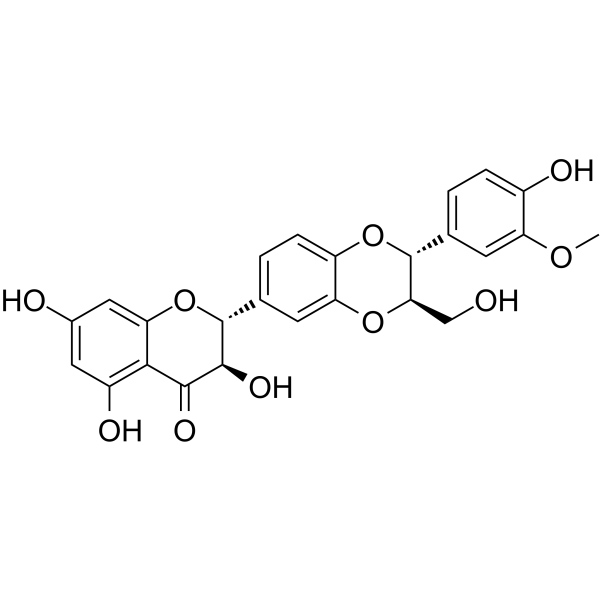
Isosilybin A (Standard) is the analytical standard of Isosilybin A (HY-N7043). Isosilybin A is a PPARγ agonist that can be isolated from silymarin. Isosilybin A activates extrinsic and intrinsic pathways of apoptosis through targeting of the Akt-NF-kB-AR axis. Isosilybin A can relieve the inflammatory response in the rosacea model via inhibiting Erk and p38 signaling pathways and M1 macrophage polarization, with its targets related to RELA and VEGFA. Isosilybin A has anti-prostate cancer (PCA) activity[1][2][3].
For research use only. We do not sell to patients.
- CAS No.: 142796-21-2
- Formula: C25H22O10
- Molecular Weight:482.44
-
Storage:
Please store the product under the recommended conditions in the Certificate of Analysis.


To place orders, for customer services and technical support, please contact: MedChemExpress USA
Tel: 609-228-6898 E-mail: [email protected] [email protected]


-
 Product Information
-
Chemical Information
- Purity & Documentation
-
 Help & FAQs




Product Information
Information
Application
The compound is the grade of analytical standard, which is the reference standard supplied assay. It is commonly used in qualitative, quantitative and methodological research experiments in HPLC, GC and MS.


Chemical Information
-
CAS No. 142796-21-2
-
Molecular Weight 482.44
-
Formula C25H22O10
-
SMILES
O=C1[C@H](O)[C@@H](C2=CC=C(O[C@H](C3=CC=C(O)C(OC)=C3)[C@@H](CO)O4)C4=C2)OC5=CC(O)=CC(O)=C15
-
Structure Classification
-
Shipping
Room temperature in continental US; may vary elsewhere.
-
Storage
Please store the product under the recommended conditions in the Certificate of Analysis.


Purity & Documentation
References
[1]. Wu CC, et al. Isosilybin A exhibits anti-inflammatory properties in rosacea by inhibiting MAPK pathway and M1 macrophage polarization. Int Immunopharmacol. 2024 Dec 25;143(Pt 1):113323. [Content Brief]
[2]. Pferschy-Wenzig EM, et al. Identification of isosilybin a from milk thistle seeds as an agonist of peroxisome proliferator-activated receptor gamma. J Nat Prod. 2014 Apr 25;77(4):842-7. [Content Brief]
[3]. Deep G, et al. Isosilybin A induces apoptosis in human prostate cancer cells via targeting Akt, NF-κB, and androgen receptor signaling. Mol Carcinog. 2010 Oct;49(10):902-12. [Content Brief]

Calculators
Concentration (start) × Volume (start) = Concentration (final) × Volume (final)


Isosilybin A (Standard) Related Classifications
HY-N7043R Related Classifications
 Powered by Bioz