



Daltroban

Based on 1 Customer Validation
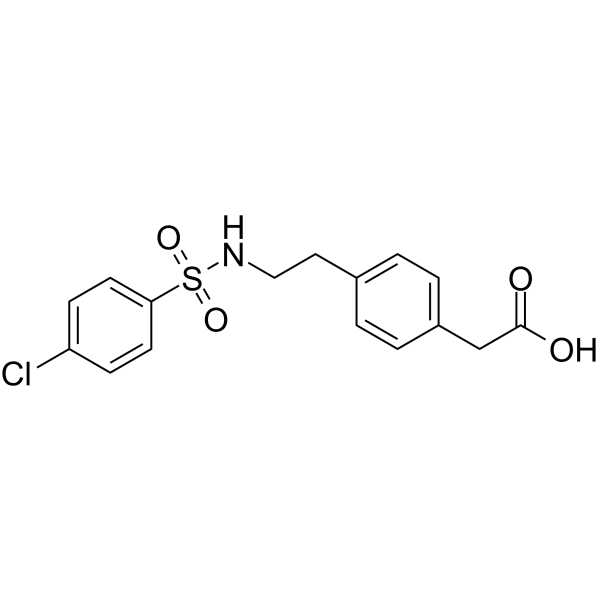
Daltroban (BM-13505) is a selective and specific thromboxane A2 (TXA2) receptor antagonist. Daltroban increase intracellular calcium in vascular smooth muscle cells. Daltroban shows protective effect in reperfusion injury.
商品は「研究用試薬」です。人や動物の医療用・臨床診断用・食品用の製品ではありません。
研究用途以外に使用した場合、当社は一切の責任を負いかねます。
- 純度 : 98.19%
- CAS 番号: 79094-20-5
- 分子式: C16H16ClNO4S
- 分子量:353.82
-
保管条件:
-20°C, sealed storage, away from moisture
* In solvent : -80°C, 6 months; -20°C, 1 month (sealed storage, away from moisture)

To place orders, for customer services and technical support, please contact: MedChemExpress USA
Tel: 609-228-6898 E-mail: [email protected] [email protected]


-
 生物活性
生物活性
-
化学情報
-
溶剤 & 溶解度
- プロトコル
- 純度とドキュメンテーション
- 参考文献
-
 Help & FAQs





生物活性
製品説明
IC50 & Target
|
TXA2 |
体内実験
In comparison with vehicle (physiological saline)-treated cats, Daltroban (20 mg/kg per hour i.v.) reduces the ischaemia-induced rise in the ST segment and prevented the development of a Q-wave in the ECG during reperfusion. Daltroban protects the myocardium from ischaemic injury and that this effect involves prevention of ischaemia-induced leukocytosis[3].
MedChemExpress (MCE) has not independently confirmed the accuracy of these methods. They are for reference only.
-
Animal Model:Adult male cats (2.8 to 4.6 kg; anesthetized cat model)[2]
-
Dosage:1 mg/kg
-
Administration:i.v.; 30 minutes before reperfusion at a rate of 1 mg/kg followed by 1 mg/kg/hour
-
Result:Significantly reduced the area of ischemic tissue as a percent of total left ventricular mass and total area at risk, without altering basic hemodynamics and thereby not influencing myocardial oxygen demand.


化学情報
-
CAS 番号 79094-20-5
-
性状 Solid
-
分子量 353.82
-
分子式 C16H16ClNO4S
-
Color White to light yellow
-
SMILES
O=C(CC1=CC=C(C=C1)CCNS(=O)(C2=CC=C(C=C2)Cl)=O)O
-
別名
BM-13505; SKF 96148
-
輸送条件
Room temperature in continental US; may vary elsewhere.
-
保管条件
-20°C, sealed storage, away from moisture
* In solvent : -80°C, 6 months; -20°C, 1 month (sealed storage, away from moisture)


溶剤 & 溶解度
体外:
DMSO : 22 mg/mL (62.18 mM; Need ultrasonic and warming; Hygroscopic DMSO has a significant impact on the solubility of product, please use newly opened DMSO)
Please refer to the solubility information to select the appropriate solvent. Once prepared, please aliquot and store the solution to prevent product inactivation from repeated freeze-thaw cycles.
Storage method and period of stock solution: -80°C, 6 months; -20°C, 1 month (sealed storage, away from moisture). When stored at -80°C, please use it within 6 months. When stored at -20°C, please use it within 1 month.
Please refer to the solubility information to select the appropriate solvent. Once prepared, please aliquot and store the solution to prevent product inactivation from repeated freeze-thaw cycles.
Storage method and period of stock solution: -80°C, 6 months; -20°C, 1 month (sealed storage, away from moisture). When stored at -80°C, please use it within 6 months. When stored at -20°C, please use it within 1 month.
濃度 (開始) × 体積 (開始) = 濃度 (終了) × 体積 (終了)


純度とドキュメンテーション
-
データシート (272 KB)
-
SDS (394 KB)
- English - EN (394 KB)
- Français - FR (394 KB)
- Deutsch - DE (394 KB)
- Norwegian - NO (394 KB)
- Español - ES (394 KB)
- Swedish - SV (394 KB)
- Italian - IT (394 KB)
- Korean - KR (394 KB)
- Portuguese - PT (394 KB)
-
取扱説明書 (2659 KB)
参考文献
[1]. Miki I, et al. Differences in activities of thromboxane A2 receptor antagonists in smooth muscle cells. Eur J Pharmacol. 1992 Oct 1;227(2):199-204. [Content Brief]
[2]. Thiemermann C, et al. The thromboxane receptor antagonist, daltroban, protects the myocardium from ischaemic injury resulting in suppression of leukocytosis. Eur J Pharmacol. 1988 Oct 11;155(1-2):57-67. [Content Brief]
[3]. Bhat AM, et al. Protective effect of the specific thromboxane receptor antagonist, BM-13505, in reperfusion injury following acute myocardial ischemia in cats. Am Heart J. 1989 Apr;117(4):799-803. [Content Brief]


Complete Stock Solution Preparation Table
Please refer to the solubility information to select the appropriate solvent. Once prepared, please aliquot and store the solution to prevent product inactivation from repeated freeze-thaw cycles.
Storage method and period of stock solution: -80°C, 6 months; -20°C, 1 month (sealed storage, away from moisture). When stored at -80°C, please use it within 6 months. When stored at -20°C, please use it within 1 month.
| Optional Solvent | Concentration Solvent Mass | 1 mg | 5 mg | 10 mg | 25 mg |
|---|---|---|---|---|---|
| DMSO | 1 mM | 2.8263 mL | 14.1315 mL | 28.2630 mL | 70.6574 mL |
| 5 mM | 0.5653 mL | 2.8263 mL | 5.6526 mL | 14.1315 mL | |
| 10 mM | 0.2826 mL | 1.4131 mL | 2.8263 mL | 7.0657 mL | |
| 15 mM | 0.1884 mL | 0.9421 mL | 1.8842 mL | 4.7105 mL | |
| 20 mM | 0.1413 mL | 0.7066 mL | 1.4131 mL | 3.5329 mL | |
| 25 mM | 0.1131 mL | 0.5653 mL | 1.1305 mL | 2.8263 mL | |
| 30 mM | 0.0942 mL | 0.4710 mL | 0.9421 mL | 2.3552 mL | |
| 40 mM | 0.0707 mL | 0.3533 mL | 0.7066 mL | 1.7664 mL | |
| 50 mM | 0.0565 mL | 0.2826 mL | 0.5653 mL | 1.4131 mL | |
| 60 mM | 0.0471 mL | 0.2355 mL | 0.4710 mL | 1.1776 mL |


Daltroban 関連分類
HY-121018 関連分類
 Powered by Bioz