



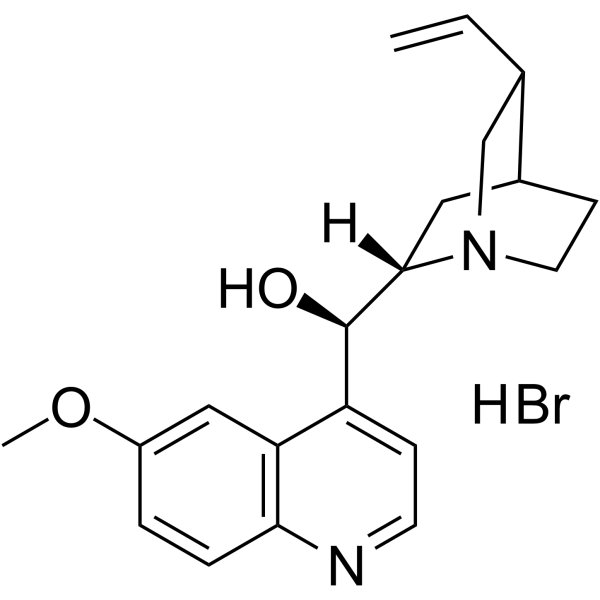
Quinine hydrobromide
Based on 7 publication(s) in Google Scholar
Quinidine hydrobromide is an antiarrhythmic agent. Quinidine is a potent, orally active, selective cytochrome P450db inhibitor. Quinidine hydrobromide is also a K+ channel blocker with an IC50 of 19.9 μM. Quinidine hydrobromide can be used for malaria research.
商品は「研究用試薬」です。人や動物の医療用・臨床診断用・食品用の製品ではありません。
研究用途以外に使用した場合、当社は一切の責任を負いかねます。
- CAS 番号: 549-49-5
- 分子式: C20H25BrN2O2
- 分子量:405.33
-
保管条件:
Please store the product under the recommended conditions in the Certificate of Analysis.

To place orders, for customer services and technical support, please contact: MedChemExpress USA
Tel: 609-228-6898 E-mail: [email protected] [email protected]


-
 生物活性
生物活性
-
化学情報
- プロトコル
- 純度とドキュメンテーション
- 参考文献
-
 Help & FAQs


MedChemExpress(MCE)の使用を引用している文献 Quinine hydrobromide
More- Neurosci Bull. 2025 May 6. [Abstract]
- Cell Mol Life Sci. 2025 Nov 25;82(1):419. [Abstract]
- J Mol Cell Biol. 2025 May 22;16(11):mjae051. [Abstract]
- ACS Omega. 2024 Feb 28;9(10):11870-11882. [Abstract]
- Mol Med Rep. 2021 May;23(5):313. [Abstract]
- Vet Microbiol. 2026 May:316:110992. [Abstract]
- Norwegian University of Science and Technology. 2019 Sep.
 Customer Validation & Images

-
In Vivo Efficacy Study

-
Cell Imaging/Staining

-
Cell Proliferation/Viability Assay

-
Cell Proliferation/Viability Assay

-
Bio/Physico-chemical Assay

Parasite アイソフォーム固有の製品をすべて表示
More

生物活性
製品説明
体外実験
Quinidine hydrobromide is an anti-arrythmic drug which affects ionic currents in heart muscle and which has also been shown to be a potent blocker of several classes of K+ channel in a variety of cell types[1].
Bath application of quinidine hydrobromide causes a dose-dependent reduction of the peak amplitude of Ik. The Kd for blockade of Ik at 0 mV is estimated to be 41 μM[1].
Quinidine hydrobromide elicits a dose-dependent increase of the rate of the decay of Ik and this effect is enhanced by membrane depolarization. Quinidine also causes a 5 mV hyperpolarizing shift of the steady-state inactivation curve and increases the half-time for recovery from inactivation. Quinidine hydrobromide does not affect the onset of inactivation measured at -30 mV[1].
MedChemExpress (MCE) has not independently confirmed the accuracy of these methods. They are for reference only. Further protocols information, click here.
体内実験
Quinidine hydrobromide is approximately 70-90 % bound to plasma proteins. It undergoes hepatic oxidative metabolism to form an N-oxide, a 3-hydroxy form, an O-demethyl form and 2'-quinidinone[2].
Quinidine hydrobromide inhibits metabolism of amphetamine in rats. Quinidine hydrobromide pretreatment results in a significant decrease in the excretion of p-hydroxyamphetamine at 24 and 48 h to 7.2 and 24.1% of the vehicle-control levels, respectively, accompanied by a significant increase in amphetamine excretion between 24 and 48 h to 542% of the control[3].
MedChemExpress (MCE) has not independently confirmed the accuracy of these methods. They are for reference only.


化学情報
-
CAS 番号 549-49-5
-
分子量 405.33
-
分子式 C20H25BrN2O2
-
SMILES
O[C@H](C1=CC=NC2=C1C=C(OC)C=C2)[C@@]3([H])[N@](C[C@@H]4C=C)CC[C@H]4C3.[H]Br
-
輸送条件
Room temperature in continental US; may vary elsewhere.
-
保管条件
Please store the product under the recommended conditions in the Certificate of Analysis.


Publications (7)
-
Journal Impact Factor
-
Most Recent
-
Neurosci Bull
A Novel Functional Method of Protector Screening for Zebrafish Lateral Line Hair Cells via the Acoustic Escape Response. [Abstract]2025 May 6. PMID: 40329138
Quinine hydrobromide purchased from MedChemExpress. Usage Cited in: Neurosci Bull. 2025 May 6. [Abstract]
Quinine (qui; 10 μM; 5 min) decreased the travel distance upon sound stimulation in zebrafish.
Quinine hydrobromide purchased from MedChemExpress. Usage Cited in: Neurosci Bull. 2025 May 6. [Abstract]
Quinine (qui; 10 μM; 5 min) remained unchanged in the number of HCs in zebrafish.
-
Cell Mol Life Sci
2025 Nov 25;82(1):419. PMID: 41288707
Quinine hydrobromide purchased from MedChemExpress. Usage Cited in: Cell Mol Life Sci. 2025 Nov 25;82(1):419. [Abstract]
Quinine (0-320 μM) showed no cytotoxicity for Primary pancreatic β cells.
-
J Mol Cell Biol
2025 May 22;16(11):mjae051. PMID: 39848918
Quinine hydrobromide purchased from MedChemExpress. Usage Cited in: J Mol Cell Biol. 2025 May 22;16(11):mjae051. [Abstract]
Quinine (0-320 μM; 24 h) showed cytotoxicity in primary pancreatic β cells and HEK293T cells.
Quinine hydrobromide purchased from MedChemExpress. Usage Cited in: J Mol Cell Biol. 2025 May 22;16(11):mjae051. [Abstract]
Quinine (0-40 μM) potentiated high glucose (25 mM)-evoked insulin secretion in a dose-dependent manner at 5–100 μM. However, under low-glucose (2 mM) conditions, quinine induced insulin secretion only at concentrations of 50–100 μM; without the addition of glucose, 5 μM quinine alone was not sufficient to stimulate insulin secretion.
-
ACS Omega
Identification of New Modulators and Inhibitors of Palmitoyl-Protein Thioesterase 1 for CLN1 Batten Disease and Cancer. [Abstract]2024 Feb 28;9(10):11870-11882. PMID: 38496939 -
Mol Med Rep
2021 May;23(5):313. PMID: 34240224 -
Vet Microbiol
The Chinese medicine monomer Schisandrin C inhibits PRRSV infection by regulating the OGT-PI3K/AKT/mTOR signaling pathway. [Abstract]2026 May:316:110992. PMID: 41865607 -

プロトコル
-
Cell Cytotoxicity Assay
Cytotoxicity assays are usually based on the assessment of cell membrane damage, which can also be indirectly detected by measuring cell viability. Detection methods include MTT assay, CKK-8 assay, LDH assay and ATP assay, etc.


純度とドキュメンテーション
参考文献
[1]. Kehl SJ, et al. Quinidine-induced inhibition of the fast transient outward K+ current in rat melanotrophs. Br J Pharmacol. 1991 Jul;103(3):1807-13. [Content Brief]
[2]. Roden DM, et al. Class I antiarrhythmic agents: quinidine, procainamide and N-acetylprocainamide, disopyramide. [Content Brief]

Calculators
濃度 (開始) × 体積 (開始) = 濃度 (終了) × 体積 (終了)


Quinine hydrobromide 関連分類
HY-B1751C 関連分類
 Powered by Bioz