



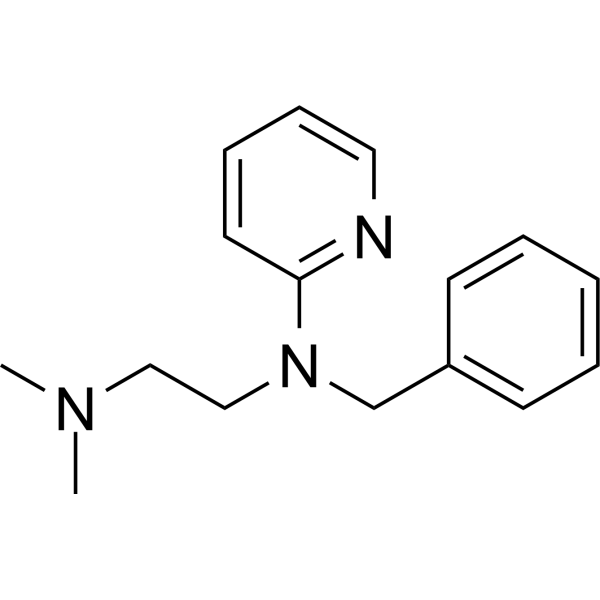
Tripelennamine
Tripelennamine is a histamine H1-receptor antagonist. Tripelennamine effectively reverses histamine-induced bronchoconstriction, increased transpulmonary pressure, elevated pulmonary vascular resistance and reduced dynamic compliance. Tripelennamine does not significantly affect arterial hypoxemia, hemoglobin desaturation and hypercapnia in horses undergoing short-term high-intensity exercise. Tripelennamine exhibits local and central analgesic activity. Tripelennamine can be used in studies related to emphysema, urticaria and acute laminitis.
商品は「研究用試薬」です。人や動物の医療用・臨床診断用・食品用の製品ではありません。
研究用途以外に使用した場合、当社は一切の責任を負いかねます。
- CAS 番号: 91-81-6
- 分子式: C16H21N3
- 分子量:255.36
-
保管条件:
Please store the product under the recommended conditions in the Certificate of Analysis.

To place orders, for customer services and technical support, please contact: MedChemExpress USA
Tel: 609-228-6898 E-mail: [email protected] [email protected]


-
 生物活性
生物活性
-
化学情報
- 純度とドキュメンテーション
- 参考文献
-
 Help & FAQs


Histamine Receptor アイソフォーム固有の製品をすべて表示
More

生物活性
製品説明
IC50 & Target
|
H1 Receptor |
体外実験
Tripelennamine (1.0 μg/mL) exhibits 83.4% protein binding in healthy Arabian camel serum and 73.6% protein binding in healthy horse serum, with no significant difference between the two species[2].
MedChemExpress (MCE) has not independently confirmed the accuracy of these methods. They are for reference only.
体内実験
MedChemExpress (MCE) has not independently confirmed the accuracy of these methods. They are for reference only.
-
Animal Model:Thoroughbred (3 fillies, 4 geldings, 3-6 yr old, 460 kg)[1]
-
Dosage:1.10 mg/kg
-
Administration:i.v.; single dose 15 minutes preexercise
-
Result:Caused central nervous system excitement, significant tachycardia, systemic and pulmonary hypertension, and raised hemoglobin concentration from 12.7 g/dl to 17.7 g/dl.
Increased mixed venous blood O2 tension and hemoglobin-O2 saturation, and increased arterial and mixed venous blood O2 content with no change in arterial-to-mixed venous O2 content gradient.
Increased core temperature during exercise to 41.2°C at 120 seconds of galloping (vs.
40.7°C in controls).
Showed no statistically significant differences from controls in exercise-induced arterial hypoxemia (arterial O2 tension at 120 seconds of galloping: 71.3 Torr vs.
71.3 Torr), arterial hemoglobin-O2 saturation (80.6% vs.
83.8%), arterial CO2 tension (60.1 Torr vs.
56.2 Torr), arterial pH (7.040 vs.
7.090), arterial and mixed venous blood O2 content, arterial-to-mixed venous O2 content gradient (22.8 mL O2/dl blood vs.
23.2 mL O2/dl blood), or O2 extraction (92.2% vs.
91.5%).
Resulted in exercise-induced pulmonary hemorrhage in all treated horses, matching control rates.


化学情報
-
CAS 番号 91-81-6
-
分子量 255.36
-
分子式 C16H21N3
-
SMILES
CN(C)CCN(CC1=CC=CC=C1)C2=NC=CC=C2
-
Structure Classification
-
Initial Source
-
輸送条件
Room temperature in continental US; may vary elsewhere.
-
保管条件
Please store the product under the recommended conditions in the Certificate of Analysis.


純度とドキュメンテーション
参考文献
[1]. Manohar M, et al. H1-receptor antagonist, tripelennamine, does not affect arterial hypoxemia in exercising Thoroughbreds. J Appl Physiol. 2002 Apr;92(4):1515-23. [Content Brief]
[2]. Wasfi IA, et al. Comparative disposition of tripelennamine in horses and camels after intravenous administration. J Vet Pharmacol Ther. 2000 Jun;23(3):145-52. [Content Brief]
[3]. Yeh SY, et al. The pharmacokinetics of pentazocine and tripelennamine. Clin Pharmacol Ther. 1986 Jun;39(6):669-76. [Content Brief]

Calculators
濃度 (開始) × 体積 (開始) = 濃度 (終了) × 体積 (終了)


Tripelennamine 関連分類
HY-17428A 関連分類
 Powered by Bioz