



Rosolutamide

Based on 1 Customer Validation
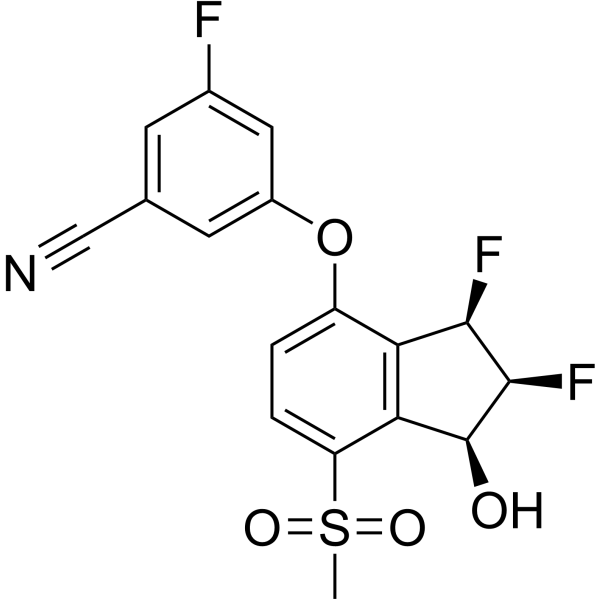
Rosolutamide (ASC-JM17) is an orally active Nrf1/Nrf2 activator. Rosolutamide activates Hsf1 pathways, upregulates proteasome subunits and antioxidant enzymes, induces proteasome complex structural rearrangement, and enhances ubiquitin-proteasome system-mediated degradation. Rosolutamide reduces mutant androgen receptor and ataxin-3 aggregates, restores mitochondrial function, attenuates reactive oxygen species (ROS) levels, induces apoptosis and ferroptosis, and inhibits cancer cell growth. Rosolutamide can be used for the research of spinal and bulbar muscular atrophy, Huntington’s disease, and temozolomide-resistant glioblastoma.
연구목적의 판매만을 진행합니다. 환자를 대상으로 한 판매는 하지 않습니다.
- Purity : ≥98.0%
- CAS No.: 1039760-91-2
- 화학식: C28H32O6
- 분자량:464.55
-
보관:Powder -20°C, 3 years ; In solvent -80°C, 6 months , -20°C, 1 month


To place orders, for customer services and technical support, please contact: MedChemExpress USA
Tel: 609-228-6898 E-mail: [email protected] [email protected]


-
 Biological Activity
-
Chemical Information
-
용액&용해도
- Protocol
- 순도&문서
- References
-
 Help & FAQs




Biological Activity
제품 설명
IC50 & Target
|
HSF1 |
Cellular Effect
|
Cell Line

|
Type | Value | Description | References |
|---|---|---|---|---|
| Glioblastoma cell line | IC50 |
2 μM
Compound: 34; ALZ003
|
Induction of ferroptosis in human primary glioblastoma cells assessed as decrease in GPX4 protein expression incubated for 48 hrs by Western blot analysis
Induction of ferroptosis in human primary glioblastoma cells assessed as decrease in GPX4 protein expression incubated for 48 hrs by Western blot analysis
|
[PMID: 36332549] |
| U-87MG ATCC | IC50 |
<5 μM
Compound: 34; ALZ003
|
Induction of ferroptosis in human U-87 MG cells assessed as decrease in GPX4 protein expression incubated for 48 hrs by Western blot analysis
Induction of ferroptosis in human U-87 MG cells assessed as decrease in GPX4 protein expression incubated for 48 hrs by Western blot analysis
|
[PMID: 36332549] |
In Vitro
Rosolutamide (0.2-5 μM; 0-12 h) accelerates UPS-mediated clearance of wild-type and polyglutamine-expanded androgen receptor in healthy control and SBMA fibroblasts, reducing AR steady-state levels and half-life[1].
Rosolutamide (5 μM) inhibits the transcriptional activity of wild-type and polyglutamine-expanded androgen receptor in DHT-treated PC12 cells[1].
Rosolutamide (0-40 μM) potently activates the heat shock response pathway in PC12 cells[1].
Rosolutamide (0-7.5 μM) activates Nrf1 to increase expression of multiple proteasome subunits in PC12 and MCF7 cells[1].
Rosolutamide enhances chymotrypsin-like, trypsin-like, and caspase-like proteasome catalytic activities in PC12 cells[1].
Rosolutamide (0-7.5 μM) activates Nrf2 to increase expression of antioxidant enzymes HO-1, Nqo1, Gclc, and catalase in PC12 cells without inducing global oxidative protein damage[1].
Rosolutamide (2.5 μM; 16 h) protects MCF7 cells against hydrogen peroxide-induced oxidative stress via Nrf2 activation[1].
Rosolutamide (0-7.5 μM) activates Hsf1 to increase expression of heat shock proteins Hsp25, Hsp40, Hsp72, Hsp90, and co-chaperone Hop in PC12 and MCF7 cells[1].
Rosolutamide (0.3-5 µM; 24 h) shows no cytotoxicity in WT, MJD26, and MJD78 cells, but induces cytotoxicity at concentrations greater than 5 µM in WT and MJD78 cells[3].
Rosolutamide (0.3-5 µM; 24 h) improves mitochondrial respiration function in MJD78 cells[3].
Rosolutamide (0.3-5 µM; 24 h) reduces mutant ataxin-3 protein expression and protein aggregation in MJD78 cells via induction of autophagy, with no effect on ATXN3 mRNA levels[3].
Rosolutamide (0.3-5 µM; 24 h) reduces oxidative stress in MJD78 cells by lowering total and mitochondrial ROS levels, and enhances antioxidant defenses by increasing NQO1, HO-1, SOD2, GSH, and catalase, with 1 µM showing the strongest effects[3].
Rosolutamide (0.3-5 µM; 24 h) activates Nrf2 in a dose-dependent manner in MJD78 cells, increasing Nrf2 transcriptional activity[3].
MedChemExpress (MCE) has not independently confirmed the accuracy of these methods. They are for reference only.
-
Cell Line:Healthy control fibroblasts, SBMA fibroblasts, PC12 cells
-
Concentration:0.5; 1; 2; 2.5; 5 μM
-
Incubation Time:0; 2; 4; 6; 8; 12 h
-
Result:Reduced steady-state levels of both normal and polyglutamine-expanded AR variants in the presence and absence of DHT.
Was effective at lower concentrations than ASC-J9 for reducing mutant AR protein.
Significantly reduced the half-life of polyglutamine-expanded AR compared to DMSO vehicle.
Induced ubiquitylation of both wild-type and mutant AR.
Promoted proteasome-mediated clearance of AR, which was blocked by epoxomicin.
-
Cell Line:wild-type SK-N-SH human neuroblastoma cells, SK-N-SH cells stably expressing ataxin-3 with 26 CAG repeats (MJD26), SK-N-SH cells stably expressing ataxin-3 with 78 CAG repeats (MJD78)
-
Concentration:0.3; 1; 5 µM
-
Incubation Time:24 h
-
Result:Caused no cytotoxicity in WT, MJD26, or MJD78 cells at 0.3, 1, or 5 µM after 24 h.
Increased cytotoxicity in WT and MJD78 cells at concentrations >5 µM after 24 h.
-
Cell Line:MJD78 human neuroblastoma cells
-
Concentration:0.3; 1; 5 µM
-
Incubation Time:24 h
-
Result:Had no significant effect on ATXN3 mRNA levels in MJD78 cells.
Reduced protein aggregation and mutant ataxin-3 protein expression, while upregulating p62 and LC3 II protein expression in MJD78 cells at 0.3 µM and 1 µM.
In Vivo
Rosolutamide (120 mg/kg; i.g.; daily; 6 weeks or 16 weeks) ameliorates disease manifestations, reduces mutant AR accumulation, and activates Nrf1/Nrf2 pathways in symptomatic AR97Q mice[1].
MedChemExpress (MCE) has not independently confirmed the accuracy of these methods. They are for reference only.
-
Animal Model:transgenic lines: GMR:UAS-AR52Q, Elav-GAL4/UAS-AR52Q/Cyo-GFP (expressing full-length human AR with expanded polyglutamine tract (AR52Q) under GMR-GAL4 eye-specific driver or Elav-GAL4 pan-neuronal driver, treated with 1 mM DHT to induce toxicity)[1]
-
Dosage:50 nM
-
Administration:incorporated into fly food; continuous exposure throughout development/ adulthood
-
Result:Rescued DHT-induced degenerative eye phenotype in GMR:UAS-AR52Q flies.
Significantly increased the population frequency of Elav > AR52Q flies from ~4% (DHT-only) to ~20% (DHT + ASC-JM17).
Failed to rescue the eye phenotype in CncC RNAi lines, but fully restored the eye phenotype in HSF RNAi lines.
-
Animal Model:F1 transgenic mice (AR97Q line, C57Bl6 × BDF1 background; male, post-disease onset at 10 weeks of age) with Spinal and bulbar muscular atrophy (SBMA)[1]
-
Dosage:120 mg/kg
-
Administration:i.g.; daily; 6 weeks or 16 weeks
-
Result:Significantly rescued weight loss and improved motor function.
Ameliorated neurogenic and myogenic muscle atrophy features on H&E and NADH-stained quadriceps cross-sections.
Reduced monomeric and high molecular weight (HMW) mutant AR protein levels in quadriceps muscle.
Significantly increased mRNA expression of Nrf1 target genes (Psmb4, Psmc1, Psmd14; P < 0.01) and Nrf2 target genes (Gsr, Gsta2, Nqo1) in quadriceps muscle.
In a post hoc analysis excluding severely affected mice, increased median survival by ~10 weeks.
- Mitochondrial membrane-potential fluorescent assay
- Annexin V plus membrane-impermeant dye apoptosis staining
- ROS/oxidative-stress fluorescent staining
- Somatic Cell Culture
- CCK-8/WST-8 Cell Proliferation Assay
- Cell Counting-Based Growth Curve Assay
- Cell Viability Determination by MTT Colorimetric Assay
- Detection of Apoptosis
- TUNEL staining for apoptotic DNA fragmentation
- Protocol for Cell Counting and Cell Density Analysis
- Research Protocol for Endocrine Diseases
- Mitochondrial membrane-potential and mitochondrial mass staining
- Apoptosis Solutions
- Ferroptosis Solutions
- MTT Cell Proliferation Assay


Chemical Information
-
CAS No. 1039760-91-2
-
Appearance Solid
-
분자량 464.55
-
화학식 C28H32O6
-
Color Light yellow to yellow
-
SMILES
COC(C=C1/C=C/C(C(C(/C=C/C2=CC(OC)=C(C=C2)OC)=O)CC3CCC3)=O)=C(C=C1)OC
-
Synonyms
ASC-JM17; ALZ-003
-
선적
Room temperature in continental US; may vary elsewhere.
-
보관
Powder -20°C 3 years In solvent -80°C 6 months -20°C 1 month


용액&용해도
In Vitro:
DMSO : 50 mg/mL (107.63 mM; Need ultrasonic; Hygroscopic DMSO has a significant impact on the solubility of product, please use newly opened DMSO)
Please refer to the solubility information to select the appropriate solvent. Once prepared, please aliquot and store the solution to prevent product inactivation from repeated freeze-thaw cycles.
Storage method and period of stock solution: -80°C, 6 months; -20°C, 1 month. When stored at -80°C, please use it within 6 months. When stored at -20°C, please use it within 1 month.
Please refer to the solubility information to select the appropriate solvent. Once prepared, please aliquot and store the solution to prevent product inactivation from repeated freeze-thaw cycles.
Storage method and period of stock solution: -80°C, 6 months; -20°C, 1 month. When stored at -80°C, please use it within 6 months. When stored at -20°C, please use it within 1 month.
Concentration (start) × Volume (start) = Concentration (final) × Volume (final)


순도&문서
-
Data Sheet (283 KB)
-
SDS (251 KB)
- English - EN (251 KB)
- Français - FR (251 KB)
- Deutsch - DE (251 KB)
- Norwegian - NO (251 KB)
- Español - ES (251 KB)
- Swedish - SV (251 KB)
- Italian - IT (251 KB)
- Korean - KR (251 KB)
- Portuguese - PT (251 KB)
-
Handling Instructions (2659 KB)
References
[1]. Bott LC, et al. A small-molecule Nrf1 and Nrf2 activator mitigates polyglutamine toxicity in spinal and bulbar muscular atrophy. Hum Mol Genet. 2016;25(10):1979-1989. [Content Brief]
[2]. Sedlacek J. Activation of the 26S Proteasome to Reduce Proteotoxic Stress and Improve the Efficacy of PROTACs. ACS Pharmacol Transl Sci. 2024 Dec 16;8(1):21-35. [Content Brief]
[3]. Wu YL, et al. In Vitro Efficacy and Molecular Mechanism of Curcumin Analog in Pathological Regulation of Spinocerebellar Ataxia Type 3. Antioxidants (Basel). 2022;11(7):1389. Published 2022 Jul 18. [Content Brief]
[4]. Osifová Z, et al. Diketo-Ketoenol Tautomers in Curcuminoids: Synthesis, Separation of Tautomers, and Kinetic and Structural Studies. J Org Chem. 2022 Aug 5;87(15):10309-10318. [Content Brief]


Complete Stock Solution Preparation Table
Please refer to the solubility information to select the appropriate solvent. Once prepared, please aliquot and store the solution to prevent product inactivation from repeated freeze-thaw cycles.
Storage method and period of stock solution: -80°C, 6 months; -20°C, 1 month. When stored at -80°C, please use it within 6 months. When stored at -20°C, please use it within 1 month.
| Optional Solvent | Concentration Solvent Mass | 1 mg | 5 mg | 10 mg | 25 mg |
|---|---|---|---|---|---|
| DMSO | 1 mM | 2.1526 mL | 10.7631 mL | 21.5262 mL | 53.8155 mL |
| 5 mM | 0.4305 mL | 2.1526 mL | 4.3052 mL | 10.7631 mL | |
| 10 mM | 0.2153 mL | 1.0763 mL | 2.1526 mL | 5.3816 mL | |
| 15 mM | 0.1435 mL | 0.7175 mL | 1.4351 mL | 3.5877 mL | |
| 20 mM | 0.1076 mL | 0.5382 mL | 1.0763 mL | 2.6908 mL | |
| 25 mM | 0.0861 mL | 0.4305 mL | 0.8610 mL | 2.1526 mL | |
| 30 mM | 0.0718 mL | 0.3588 mL | 0.7175 mL | 1.7939 mL | |
| 40 mM | 0.0538 mL | 0.2691 mL | 0.5382 mL | 1.3454 mL | |
| 50 mM | 0.0431 mL | 0.2153 mL | 0.4305 mL | 1.0763 mL | |
| 60 mM | 0.0359 mL | 0.1794 mL | 0.3588 mL | 0.8969 mL | |
| 80 mM | 0.0269 mL | 0.1345 mL | 0.2691 mL | 0.6727 mL | |
| 100 mM | 0.0215 mL | 0.1076 mL | 0.2153 mL | 0.5382 mL |


Rosolutamide Related Classifications
HY-149127 Related Classifications
 Powered by Bioz
Keywords
- Rosolutamide
- 1039760-91-2
- ASC-JM17
- ALZ-003
- ALZ003
- ALZ 003
- ALZ-003
- Keap1-Nrf2
- Androgen Receptor
- HSP
- Mitophagy
- Ferroptosis
- Apoptosis
- Reactive Oxygen Species (ROS)
- Autophagy
- ataxin-3 aggregates
- spinal and bulbar muscular atrophy
- Nrf2
- Nrf1
- mutant androgen receptor
- spinocerebellar ataxia
- temozolomide-resistant glioblastoma
- ubiquitin-proteasome system
- Hsf1
- Huntington’s disease
- Inhibitor
- inhibitor
- inhibit