



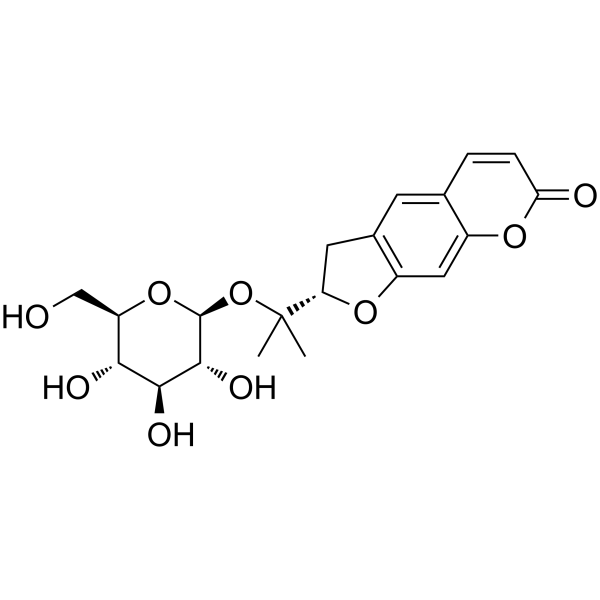
Marmesinin

Based on 1 Customer Validation
Marmesinin ((-)-Marmesinin; Ammijin) is an orally active furanocoumarin glycoside that enhances insulin secretion by inhibiting CYP1A2/CYP3A4 and Aldose Reductase, and modulating the PPARγ/PDX-1/IRS-2 pathway, while also exhibiting anti-inflammatory, antioxidant, and myocardial membrane-stabilizing effects. Marmesinin is used in research on type 2 diabetes, diabetic complications, myocardial injury, neurodegenerative diseases, and malaria.
For research use only. We do not sell to patients.
- Purity : 99.80%
- CAS No.: 495-30-7
- Formula: C20H24O9
- Molecular Weight:408.40
-
Storage:
4°C, protect from light
* In solvent : -80°C, 6 months; -20°C, 1 month (protect from light)

To place orders, for customer services and technical support, please contact: MedChemExpress USA
Tel: 609-228-6898 E-mail: [email protected] [email protected]


-
 Biological Activity
-
Chemical Information
-
Solvent & Solubility
- Purity & Documentation
- References
-
 Help & FAQs




Biological Activity
Description
IC50 & Target
[1]|
CYP1A2 |
CYP3A4 |
Cellular Effect
|
Cell Line

|
Type | Value | Description | References |
|---|---|---|---|---|
| SK-OV-3 | IC50 |
> 100 μM
|
Cytotoxicity against human SK-OV-3 cancer cells assessed as reduction in cell viability incubated for 21 hrs by MTT assay.
Cytotoxicity against human SK-OV-3 cancer cells assessed as reduction in cell viability incubated for 21 hrs by MTT assay.
|
21428713 |
In Vitro
Marmesinin ((-)-Marmesinin; Ammijin) (2.5-10 μM; 2 h (marmesinin); 1 h (glucose)) enhances D-Glucose (HY-B0389)-stimulated insulin secretion in INS-1 pancreatic β cells, with a GSI of 13.21 at 10 µM[2].
Marmesinin (compound 19) (2.5-10 μM) increases the glucose-dependent ATP/ADP ratio in INS-1 pancreatic β cells[2].
Marmesinin (15-30 min) inhibits recombinant CYP3A4 and CYP1A2, but does not exhibit time-dependent inhibition[1].
Marmesinin (30 min) is a weak inhibitor of CYP3A4 and CYP1A2 in pooled human liver microsomes[1].
Marmesinin (5 min) exhibits strong inhibitory activity against human recombinant aldose reductase, with an IC50 of 5.32 μM[4].
Marmesinin (at several fixed concentrations; 5 min) inhibits human recombinant aldose reductase via a noncompetitive mechanism with a Ki of 4.86 μM and binds to the enzyme in an allosteric manner[4].
Marmesinin binds to the active site of aldose reductase with a binding affinity of −8.8 kcal/mol, forming polar contacts with Val47 and Gln49, and hydrophobic interactions with Tyr209 and Trp111[4].
Marmesinin (200 ns) forms a moderately stable complex with human recombinant aldose reductase during 200 ns MD simulation, with a total binding free energy (ΔGtotal) of −9.42 kcal/mol, and exhibits moderate electrostatic and van der Waals interactions[4].
Marmesinin (10 μM)-induced GSIS in INS-1 cells is enhanced by L-type Ca2+ channel agonists and K+ channel blockers, abolished by L-type Ca2+ channel blockers, and abolished by K+ channel activators[2].
Marmesinin (10 μM) increases the protein expression of PPARγ and PDX-1 in INS-1 pancreatic β cells[2].
Marmesinin (10 μM) increases the phosphorylation level of IRS-2 in INS-1 pancreatic β cells[2].
Marmesinin (0.1-10 μM; 1 h) exhibits significant neuroprotective activity against glutamate-induced toxicity in primary cultured rat cortical cells, with an EC50 between 1 and 10 μM[6].
Marmesinin (0.1-100 μM) exhibits significant growth inhibitory activity against the Chloroquine (HY-17589A)-sensitive P. falciparum D10 strain with an IC50 of 5.3 μM[9].
Marmesinin (0.1-100 μM; 21 h) does not exhibit significant cytotoxicity against SK-OV-3 cancer cells, with an IC50 > 100 μM[9].
MedChemExpress (MCE) has not independently confirmed the accuracy of these methods. They are for reference only.
-
Cell Line:INS-1
-
Concentration:2.5, 5, 10 μM
-
Incubation Time:2 h (marmesinin); 1 h (glucose)
-
Result:Increased the GSI to 13.21 at 10 μM, which was superior to gliclazide (7.02).
-
Cell Line:Primary cultured rat cortical cells
-
Concentration:0.1, 1, 10 μM
-
Incubation Time:1 h (pre-incubation); 24 h (glutamate exposure)
-
Result:Exhibited cell viabilities of 45.9% at 0.1 μM, 50.4% at 1 μM, and 40.4% at 10 μM.
Showed an EC50 between 1 and 10 μM.
-
Cell Line:SK-OV-3
-
Concentration:0.1, 1, 5, 25, 100 μM
-
Incubation Time:21 h
-
Result:Showed no significant cytotoxicity with an IC50 > 100 μM.
In Vivo
Marmesinin (p.o.; administered 2 days before and during (-)-Isoproterenol hydrochloride (HY-B1670A) treatment), a linear furanocoumarin constituent from A. majus, possibly provides protection against experimental myocardial injury by reducing lipid peroxidation and stabilizing membranes[7].
Marmesinin (200 mg/kg) exhibits cardioprotective effects in isoproterenol-induced myocardial injury in male albino Wistar rats by reducing lipid peroxidation and counteracting the elevation of serum marker enzymes[8].
MedChemExpress (MCE) has not independently confirmed the accuracy of these methods. They are for reference only.
-
Animal Model:Wistar (male albino rats, 100-120 g)[3]
-
Dosage:25, 50, 100, 200, 400 mg/kg
-
Administration:p.o.; daily; starting 2 days before and continuing during isoproterenol administration
-
Result:Decreased serum CK to 207.63 IU from 514.23 IU.
Decreased serum CK-MB to 102.93 IU from 409.23 IU.
Decreased serum LDH to 159.62 IU from 225.12 IU.
Restored heart rate to 456 beats/min from 508 beats/min.
Restored R amplitude to 1.02 mV from 0.69 mV.
Restored ST segment to 0.143 mV from 0.359 mV.
Decreased LDH1 level to 7.42% from 23.04%.
Decreased LDH1/LDH2 ratio to 1.74 from 20.57.
Increased alpha-tocopherol to 4.06 µg/mL from 2.22 µg/mL.
Increased reduced glutathione to 2.74 nmol/g from 0.79 nmol/g.
Increased protein sulfhydryl groups to 43.12 µmol/g from 37.86 µmol/g.
Increased serum ascorbic acid to 1.05 mg/dl from 0.65 mg/dl.
Increased heart ascorbic acid to 197 mg/g from 135 mg/g.
Increased ceruloplasmin to 32.17 mg/dl from 18.12 mg/dl.
Increased superoxide dismutase to 9.27 from 5.12.
Increased catalase to 14.72 from 9.84.
Increased glutathione peroxidase to 2.03 from 1.52.
Increased glutathione-S-transferase to 0.47 from 0.23.
Restored total beta-glucuronidase activity to 20.29 from 31.
Restored cytosolic beta-glucuronidase activity to 4.10 from 6.60.
Restored cytosol/lysosomal ratio to 0.400 from 1.090.


Chemical Information
-
CAS No. 495-30-7
-
Appearance Solid
-
Molecular Weight 408.40
-
Formula C20H24O9
-
Color White to off-white
-
SMILES
O=C1C=CC2=CC3=C(O[C@H](C(C)(O[C@H]4[C@@H]([C@H]([C@@H]([C@@H](CO)O4)O)O)O)C)C3)C=C2O1
-
Synonyms
(-)-Marmesinin; Ammijin
-
Structure Classification
-
Initial Source
-
Shipping
Room temperature in continental US; may vary elsewhere.
-
Storage
4°C, protect from light
* In solvent : -80°C, 6 months; -20°C, 1 month (protect from light)


Solvent & Solubility
In Vitro:
DMSO : 50 mg/mL (122.43 mM; Need ultrasonic; Hygroscopic DMSO has a significant impact on the solubility of product, please use newly opened DMSO)
Please refer to the solubility information to select the appropriate solvent. Once prepared, please aliquot and store the solution to prevent product inactivation from repeated freeze-thaw cycles.
Storage method and period of stock solution: -80°C, 6 months; -20°C, 1 month (protect from light). When stored at -80°C, please use it within 6 months. When stored at -20°C, please use it within 1 month.
Please refer to the solubility information to select the appropriate solvent. Once prepared, please aliquot and store the solution to prevent product inactivation from repeated freeze-thaw cycles.
Storage method and period of stock solution: -80°C, 6 months; -20°C, 1 month (protect from light). When stored at -80°C, please use it within 6 months. When stored at -20°C, please use it within 1 month.
Concentration (start) × Volume (start) = Concentration (final) × Volume (final)
In Vivo:
Select the appropriate dissolution method based on your experimental animal and administration route.
- For the following dissolution methods, please ensure to first prepare a clear stock solution using an In Vitro approach and then sequentially add co-solvents:
- To ensure reliable experimental results, the clarified stock solution can be appropriately stored based on storage conditions. As for the working solution for In Vivo experiments, it is recommended to prepare freshly and use it on the same day.
- The percentages shown for the solvents indicate their volumetric ratio in the final prepared solution. If precipitation or phase separation occurs during preparation, heat and/or sonication can be used to aid dissolution.
Add each solvent one by one: 10% DMSO 40% PEG300 5% Tween-80 45% Saline
Solubility: ≥ 1.25 mg/mL (3.06 mM); Clear solution
This protocol yields a clear solution of ≥ 1.25 mg/mL (saturation unknown).
Taking 1 mL working solution as an example, add 100 μL DMSO stock solution (12.5 mg/mL) to 400 μL PEG300, and mix evenly; then add 50 μL Tween-80 and mix evenly; then add 450 μL Saline to adjust the volume to 1 mL.
Preparation of Saline: Dissolve 0.9 g sodium chloride in ddH₂O and dilute to 100 mL to obtain a clear Saline solution.
Add each solvent one by one: 10% DMSO 90% (20% SBE-β-CD in Saline)
Solubility: ≥ 1.25 mg/mL (3.06 mM); Clear solution
This protocol yields a clear solution of ≥ 1.25 mg/mL (saturation unknown).
Taking 1 mL working solution as an example, add 100 μL DMSO stock solution (12.5 mg/mL) to 900 μL 20% SBE-β-CD in Saline, and mix evenly.
Preparation of 20% SBE-β-CD in Saline (4°C, storage for one week): 2 g SBE-β-CD powder is dissolved in 10 mL Saline, completely dissolve until clear.
In Vivo Dissolution Calculator
Please enter the basic information of animal experiments:
-
-
-
-
Recommended: Prepare an additional quantity of animals to account for potential losses during experiments.
Please enter your animal formula composition:
-
%DMSO +
Recommended: Keep the proportion of DMSO in working solution below 2% if your animal is weak.
-
%+
-
+%Tween-80 + +
-
%Saline +
The co-solvents required include: DMSO, . All of co-solvents are available by MedChemExpress (MCE). , Tween 80. All of co-solvents are available by MedChemExpress (MCE).
Working solution concentration: 0.22 mg/mL
Method for preparing stock solution: mg drug dissolved in μL DMSO. Stock solution concentration: mg/mL. * In solvent : -80°C, 6 months; -20°C, 1 month (protect from light)
1. Take μL DMSO stock solution;
2. Add μL .
μL , mix evenly;
3. Then add μL Tween 80, mix evenly;
4. Then add μL
Please ensure that the stock solution in the first step is dissolved to a clear state, and add co-solvents in sequence. You can use ultrasonic heating (ultrasonic cleaner, recommended frequency 20-40 kHz), vortexing, etc. to assist dissolution.


Purity & Documentation
-
Data Sheet (285 KB)
-
SDS (251 KB)
- English - EN (251 KB)
- Français - FR (251 KB)
- Deutsch - DE (251 KB)
- Norwegian - NO (251 KB)
- Español - ES (251 KB)
- Swedish - SV (251 KB)
- Italian - IT (251 KB)
- Korean - KR (251 KB)
- Portuguese - PT (251 KB)
-
Handling Instructions (2659 KB)
References


Complete Stock Solution Preparation Table
Please refer to the solubility information to select the appropriate solvent. Once prepared, please aliquot and store the solution to prevent product inactivation from repeated freeze-thaw cycles.
Storage method and period of stock solution: -80°C, 6 months; -20°C, 1 month (protect from light). When stored at -80°C, please use it within 6 months. When stored at -20°C, please use it within 1 month.
| Optional Solvent | Concentration Solvent Mass | 1 mg | 5 mg | 10 mg | 25 mg |
|---|---|---|---|---|---|
| DMSO | 1 mM | 2.4486 mL | 12.2429 mL | 24.4858 mL | 61.2145 mL |
| 5 mM | 0.4897 mL | 2.4486 mL | 4.8972 mL | 12.2429 mL | |
| 10 mM | 0.2449 mL | 1.2243 mL | 2.4486 mL | 6.1214 mL | |
| 15 mM | 0.1632 mL | 0.8162 mL | 1.6324 mL | 4.0810 mL | |
| 20 mM | 0.1224 mL | 0.6121 mL | 1.2243 mL | 3.0607 mL | |
| 25 mM | 0.0979 mL | 0.4897 mL | 0.9794 mL | 2.4486 mL | |
| 30 mM | 0.0816 mL | 0.4081 mL | 0.8162 mL | 2.0405 mL | |
| 40 mM | 0.0612 mL | 0.3061 mL | 0.6121 mL | 1.5304 mL | |
| 50 mM | 0.0490 mL | 0.2449 mL | 0.4897 mL | 1.2243 mL | |
| 60 mM | 0.0408 mL | 0.2040 mL | 0.4081 mL | 1.0202 mL | |
| 80 mM | 0.0306 mL | 0.1530 mL | 0.3061 mL | 0.7652 mL | |
| 100 mM | 0.0245 mL | 0.1224 mL | 0.2449 mL | 0.6121 mL |


Marmesinin Related Classifications
HY-N5110 Related Classifications
 Powered by Bioz