



AV-153
Based on 2 publication(s) in Google Scholar
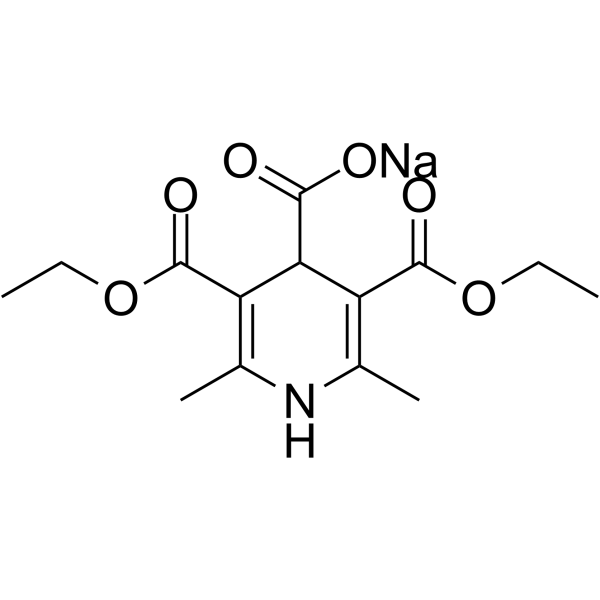
AV-153, a 1,4-dihydropyridine (1,4-DHP) derivative, is an antimutagenic. AV-153 intercalates to DNA in a single strand break and reduces DNA damage, stimulates DNA repair in human cells in vitro. AV-153 interacts with thymine and cytosine and has an influence on poly(ADP)ribosylation. AV-153 has anti-cancer activity.
For research use only. We do not sell to patients.
- CAS No.: 27296-05-5
- Formula: C14H18NNaO6
- Molecular Weight:319.29
-
Storage:
Please store the product under the recommended conditions in the Certificate of Analysis.

To place orders, for customer services and technical support, please contact: MedChemExpress USA
Tel: 609-228-6898 E-mail: [email protected] [email protected]


-
 Biological Activity
-
Chemical Information
- Protocols
- Purity & Documentation
- References
-
 Help & FAQs


Publications Citing Use of MedChemExpress (MCE) AV-153
MoreAll DNA/RNA Synthesis Isoforms
More

Biological Activity
Description
In Vitro
AV-153 causes IC50s for Raji and HL-60 cells of 14.9 mM and 10.3 mM, respectively[1].
AV-153 (1 nM to 10 μM; 3 hours) reduces the level of spontaneously arising DNA single-strand breaks (SSBs) in peripheral blood lymphocytes or HL-60 cells by 13-67%[1].
MedChemExpress (MCE) has not independently confirmed the accuracy of these methods. They are for reference only. Further protocols information, click here.


Chemical Information
-
CAS No. 27296-05-5
-
Molecular Weight 319.29
-
Formula C14H18NNaO6
-
SMILES
O=C(C1=C(C)NC(C)=C(C(OCC)=O)C1C(O[Na])=O)OCC
-
Shipping
Room temperature in continental US; may vary elsewhere.
-
Storage
Please store the product under the recommended conditions in the Certificate of Analysis.


Publications (2)
-
Journal Impact Factor
-
Most Recent
-
Int J Biol Sci
Diallyl disulfide induces DNA damage and growth inhibition in colorectal cancer cells by promoting POU2F1 ubiquitination. [Abstract]2024 Jan 21;20(4):1125-1141. PMID: 38385081 -
J Mol Cell Cardiol
Deletion of SIRT6 in vascular smooth muscle cells facilitates vascular calcification via suppression of DNA damage repair. [Abstract]2022 Dec:173:154-168. PMID: 36367517

Protocols
-
Genotoxicity/Mutagenicity Study
The bacterial reverse mutation assay detects point mutations that restore amino-acid prototrophy in auxotrophic Salmonella typhimurium or Escherichia coli tester strains; after exposure to a test article, mutagenic activity is read out as an increased number of revertant colonies on minimal agar compared with the vehicle control. The assay uses tester strains with different mutation targets so that base-substitution and frameshift mutagens can be detected, and testing is performed with and without exogenous mammalian metabolic activation because some chemicals require biotransformation to become mutagenic.


Purity & Documentation
References
[1]. Nadezhda I Ryabokon, et al. A 1,4-dihydropyridine Derivative Reduces DNA Damage and Stimulates DNA Repair in Human Cells in Vitro. Mutat Res. 2005 Nov 10;587(1-2):52-8. [Content Brief]
[2]. E Buraka, et al. DNA-binding Studies of AV-153, an Antimutagenic and DNA Repair-Stimulating Derivative of 1,4-dihydropiridine. Chem Biol Interact. 2014 Sep 5;220:200-7. [Content Brief]
[3]. Lidija Milkovic, et al. Antioxidative 1,4-Dihydropyridine Derivatives Modulate Oxidative Stress and Growth of Human Osteoblast-Like Cells In Vitro. Antioxidants (Basel). 2018 Sep 19;7(9):123. [Content Brief]

Calculators
Concentration (start) × Volume (start) = Concentration (final) × Volume (final)


AV-153 Related Classifications
HY-135218 Related Classifications
 Powered by Bioz